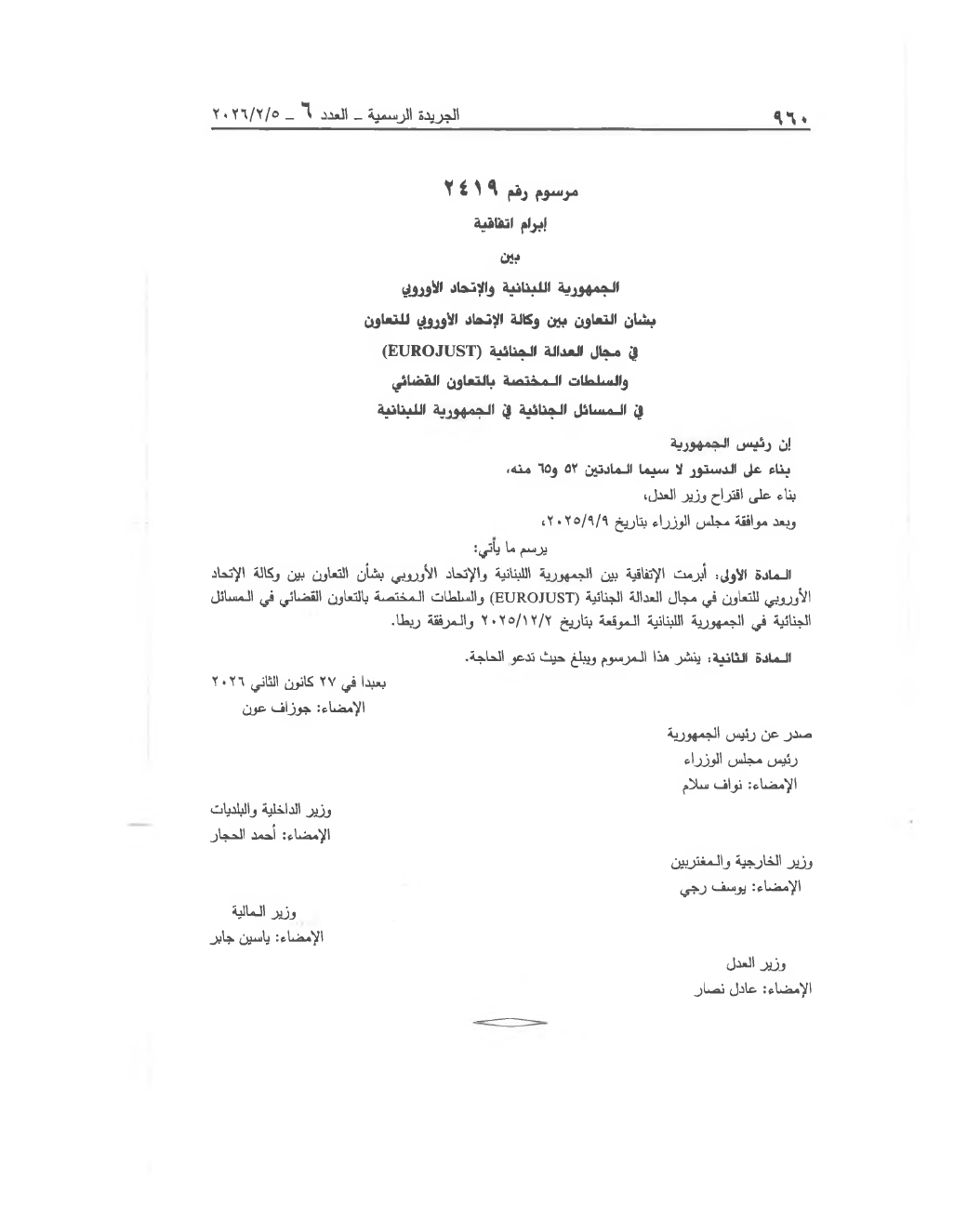
بعبدا في ٢٧ كانون الثاني ٢٠٢٦
الإمضاء: جوزاف عون
صدر عن رئيس الجمهورية
رئيس مجلس الوزراء
الإمضاء: نواف سلام
وزير الداخلية والبلديات
الإمضاء: أحمد الحجار
وزير الخارجية والمغتربين
الإمضاء: يوسف رجي
وزير المالية
الإمضاء: ياسين جابر
وزير العدل
الإمضاء: عادل نصار
اتفاقية
بين الاتحاد الأوروبي والجمهورية اللبنانية بشأن التعاون بين وكالة الاتحاد الأوروبي للتعاون في مجال العدالة الجنائية (EUROJUST) والسلطات المختصة بالتعاون القضائي في المسائل الجنائية في الجمهورية اللبنانية
СПОРАЗУМЕНИЕ
МЕЖДУ ЕВРОПЕЙСКИЯ СЪЮЗ И РЕПУБЛИКА ЛИВАН ЗА СЪТРУДНИЧЕСТВОТО МЕЖДУ АГЕНЦИЯТА НА ЕВРОПЕЙСКИЯ СЪЮЗ ЗА СЪТРУДНИЧЕСТВО В ОБЛАСТТА НА НАКАЗАТЕЛНОТО ПРАВОСЪДИЕ (ЕВРОЮСТ) И ОРГАНИТЕ НА РЕПУБЛИКА ЛИВАН, КОМПЕТЕНТНИ В ОБЛАСТТА НА СЪДЕБНОТО СЪТРУДНИЧЕСТВО ПО НАКАЗАТЕЛНОПРАВНИ ВЪПРОСИ
ACUERDO
ENTRE LA UNIÓN EUROPEA Y LA REPÚBLICA LIBANESA SOBRE LA COOPERACIÓN ENTRE LA AGENCIA DE LA UNIÓN EUROPEA PARA LA COOPERACIÓN JUDICIAL PENAL (EUROJUST) Y LAS AUTORIDADES COMPETENTES DE LA REPÚBLICA LIBANESA EN EL ÁMBITO DE LA COOPERACIÓN JUDICIAL EN MATERIA PENAL
DOHODA
MEZI EVROPSKOU UNIÍ A LIBANONSKOU REPUBLIKOU O SPOLUPRÁCI MEZI AGENTUROU EVROPSKÉ UNIE PRO JUSTIČNÍ SPOLUPRÁCI V TRESTNÍCH VĚCECH (EUROJUST) A ORGÁNY LIBANONSKÉ REPUBLIKY PŘÍSLUŠNÝMI PRO JUSTIČNÍ SPOLUPRÁCI V TRESTNÍCH VĚCECH
AFTALE
MELLEM DEN EUROPÆISKE UNION OG DEN LIBANESISKE REPUBLIK OM SAMARBEJDE MELLEM DEN EUROPÆISKE UNIONS AGENTUR FOR STRAFFERETLIGT SAMARBEJDE (EUROJUST) OG DEN LIBANESISKE REPUBLIKS MYNDIGHEDER MED ANSVAR FOR RETLIGT SAMARBEJDE I STRAFFESAGER
ABKOMMEN
EUROOPA LIIDU JA LIIBANONI VABARIIGI VAHELINE EUROOPA LIIDU KRIMINAALÕIGUSALASE KOOSTÖÖ AMETI (EUROJUST) JA LIIBANONI VABARIIGIS KRIMINAALASJADES TEHTAVA ÕIGUSALASE KOOSTÖÖ EEST VASTUTAVATE PÄDEVATE ASUTUSTE VAHELIST KOOSTÖÖD KÄSITLEV LEPING
ΣΥΜΦΩΝΙΑ ΜΕΤΑΞΥ ΤΗΣ ΕΥΡΩΠΑΪΚΗΣ ΕΝΩΣΗΣ ΚΑΙ ΤΗΣ ΔΗΜΟΚΡΑΤΙΑΣ ΤΟΥ ΛΙΒΑΝΟΥ ΣΧΕΤΙΚΑ ΜΕ ΤΗ ΣΥΝΕΡΓΑΣΙΑ ΜΕΤΑΞΥ ΤΟΥ ΟΡΓΑΝΙΣΜΟΥ ΤΗΣ ΕΥΡΩΠΑΪΚΗΣ ΕΝΩΣΗΣ / ΈΝΩΣΗΣ ΓΙΑ ΤΗ ΣΥΝΕΡΓΑΣΙΑ ΣΤΟΝ ΤΟΜΕΑ ΤΗΣ ΠΟΙΝΙΚΗΣ ΔΙΚΑΙΟΣΥΝΗΣ (EUROJUST) ΚΑΙ ΤΩΝ ΑΡΧΩΝ ΤΗΣ ΔΗΜΟΚΡΑΤΙΑΣ ΤΟΥ ΛΙΒΑΝΟΥ ΠΟΥ ΕΙΝΑΙ ΑΡΜΟΔΙΕΣ ΓΙΑ ΤΗ ΔΙΚΑΣΤΙΚΗ ΣΥΝΕΡΓΑΣΙΑ ΣΕ ΠΟΙΝΙΚΕΣ ΥΠΟΘΕΣΕΙΣ
AGREEMENT BETWEEN THE LEBANESE REPUBLIC AND THE EUROPEAN UNION ON THE COOPERATION BETWEEN THE EUROPEAN UNION AGENCY FOR CRIMINAL JUSTICE COOPERATION (EUROJUST) AND THE AUTHORITIES OF THE LEBANESE REPUBLIC COMPETENT FOR JUDICIAL COOPERATION IN CRIMINAL MATTERS
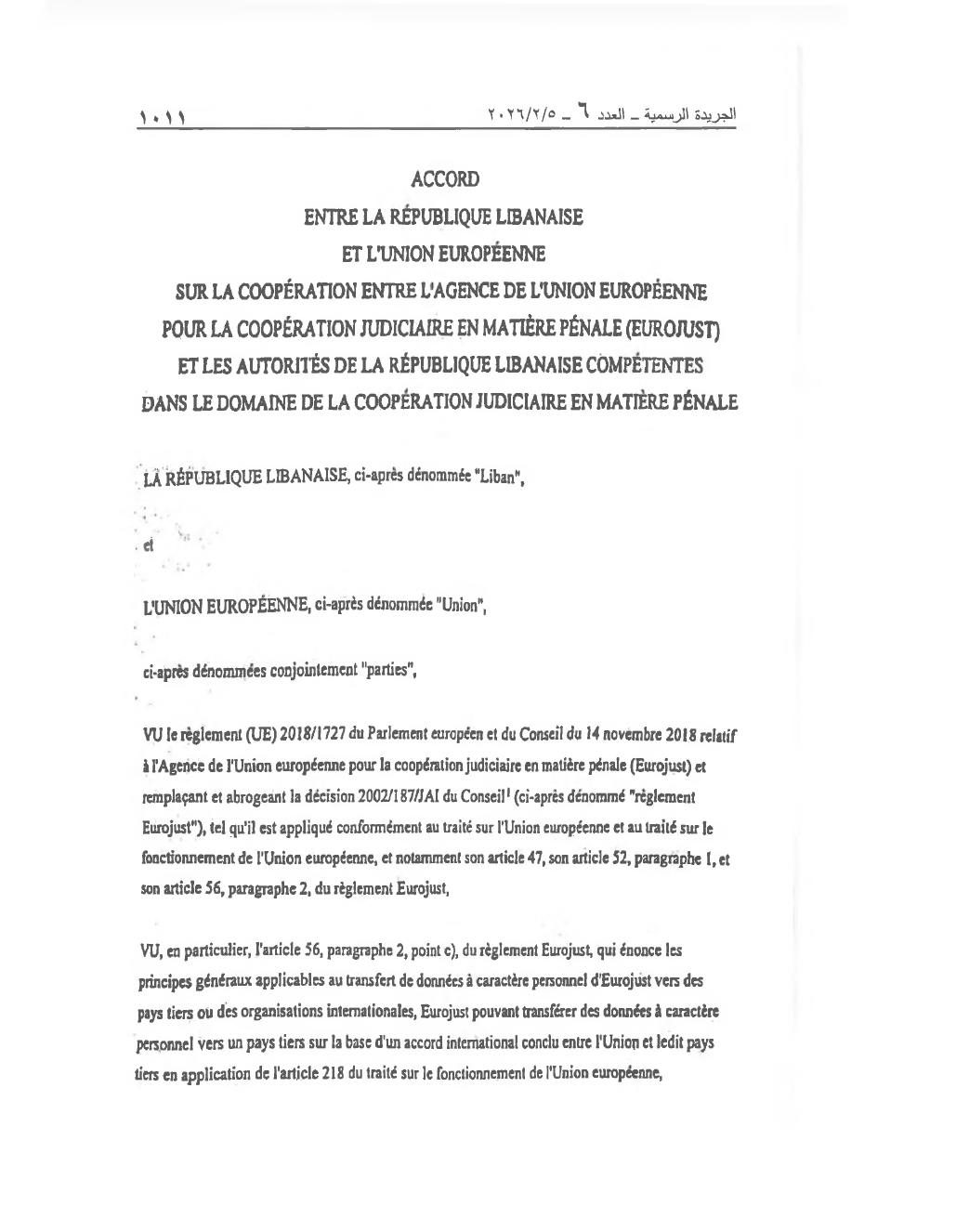
ACCORD ENTRE L'UNION EUROPÉENNE ET LA RÉPUBLIQUE LIBANAISE SUR LA COOPÉRATION ENTRE L'AGENCE DE L'UNION EUROPÉENNE POUR LA COOPÉRATION JUDICIAIRE EN MATIÈRE PÉNALE (EUROJUST) ET LES AUTORITÉS DE LA RÉPUBLIQUE LIBANAISE COMPÉTENTES DANS LE DOMAINE DE LA COOPÉRATION JUDICIAIRE EN MATIÈRE PÉNALE
COMHAONTÚ IDIR AN tAONTAS EORPACH AGUS POBLACHT NA LIOBÁINE MAIDIR LEIS AN gCOMHAR IDIR GNÍOMHAIREACHT AN AONTAIS EORPAIGH UM CHOMHAR CEARTAIS CHOIRIÚIL (EUROJUST) AGUS ÚDARÁIS PHOBLACHT NA LIOBÁINE ATÁ INNIÚIL I gCOMHAR BREITHIÚNACH IN ÁBHAIR CHOIRIÚLA
SPORAZUM IZMEĐU EUROPSKE UNIJE I LIBANONSKE REPUBLIKE O SURADNJI IZMEĐU AGENCIJE EUROPSKE UNIJE ZA SURADNJU U KAZNENOM PRAVOSUĐU (EUROJUST) I TIJELA LIBANONSKE REPUBLIKE NADLEŽNIH ZA PRAVOSUDNU SURADNJU U KAZNENIM STVARIMA
ACCORDO TRA L'UNIONE EUROPEA E LA REPUBBLICA LIBANESE SULLA COOPERAZIONE TRA L'AGENZIA DELL'UNIONE EUROPEA PER LA COOPERAZIONE GIUDIZIARIA PENALE (EUROJUST) E LE AUTORITÀ DELLA REPUBBLICA LIBANESE COMPETENTI PER LA COOPERAZIONE GIUDIZIARIA IN MATERIA PENALE
NOLĪGUMS STARP EIROPAS SAVIENĪBU UN LIBĀNAS REPUBLIKU PAR SADARBĪBU STARP EIROPAS SAVIENĪBAS AĢENTŪRU TIESU IESTĀŽU SADARBĪBAI KRIMINĀLLIETĀS (EUROJUST) UN LIBĀNAS REPUBLIKAS KOMPETENTAJĀM IESTĀDĒM TIESU IESTĀŽU SADARBĪBAI KRIMINĀLLIETĀS
EUROPOS SĄJUNGOS IR LIBANO RESPUBLIKOS SUSITARIMAS DĖL EUROPOS SĄJUNGOS BENDRADARBIAVIMO BAUDŽIAMOSIOS TEISENOS SRITYJE AGENTŪROS (EUROJUSTO) IR LIBANO RESPUBLIKOS INSTITUCIJŲ, KOMPETENTINGŲ TEISMINIO BENDRADARBIAVIMO BAUDŽIAMOSIOSE BYLOSE SRITYJE, BENDRADARBIAVIMO
MEGÁLLAPODÁS AZ EURÓPAI UNIÓ ÉS A LIBANONI KÖZTÁRSASÁG KÖZÖTT AZ EURÓPAI UNIÓ BÜNTETŐ IGAZSÁGÜGYI EGYÜTTMŰKÖDÉSI ÜGYNÖKSÉGE (EUROJUST) ÉS A LIBANONI KÖZTÁRSASÁG BÜNTETŐÜGYEKBEN FOLYTATOTT IGAZSÁGÜGYI EGYÜTTMŰKÖDÉSÉRT FELELŐS ILLETÉKES HATÓSÁGAI KÖZÖTTI EGYÜTTMŰKÖDÉSRŐL
FTEHIM BEJN L-UNJONI EWROPEA U R-REPUBBLIKA LIBANIŻA DWAR IL-KOOPERAZZJONI BEJN L-AĠENZIJA TAL-UNJONI EWROPEA GĦALL-KOOPERAZZJONI FIL-ĠUSTIZZJA KRIMINALI (EUROJUST) U L-AWTORITAJIET KOMPETENTI TAR-REPUBBLIKA LIBANIŻA GĦALL-KOOPERAZZJONI ĠUDIZZJARJA F'MATERJI KRIMINALI
OVEREENKOMST TUSSEN DE EUROPESE UNIE EN DE REPUBLIEK LIBANON BETREFFENDE DE SAMENWERKING TUSSEN HET AGENTSCHAP VAN DE EUROPESE UNIE VOOR JUSTITIËLE SAMENWERKING IN STRAFZAKEN (EUROJUST) EN DE VOOR JUSTITIËLE SAMENWERKING IN STRAFZAKEN BEVOEGDE AUTORITEITEN VAN DE REPUBLIEK LIBANON
UMOWA MIĘDZY UNIĄ EUROPEJSKĄ A REPUBLIKĄ LIBAŃSKĄ O WSPÓŁPRACY MIĘDZY AGENCJĄ UNII EUROPEJSKIEJ DS. WSPÓŁPRACY WYMIARÓW SPRAWIEDLIWOŚCI W SPRAWACH KARNYCH (EUROJUST) A ORGANAMI REPUBLIKI LIBAŃSKIEJ WŁAŚCIWYMI W ZAKRESIE WSPÓŁPRACY WYMIARÓW SPRAWIEDLIWOŚCI W SPRAWACH KARNYCH
ACORDO ENTRE A UNIÃO EUROPEIA E A REPÚBLICA LIBANESA RELATIVO À COOPERAÇÃO ENTRE A AGÊNCIA DA UNIÃO EUROPEIA PARA A COOPERAÇÃO JUDICIÁRIA PENAL (EUROJUST) E AS AUTORIDADES DA REPÚBLICA LIBANESA COMPETENTES PARA A COOPERAÇÃO JUDICIÁRIA PENAL
DOHODA MEDZI EURÓPSKOU ÚNIOU A LIBANONSKOU REPUBLIKOU O SPOLUPRÁCI MEDZI AGENTÚROU EURÓPSKEJ ÚNIE PRE JUSTIČNÚ SPOLUPRÁCU V TRESTNÝCH VECIACH (EUROJUST) A ORGÁNMI LIBANONSKEJ REPUBLIKY PRÍSLUŠNÝMI PRE JUSTIČNÚ SPOLUPRÁCU V TRESTNÝCH VECIACH
SPORAZUM MED EVROPSKO UNIJO IN LIBANONSKO REPUBLIKO O SODELOVANJU MED AGENCIJO EVROPSKE UNIJE ZA PRAVOSODNO SODELOVANJE V KAZENSKIH ZADEVAH (EUROJUST) IN ORGANI LIBANONSKE REPUBLIKE, PRISTOJNIMI ZA PRAVOSODNO SODELOVANJE V KAZENSKIH ZADEVAH
SOPIMUS EUROOPAN UNIONIN JA LIBANONIN TASAVALLAN VÄLILLÄ EUROOPAN UNIONIN RIKOSOIKEUDELLISEN YHTEISTYÖN VIRASTON (EUROJUST) JA RIKOSASIOISSA TEHTÄVÄN OIKEUDELLISEN YHTEISTYÖN ALALLA TOIMIVALTAISTEN LIBANONIN TASAVALLAN VIRANOMAISTEN VÄLISESTÄ YHTEISTYÖSTÄ
AVTAL MELLAN EUROPEISKA UNIONEN OCH REPUBLIKEN LIBANON OM SAMARBETE MELLAN EUROPEISKA UNIONENS BYRÅ FÖR STRAFFRÄTTSLIGT SAMARBETE (EUROJUST) OCH DE MYNDIGHETER I REPUBLIKEN LIBANON SOM ÄR BEHÖRIGA I FRÅGA OM STRAFFRÄTTSLIGT SAMARBETE
اتفاقية
بين الاتحاد الأوروبي والجمهورية اللبنانية
بشأن التعاون بين وكالة الاتحاد الأوروبي للتعاون في مجال العدالة الجنائية (EUROJUST) والسلطات المختصة بالتعاون القضائي في المسائل الجنائية في الجمهورية اللبنانية
الاتحاد الأوروبي، المشار إليه فيما يلي باسم "الاتحاد"،
و
الجمهورية اللبنانية، المشار إليها فيما يلي باسم "لبنان"،
ويشار إليهما فيما بعد باسم "الطرفين"،
بالنظر إلى لائحة الاتحاد الأوروبي) رقم ۱۷۲۷/۲۰۱۸ الصادرة عن البرلمان الأوروبي والمجلس الأوروبي بتاريخ 14 نوفمبر ۲۰۱۸ بشأن وكالة الاتحاد الأوروبي للتعاون في مجال العدالة الجنائية (Eurojust)، التي تنسخ وتلغي قرار المجلس رقم ۲۰۰۲/HAJ/۱۸۷ / ١٨٧/٢٠٠٢/JHA 1 ("لائحة Eurojust")، والمطبقة وفقاً لمعاهدة الاتحاد الأوروبي والمعاهدة المنظمة لعمل الاتحاد الأوروبي، وخاصةً المادة ٤٧ والمادة ٥٢ (١) والمادة ٥٦ (۲) من لائحة Eurojust.
وبالنظر، على وجه الخصوص، إلى المادة ٥٦ (۲)، الفقرة (ج) من لائحة Eurojust التي تحدد المبادئ العامة لنقل البيانات الشخصية من Eurojust إلى دول ثالثة ومنظمات دولية، والتي بموجبها يجوز لوكالة Eurojust نقل البيانات الشخصية إلى دولة ثالثة بناءً على اتفاقية دولية مبرمة بين الاتحاد وتلك الدولة الثالثة وفقاً للمادة ۲۱۸ من المعاهدة المنظمة لعمل الاتحاد الأوروبي،
1 لائحة (الاتحاد الأوروبي) رقم ۱۷۲۷/۲۰۱۸ الصادرة عن البرلمان الأوروبي والمجلس الأوروبي بتاريخ ١٤ نوفمبر ۲۰۱۸ بشأن وكالة الاتحاد الأوروبي للتعاون في مجال العدالة الجنائية (Eurojust)، التي تنسخ وتلغي قرار المجلس رقم ۲۰۰۲/JHA/۱۸۷ / ١٨٧/٢٠٠٢/JHA (الجريدة الرسمية للاتحاد الأوروبي، العدد ۲۹٥ ، / العددL٢٩٥، بتاريخ ۲۰۱۸/۱۱/۲۱، ص ۱۳۸).
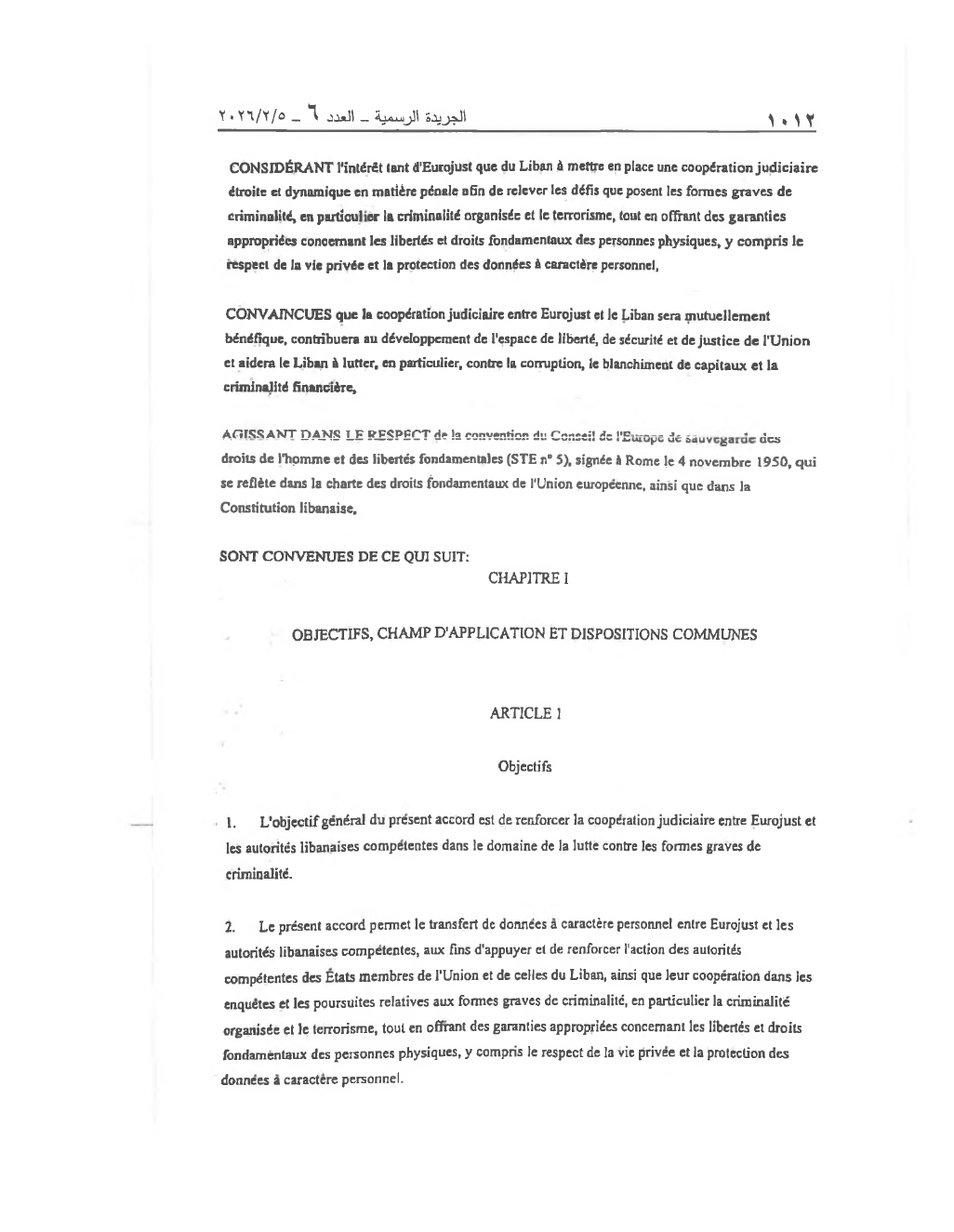
ومع مراعاة مصالح كل من Eurojust ولبنان في تطوير تعاون قضائي وثيق وديناميكي في المسائل الجنائية لمواجهة التحديات التي تفرضها الجرائم الخطيرة، وخاصة الجريمة المنظمة والإرهاب، مع توفير الضمانات المناسبة فيما يتعلق بالحقوق والحريات الأساسية للأفراد، بما في ذلك الخصوصية وحماية البيانات الشخصية،
ونظراً للاقتناع بأن التعاون القضائي بين Eurojust ولبنان سيكون مفيداً للطرفين وسيساعد في تطوير مجال الحرية والأمن والعدالة في الاتحاد، فضلاً عن مساعدة لبنان في التصدي لجرائم الفساد وغسيل الأموال والجرائم المالية على وجه الخصوص،
واحتراماً لاتفاقية مجلس أوروبا (سلسلة المعاهدات الأوروبية (ETS) رقم 5) لحماية حقوق الإنسان والحريات الأساسية المبرمة في روما في 4 / ٣ نوفمبر 1950، والتي تنعكس في ميثاق الحقوق الأساسية للاتحاد الأوروبي، وفي دستور لبنان،
تم الاتفاق على ما يلي:
الفصل 1
الأهداف والنطاق والأحكام العامة
المادة 1
الأهداف
1. الهدف العام لهذه الاتفاقية هو تعزيز التعاون القضائي بين Eurojust والسلطات المختصة في لبنان في مكافحة الجرائم الخطيرة.
2. تسمح هذه الاتفاقية بنقل البيانات الشخصية بين Eurojust والسلطات المختصة في لبنان، بهدف دعم وتعزيز عمل السلطات المختصة في الدول الأعضاء في الاتحاد والسلطات المختصة في لبنان، فضلاً عن تعاونها في التحقيق في الجرائم الخطيرة ومقاضاة مرتكبيها، وخاصة الجريمة المنظمة والإرهاب، مع ضمان توفير الضمانات المناسبة فيما يتعلق بالحقوق والحريات الأساسية للأفراد، بما في ذلك الخصوصية وحماية البيانات الشخصية.
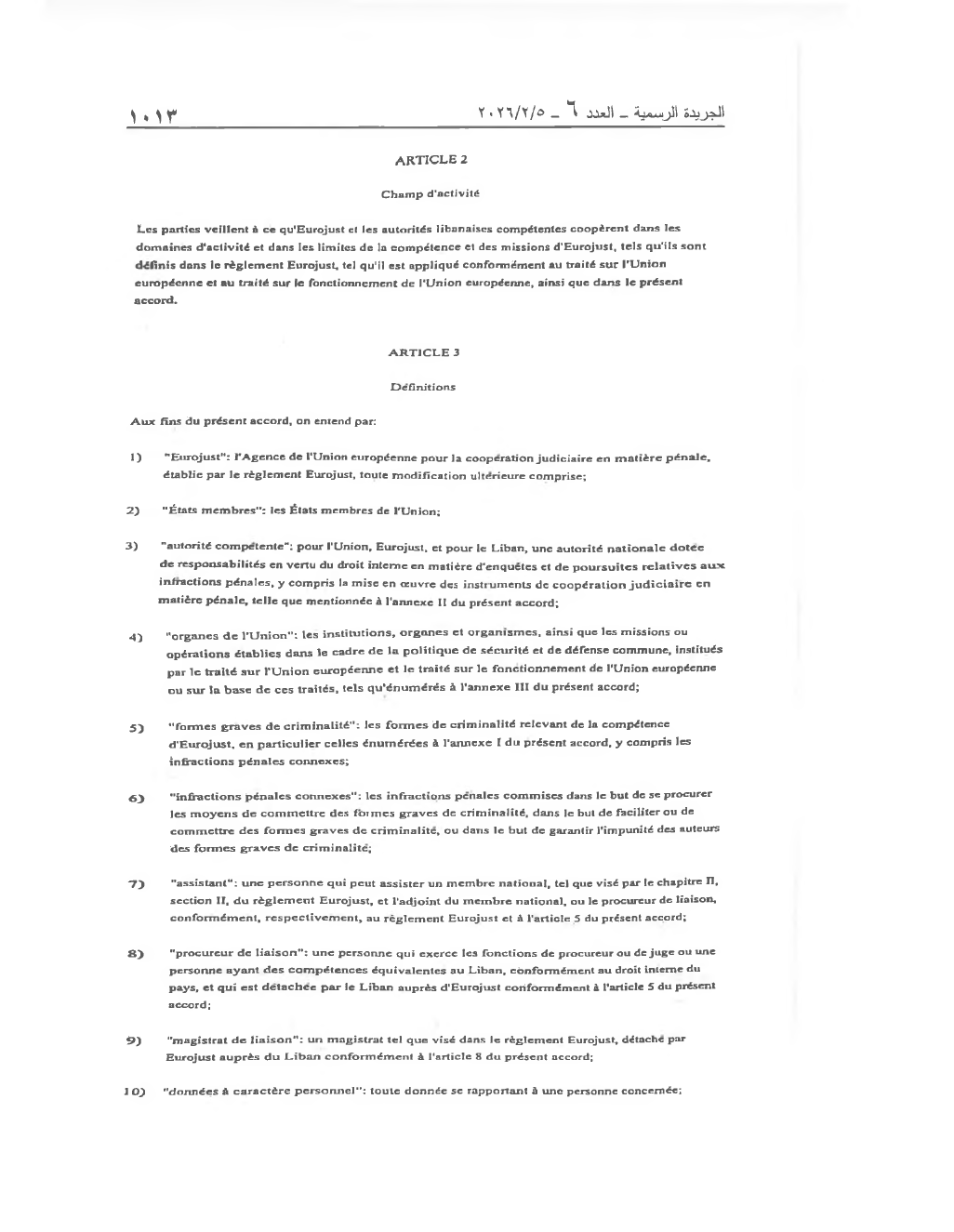
المادة ٢
النطاق
يعمل الطرفان على ضمان تعاون Eurojust والسلطات المختصة في لبنان في مجالات الأنشطة وفي إطار اختصاص ومهام Eurojust، على النحو المنصوص عليه في لائحة Eurojust، المطبقة وفقًا لمعاهدة الاتحاد الأوروبي والمعاهدة المنظمة لعمل الاتحاد الأوروبي، وفي هذه الاتفاقية.
المادة ٣
التعريفات
لغرض هذه الاتفاقية، تطبق / تنطبق التعريفات التالية:
(١) "Eurojust" تعني وكالة الاتحاد الأوروبي للتعاون في مجال العدالة الجنائية، التي أنشئت بموجب لائحة Eurojust بما في ذلك أي تعديلات لاحقة عليها؛
(٢) "الدول الأعضاء" تعني الدول الأعضاء في الاتحاد؛
(٣) "السلطة المختصة" تعني بالنسبة للاتحاد، وكالة Eurojust، وبالنسبة للبنان، سلطة محلية تتحمل مسؤوليات بموجب القانون المحلي فيما يتصل بالتحقيق في الجرائم الجنائية وملاحقتها، بما في ذلك تنفيذ آليات التعاون القضائي في المسائل الجنائية، حسبما ترد في الملحق الثاني لهذه الاتفاقية؛
(٤) "هيئات الاتحاد" تعني المؤسسات والهيئات والمكاتب والوكالات وكذلك البعثات أو العمليات المنشأة بموجب السياسة الأوروبية المشتركة للأمن والدفاع المشتركة، التي أنشئت بموجب معاهدة الاتحاد الأوروبي والمعاهدة المنظمة لعمل الاتحاد الأوروبي أو على أساسهما، حسبما ترد في الملحق الثالث لهذه الاتفاقية؛
(٥) "الجريمة الخطيرة" تعني أشكال الجريمة التي تكون Eurojust مختصة بها، وخاصةً تلك المدرجة في الملحق الأول لهذه الاتفاقية، بما في ذلك الجرائم الجنائية ذات الصلة؛
(٦) "الجرائم الجنائية ذات الصلة" تعني الجرائم الجنائية المرتكبة من أجل تدبير الوسائل اللازمة لارتكاب جرائم خطيرة أو من أجل تسهيل ارتكاب جرائم خطيرة أو من أجل ضمان إفلات مرتكبي الجرائم الخطيرة من العقاب ؛
(٧) "مساعد" يعني الشخص الذي قد يساعد عضوًا وطنيًا، كما هو مذكور في الفصل الثاني، القسم الثاني، من لائحة Eurojust، ونائب العضو الوطني، أو النائب العام المنتدب، كما هو مذكور في لائحة Eurojust وفي المادة ٥ من هذه الاتفاقية، على التوالي؛
(٨) "النائب العام المنتدب" يعني الشخص الذي يشغل وظيفة النائب العام أو القاضي أو الشخص الذي يتمتع بمنصب موازي في لبنان وفقًا لقانونه الداخلي، وتتم إعارته من قبل لبنان إلى Eurojust وفقًا / وفقً ا للمادة ٥ من هذه الاتفاقية؛
(٩) "قاضي الاتصال" يعني القاضي المشار إليه في لائحة Eurojust الذي تم تعيينه من قبل Eurojust في لبنان بموجب المادة ٨ من هذه الاتفاقية؛
(١٠) "البيانات الشخصية" تعني أي بيانات تتعلق بصاحب البيانات؛
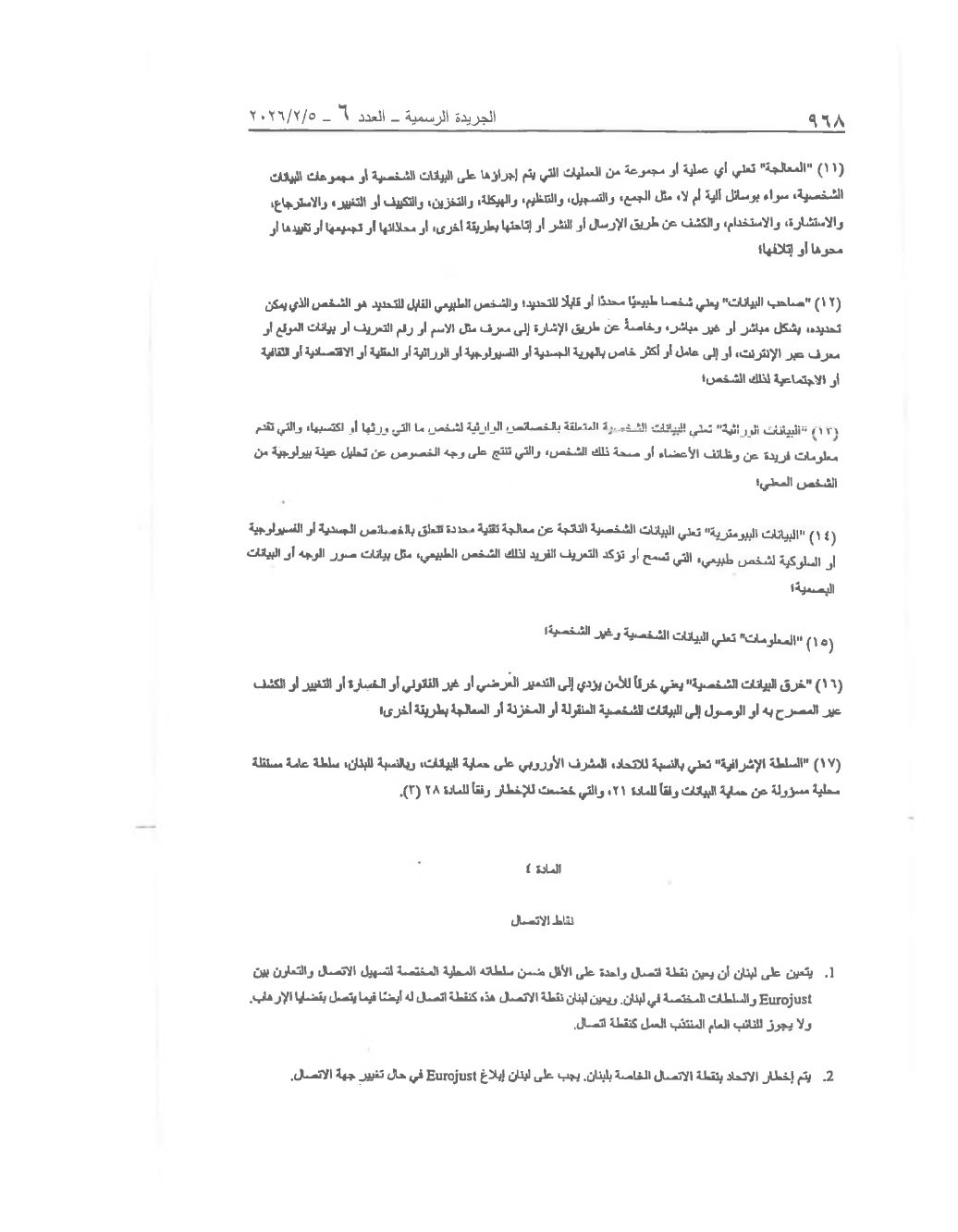
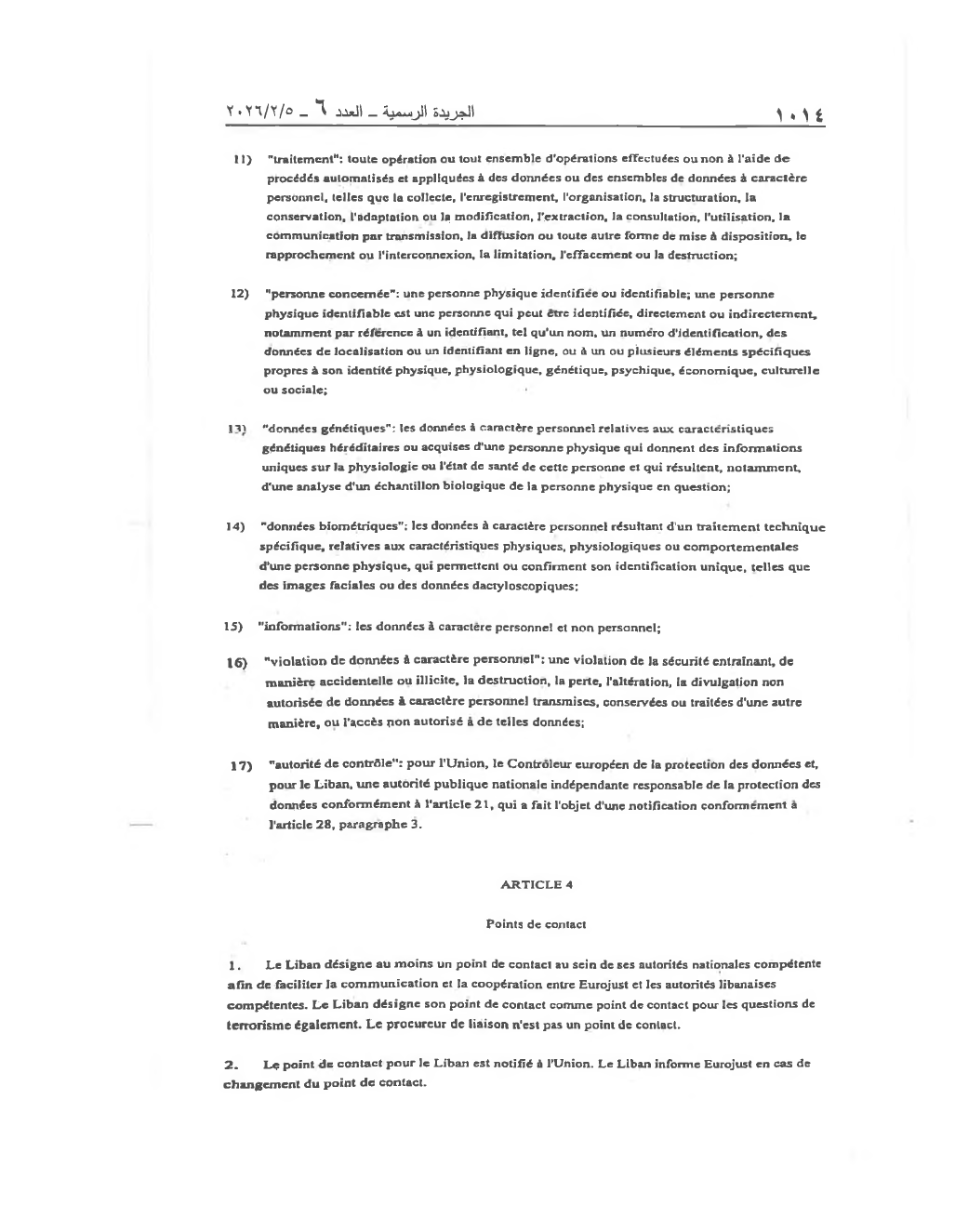
(١١) "المعالجة" تعني أي عملية أو مجموعة من العمليات التي يتم إجراؤها على البيانات الشخصية أو مجموعات البيانات الشخصية، سواء بوسائل آلية أم لا، مثل الجمع، والتسجيل، والتنظيم، والهيكلة، والتخزين، والتكييف أو التغيير، والاسترجاع، والاستشارة، والاستخدام، والكشف عن طريق الإرسال أو النشر أو إتاحتها بطريقة أخرى، أو محاذاتها أو تجميعها أو تقييدها أو محوها أو إتلافها؛
(١٢) "صاحب البيانات" يعني شخصا طبيعيًا محددًا أو قابلاً للتحديد؛ والشخص الطبيعي القابل للتحديد هو الشخص الذي يمكن تحديده، بشكل مباشر أو غير مباشر، وخاصةً عن طريق الإشارة إلى معرف مثل الاسم أو رقم التعريف أو بيانات الموقع أو معرف عبر الإنترنت، أو إلى عامل أو أكثر خاص بالهوية الجسدية أو الفسيولوجية أو الوراثية أو العقلية أو الاقتصادية أو الثقافية أو الاجتماعية لذلك الشخص؛
(١٣) "البيانات الوراثية" تعني البيانات الشخصية المتعلقة بالخصائص الوراثية / الوارثية لشخص ما التي ورثها أو اكتسبها، والتي تقدم معلومات فريدة عن وظائف الأعضاء أو صحة ذلك الشخص، والتي تنتج على وجه الخصوص عن تحليل عينة بيولوجية من الشخص المعني؛
(١٤) "البيانات البيومترية" تعني البيانات الشخصية الناتجة عن معالجة تقنية محددة تتعلق بالخصائص الجسدية أو الفسيولوجية أو السلوكية لشخص طبيعي، والتي / التي تسمح أو تؤكد التعريف الفريد لذلك الشخص الطبيعي، مثل بيانات صور الوجه أو البيانات البصمية؛
(١٥) "المعلومات" تعني البيانات الشخصية وغير الشخصية؛
(١٦) "خرق البيانات الشخصية" يعني خرقاً للأمن يؤدي إلى التدمير العرضي أو غير القانوني أو الخسارة أو التغيير أو الكشف غير المصرح به أو الوصول إلى البيانات الشخصية المنقولة أو المخزنة أو المعالجة بطريقة أخرى؛
(١٧) "السلطة الإشرافية" تعني بالنسبة للاتحاد، المشرف الأوروبي على حماية البيانات، وبالنسبة للبنان، سلطة عامة مستقلة محلية مسؤولة عن حماية البيانات وفقاً للمادة ٢١، والتي خضعت للإخطار وفقاً للمادة ٢٨ (٢).
المادة ٤
نقاط الاتصال
1. يتعين على لبنان أن يعين نقطة اتصال واحدة على الأقل ضمن سلطاته المحلية المختصة لتسهيل الاتصال والتعاون بين Eurojust والسلطات المختصة في لبنان. ويعين لبنان نقطة الاتصال هذه كنقطة اتصال له أيضاً فيما يتصل بقضايا الإرهاب. ولا يجوز للنائب العام المنتدب العمل كنقطة اتصال.
2. يتم إخطار الاتحاد بنقطة الاتصال الخاصة بلبنان. يجب على لبنان إبلاغ Eurojust في حال تغيير جهة الاتصال.
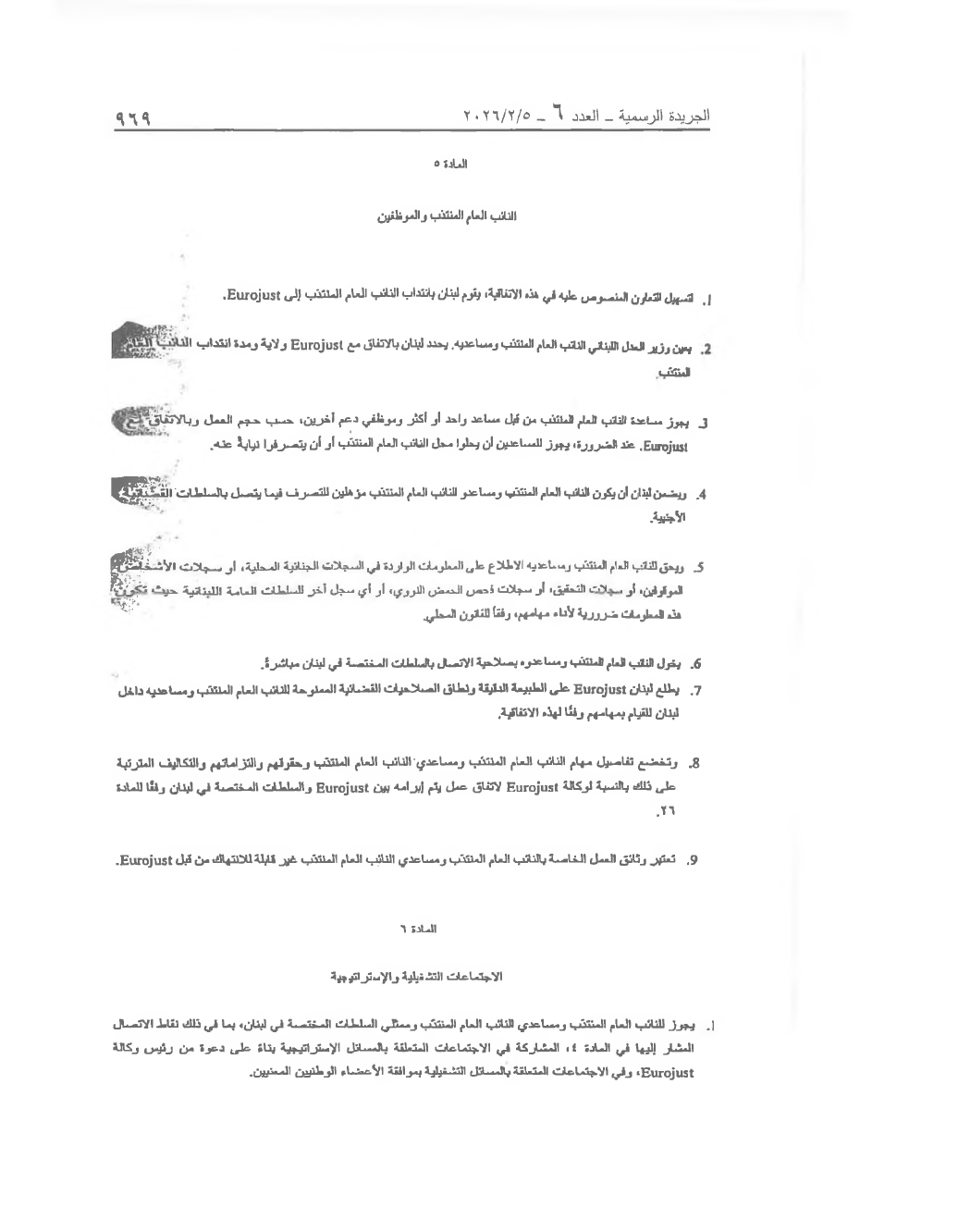
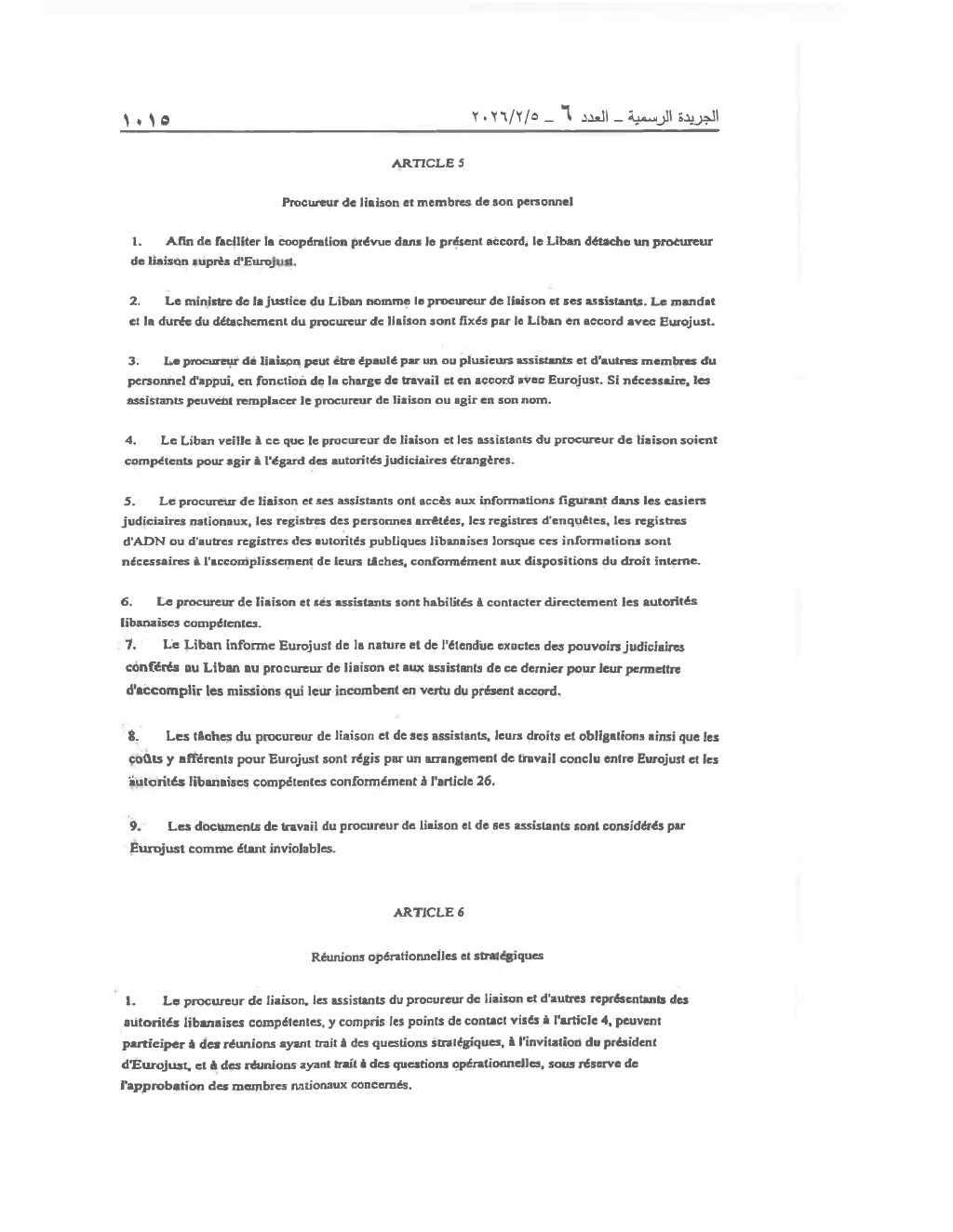
المادة ٥
النائب العام المنتدب والموظفين
1. لتسهيل التعاون المنصوص عليه في هذه الاتفاقية، يقوم لبنان بانتداب النائب العام المنتدب إلى Eurojust.
2. يعين وزير العدل اللبناني النائب العام المنتدب ومساعديه. يحدد لبنان بالاتفاق مع Eurojust ولاية ومدة انتداب النائب العام المنتدب.
3. يجوز مساعدة النائب العام المنتدب من قبل مساعد واحد أو أكثر وموظفي دعم آخرين، حسب حجم العمل وبالاتفاق مع Eurojust. عند الضرورة، يجوز للمساعدين أن يحلوا محل النائب العام المنتدب أو أن يتصرفوا نيابةً عنه.
4. يضمن / ويضمن لبنان أن يكون النائب العام المنتدب ومساعدو النائب العام المنتدب مؤهلين للتصرف فيما يتصل بالسلطات القضائية الأجنبية.
5. ويحق للنائب العام المنتدب ومساعديه الاطلاع على المعلومات الواردة في السجلات الجنائية المحلية، أو سجلات الأشخاص الموقوفين، أو سجلات التحقيق، أو سجلات فحص الحمض النووي، أو أي سجل آخر للسلطات العامة اللبنانية حيث تكون هذه المعلومات ضرورية لأداء مهامهم، وفقا للقانون المحلي.
6. يخول النائب العام المنتدب ومساعدوه بصلاحية الاتصال بالسلطات المختصة في لبنان مباشرة.
7. يطلع لبنان Eurojust على الطبيعة الدقيقة ونطاق الصلاحيات القضائية الممنوحة للنائب العام المنتدب ومساعديه داخل لبنان للقيام بمهامهم وفقاً لهذه الاتفاقية.
8. وتخضع تفاصيل مهام النائب العام المنتدب ومساعدي النائب العام المنتدب وحقوقهم والتزاماتهم والتكاليف المترتبة على ذلك بالنسبة لوكالة Eurojust لاتفاق عمل يتم إبرامه بين Eurojust والسلطات المختصة في لبنان وفقا للمادة ٢٦.
9. تعتبر وثائق العمل الخاصة بالنائب العام المنتدب ومساعدي النائب العام المنتدب غير قابلة للانتهاك من قبل Eurojust.
المادة ٦
الاجتماعات التشغيلية والإستراتيجية
1. يجوز للنائب العام المنتدب ومساعدي النائب العام المنتدب وممثلي السلطات المختصة في لبنان، بما في ذلك نقاط الاتصال المشار إليها في المادة ٤، المشاركة في الاجتماعات المتعلقة بالمسائل الاستراتيجية بناءً على دعوة من رئيس وكالة Eurojust، وفي الاجتماعات المتعلقة بالمسائل التشغيلية بموافقة الأعضاء الوطنيين المعنيين.
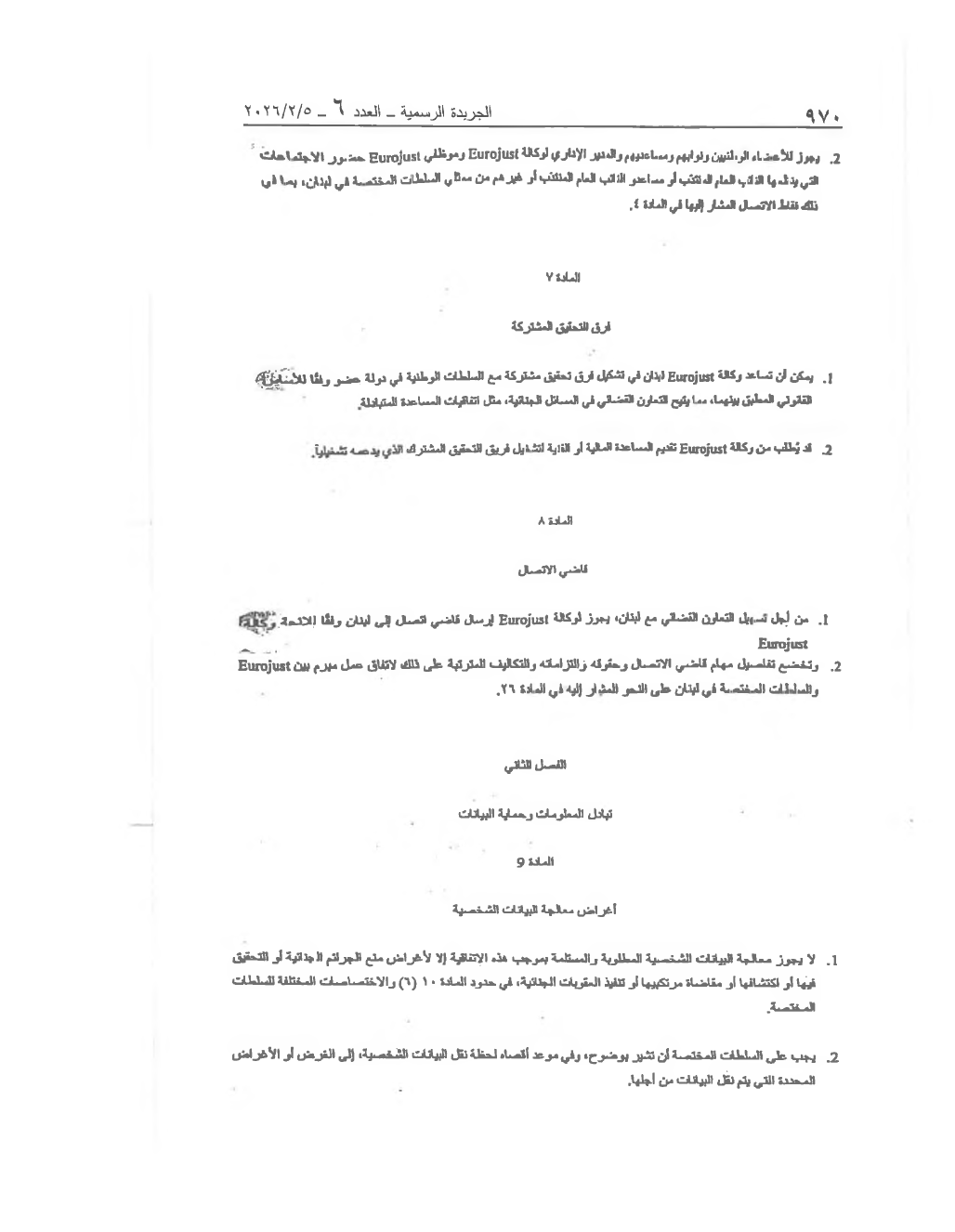
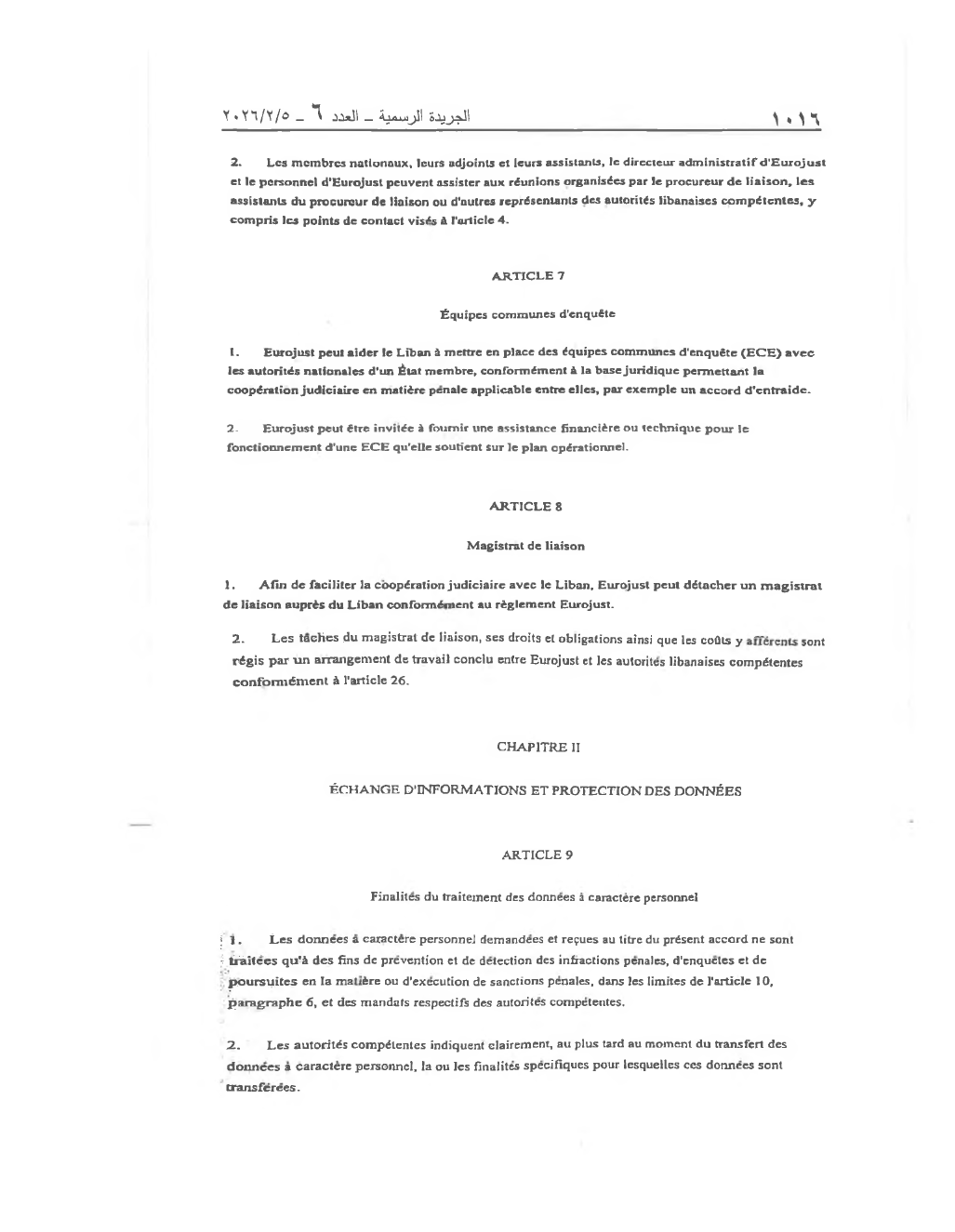
2. يجوز للأعضاء الوطنيين ونوابهم ومساعديهم والمدير الإداري لوكالة Eurojust وموظفي Eurojust حضور الاجتماعات التي يدعو لها / ينظمها النائب العام لدى التمييز / المنتدب أو مساعدو النائب العام المنتدب أو غيرهم من ممثلي السلطات المختصة في لبنان، بما في ذلك نقاط الاتصال المشار إليها في المادة 4.
المادة 7
فرق التحقيق المشتركة
1. يمكن أن تساعد وكالة Eurojust لبنان في تشكيل فرق تحقيق مشتركة مع السلطات الوطنية في دولة عضو وفقا للإطار / للأساس القانوني المطبق بينهما، مما يتيح التعاون القضائي في المسائل الجنائية، مثل اتفاقيات المساعدة المتبادلة.
2. قد يطلب من وكالة Eurojust تقديم المساعدة المالية أو المادية / الفنية لتشغيل فريق التحقيق المشترك الذي يدعمه تشغيليا.
المادة 8
قاضي الاتصال
1. من أجل تسهيل التعاون القضائي مع لبنان، يجوز لوكالة Eurojust إرسال قاضي اتصال إلى لبنان وفقا للائحة وكالة Eurojust
2. وتخضع تفاصيل مهام قاضي الاتصال وحقوقه والتزاماته والتكاليف المترتبة على ذلك لاتفاق عمل مبرم بين Eurojust والسلطات المختصة في لبنان على النحو المشار إليه في المادة 26.
الفصل الثاني
تبادل المعلومات وحماية البيانات
المادة 9
أغراض معالجة البيانات الشخصية
1. لا يجوز معالجة البيانات الشخصية المطلوبة والمستلمة بموجب هذه الإتفاقية إلا لأغراض منع الجرائم الجنائية أو التحقيق فيها أو اكتشافها أو مقاضاة مرتكبيها أو تنفيذ العقوبات الجنائية، في حدود المادة 10 (6) والاختصاصات المختلفة للسلطات المختصة.
2. يجب على السلطات المختصة أن تشير بوضوح، وفي موعد أقصاه لحظة نقل البيانات الشخصية، إلى الغرض أو الأغراض المحددة التي يتم نقل البيانات من أجلها.
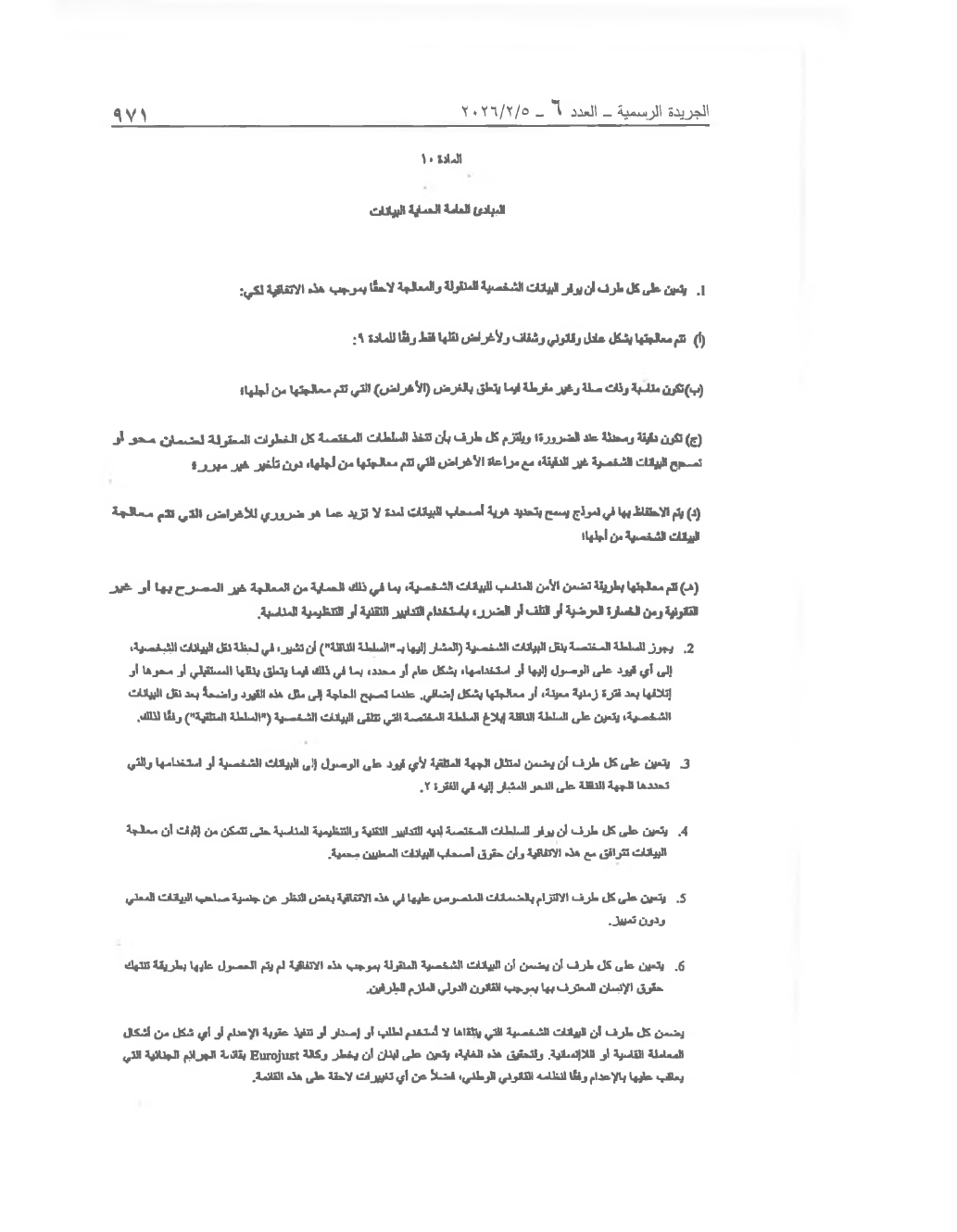
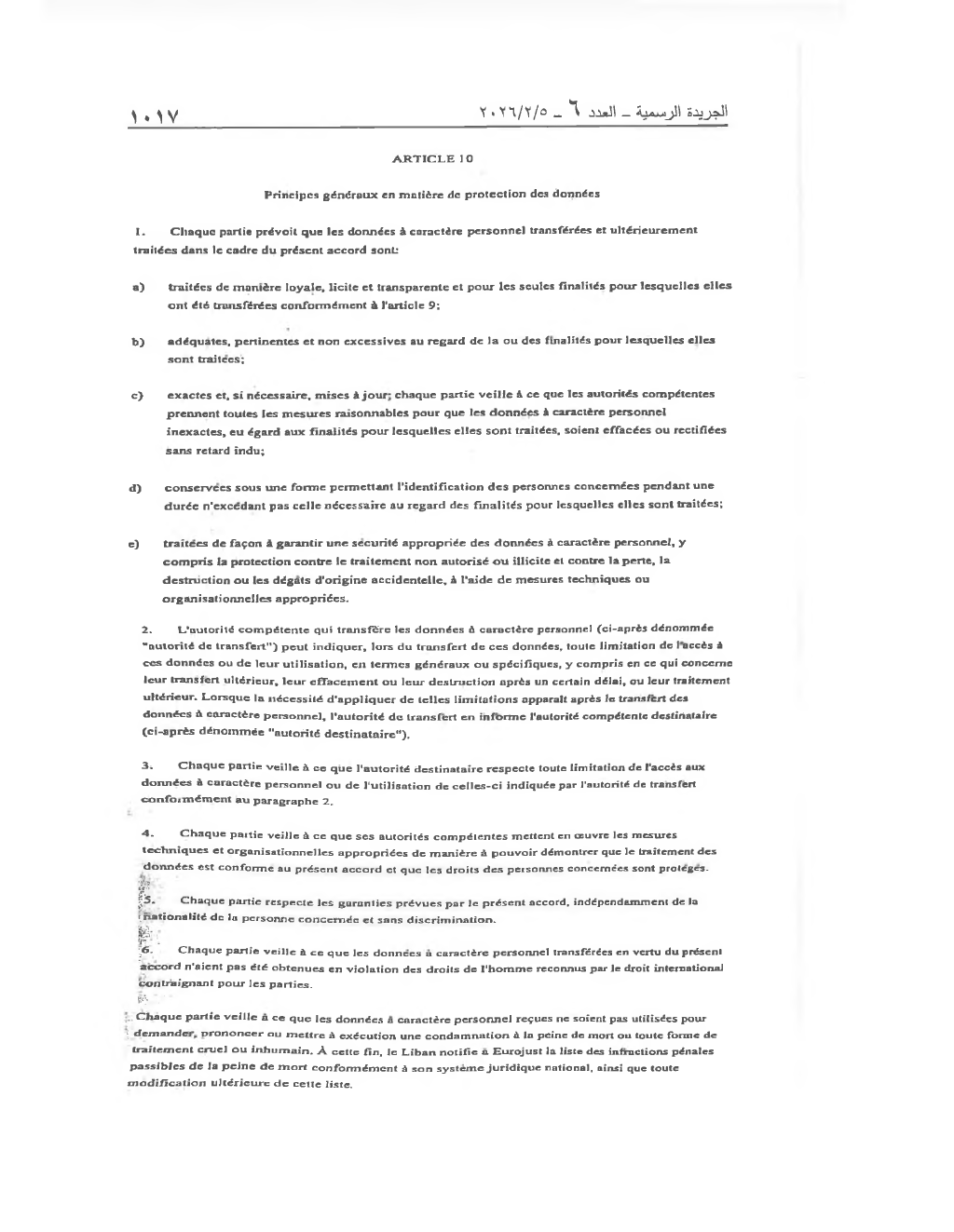
المادة ١٠
المبادئ العامة لحماية البيانات
1. يتعين على كل طرف أن يوفر للبيانات / البيانات الشخصية المنقولة والمعالجة لاحقاً بموجب هذه الاتفاقية لكي:
(أ) تتم معالجتها بشكل عادل وقانوني وشفاف ولأغراض نقلها فقط وفقاً للمادة ٩؛
(ب) تكون مناسبة وذات صلة وغير مفرطة فيما يتعلق بالغرض (الأغراض) التي تتم معالجتها من أجلها؛
(ج) تكون دقيقة ومحدثة عند الضرورة؛ ويلتزم كل طرف بأن تتخذ السلطات المختصة كل الخطوات المعقولة لضمان محو أو تصحيح البيانات الشخصية غير الدقيقة، مع مراعاة الأغراض التي تتم معالجتها من أجلها، دون تأخير غير مبرر؛
(د) يتم الاحتفاظ بها في نموذج يسمح بتحديد هوية أصحاب البيانات لمدة لا تزيد عما هو ضروري للأغراض التي تتم معالجة البيانات الشخصية من أجلها؛
(هـ) تتم معالجتها بطريقة تضمن الأمن المناسب للبيانات الشخصية، بما في ذلك الحماية من المعالجة غير المصرح بها أو غير القانونية ومن الخسارة العرضية أو التلف أو الضرر، باستخدام التدابير التقنية أو التنظيمية المناسبة.
2. يجوز للسلطة المختصة بنقل البيانات الشخصية (المشار إليها بـ "السلطة الناقلة") أن تشير، في لحظة نقل البيانات الشخصية، إلى أي قيود على الوصول إليها أو استخدامها، بشكل عام أو محدد، بما في ذلك فيما يتعلق بنقلها المستقبلي أو محوها أو إتلافها بعد فترة زمنية معينة، أو معالجتها بشكل إضافي. عندما تصبح الحاجة إلى مثل هذه القيود واضحة بعد نقل البيانات الشخصية، يتعين على السلطة الناقلة إبلاغ السلطة المختصة التي تتلقى البيانات الشخصية ("السلطة المتلقية") وفقاً لذلك.
3. يتعين على كل طرف أن يضمن امتثال الجهة المتلقية لأي قيود على الوصول إلى البيانات الشخصية أو استخدامها والتي تحددها الجهة الناقلة على النحو المشار إليه في الفقرة ٢.
4. يتعين على كل طرف أن يوفر للسلطات المختصة لديه التدابير التقنية والتنظيمية المناسبة حتى تتمكن من إثبات أن معالجة البيانات تتوافق مع هذه الاتفاقية وأن حقوق أصحاب البيانات المعنيين محمية.
5. يتعين على كل طرف الالتزام بالضمانات المنصوص عليها في هذه الاتفاقية بغض النظر عن جنسية صاحب البيانات المعني ودون تمييز.
6. يتعين على كل طرف أن يضمن أن البيانات الشخصية المنقولة بموجب هذه الاتفاقية لم يتم الحصول عليها بطريقة تنتهك حقوق الإنسان المعترف بها بموجب القانون الدولي الملزم للطرفين.
يضمن كل طرف أن البيانات الشخصية التي يتلقاها لا تستخدم لطلب أو إصدار أو تنفيذ عقوبة الإعدام أو أي شكل من أشكال المعاملة القاسية أو اللاإنسانية. ولتحقيق هذه الغاية، يتعين على لبنان أن يخطر وكالة Eurojust بقائمة الجرائم الجنائية التي يعاقب عليها بالإعدام وفقاً لنظامه القانوني الوطني، فضلاً عن أي تغييرات لاحقة على هذه القائمة.
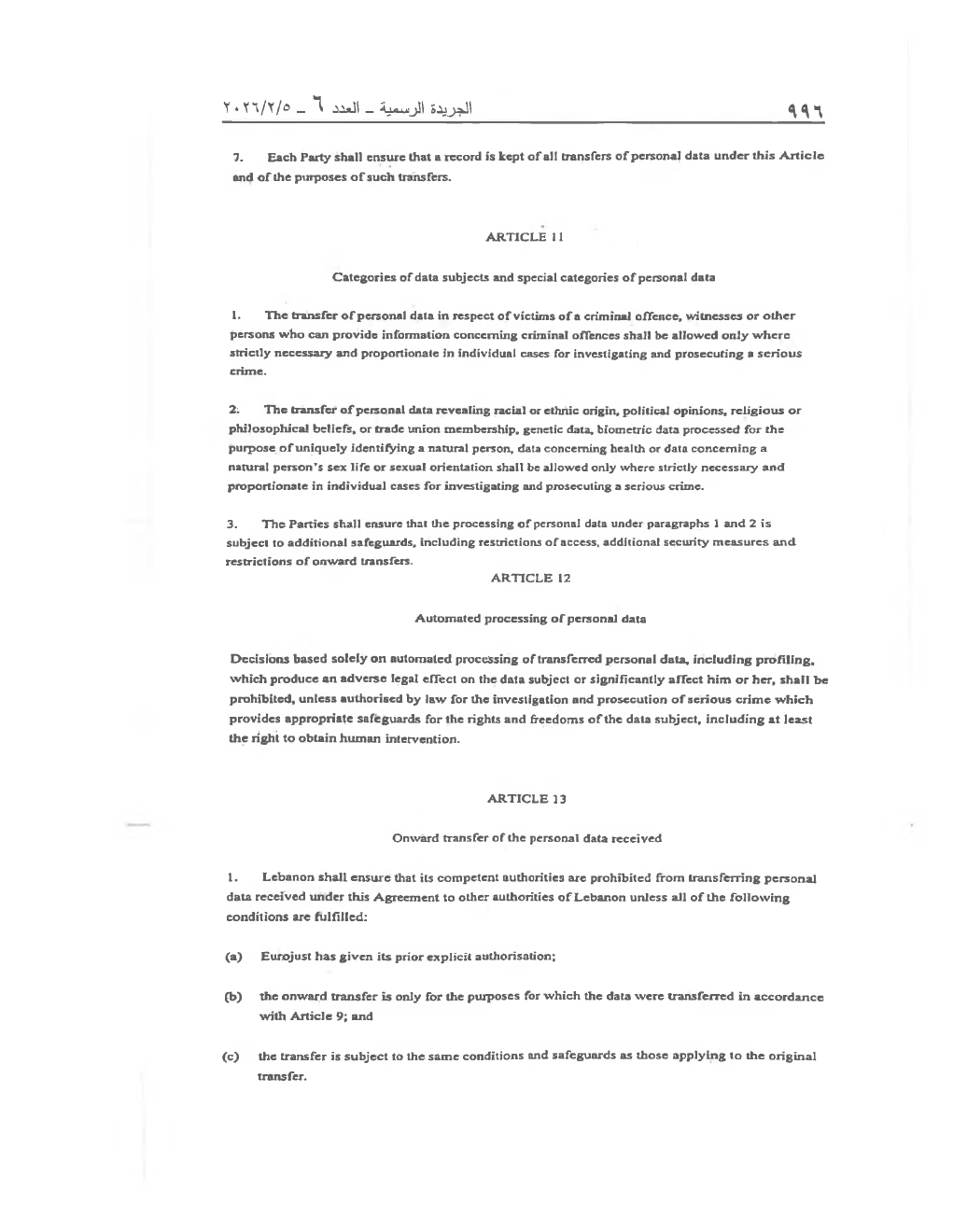
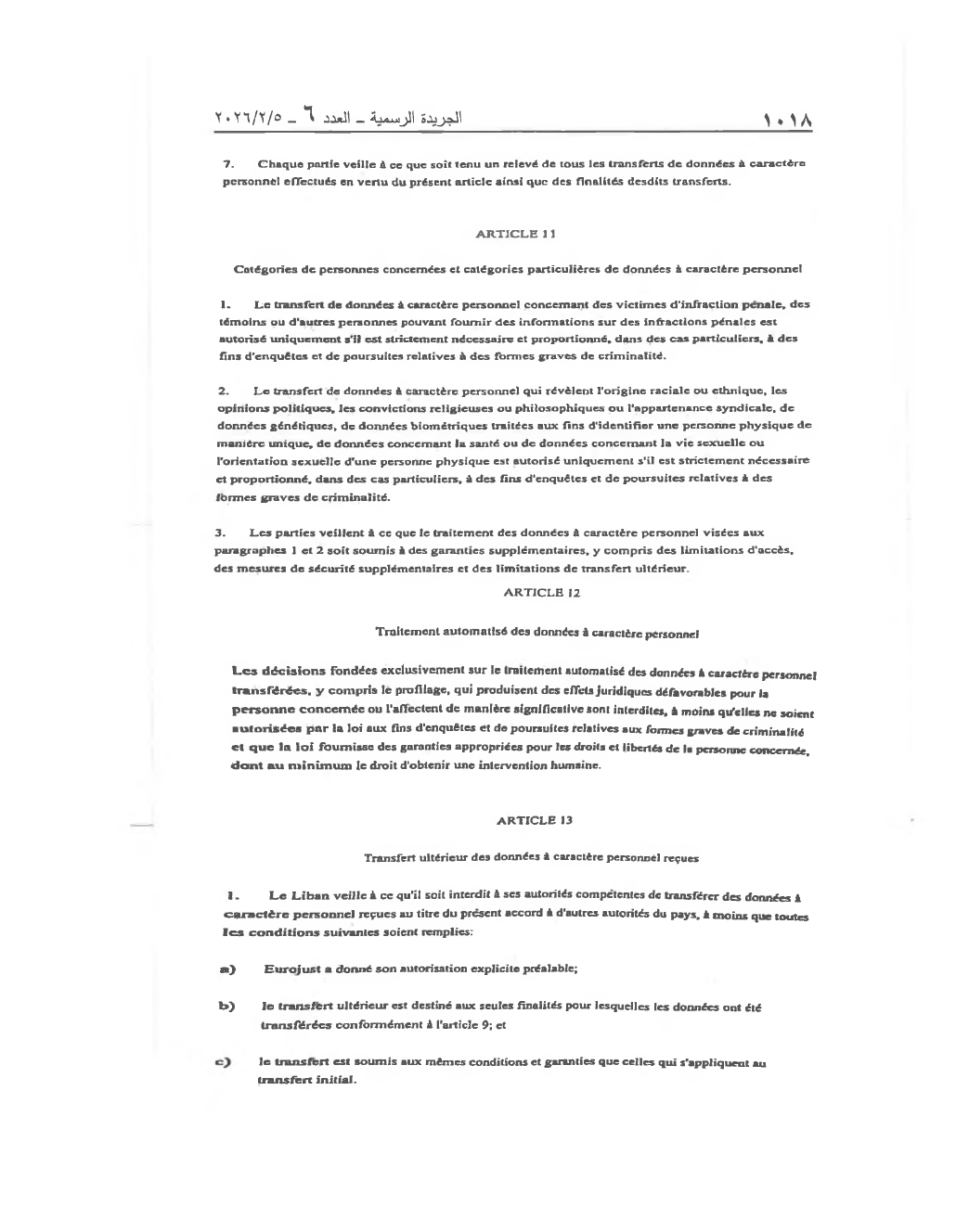
7. يتعين على كل طرف أن يضمن الاحتفاظ بسجل لجميع عمليات نقل البيانات الشخصية بموجب هذه المادة وأغراض عمليات النقل تلك.
المادة ١١
فئات أصحاب البيانات وفئات البيانات الشخصية
1. لا يجوز نقل البيانات الشخصية فيما يتعلق بضحايا الجرائم الجنائية أو الشهود أو غيرهم من الأشخاص الذين يمكنهم تقديم معلومات تتعلق بالجرائم الجنائية إلا عندما يكون ذلك ضرورياً للغاية ومتناسباً في حالات فردية للتحقيق في جريمة خطيرة وملاحقة مرتكبيها.
2. لا يجوز نقل البيانات الشخصية التي تكشف عن الأصل العرقي أو الإثني، أو الآراء السياسية، أو المعتقدات الدينية أو الفلسفية، أو عضوية النقابات العمالية، أو البيانات الوراثية، أو البيانات البيومترية التي تتم معالجتها بغرض التعرف بشكل فريد على شخص طبيعي، أو البيانات المتعلقة بالصحة أو البيانات المتعلقة بالحياة الجنسية أو التوجه الجنسي لشخص طبيعي، إلا عندما يكون ذلك ضرورياً للغاية ومتناسباً في حالات فردية للتحقيق في جريمة خطيرة وملاحقة مرتكبيها.
3. يتعين على الطرفين ضمان أن تكون معالجة البيانات الشخصية بموجب الفقرتين 1 و 2 خاضعة لضمانات إضافية، بما في ذلك قيود الوصول وتدابير أمنية إضافية، وقيود عمليات النقل اللاحق.
المادة ١٢
المعالجة الآلية للبيانات الشخصية
يحظر اتخاذ القرارات التي تعتمد فقط على المعالجة الآلية للبيانات الشخصية المنقولة، بما في ذلك إنشاء الملفات التعريفية، والتي تنتج تأثيراً قانونياً سلبياً على صاحب البيانات أو تؤثر عليه بشكل كبير، ما لم يتم الترخيص بذلك بموجب القانون للتحقيق في الجرائم الخطيرة وملاحقة مرتكبيها والتي توفر الضمانات المناسبة لحقوق وحريات صاحب البيانات، بما في ذلك على الأقل الحق في الحصول على تدخل بشري.
المادة ١٣
النقل اللاحق للبيانات الشخصية المستلمة
1. يضمن لبنان أن سلطاته المختصة ممنوعة من نقل البيانات الشخصية التي تلقتها بموجب هذه الاتفاقية إلى سلطات أخرى في لبنان ما لم يتم استيفاء جميع الشروط التالية:
(أ) تعطي وكالة Eurojust موافقتها الصريحة المسبقة؛
(ب) ويكون النقل اللاحق فقط للأغراض التي تم نقل البيانات من أجلها وفقا للمادة ١٩؛ / ٩؛
(ج) ويكون النقل لنفس الشروط والضمانات المطبقة على النقل الأصلي.
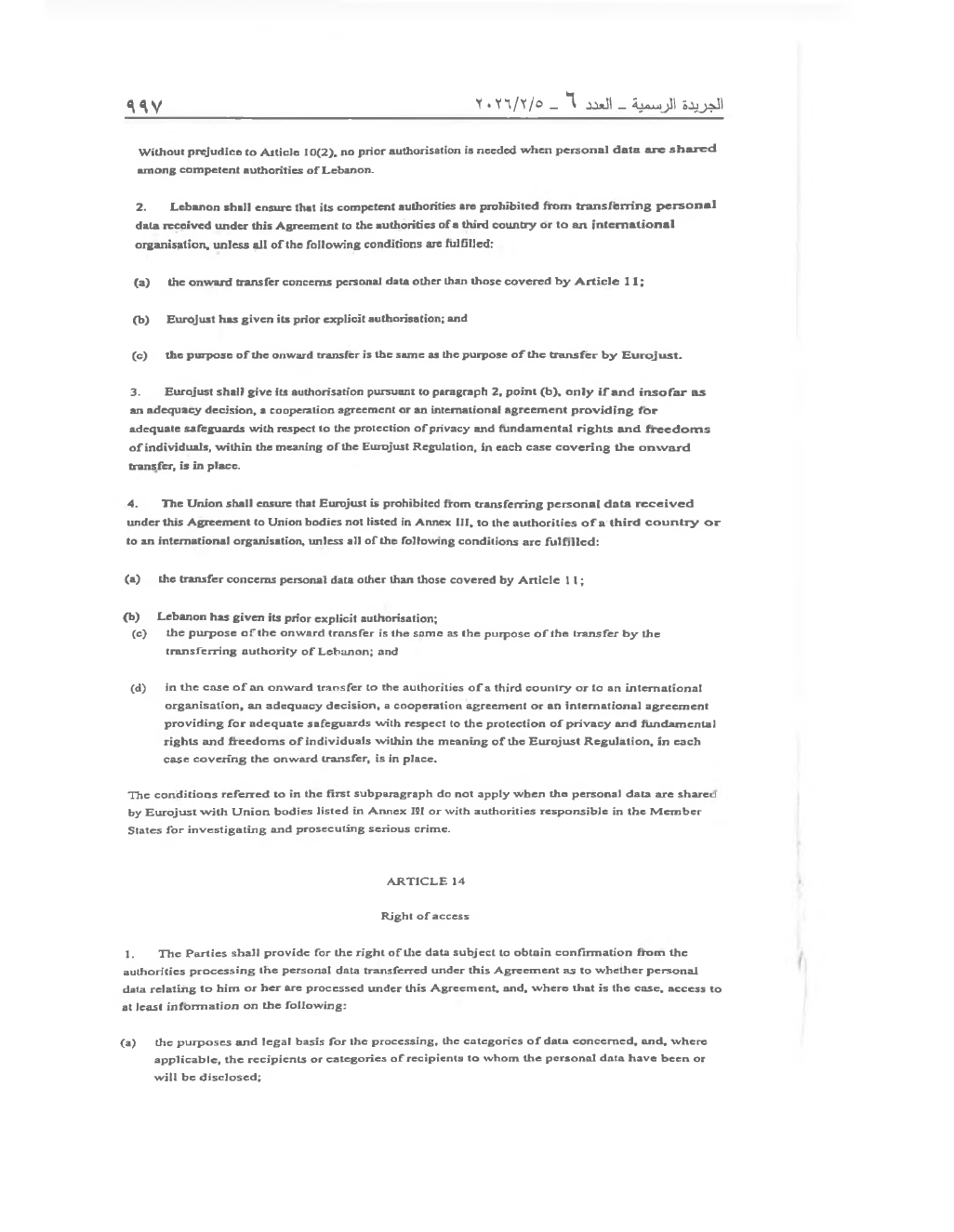
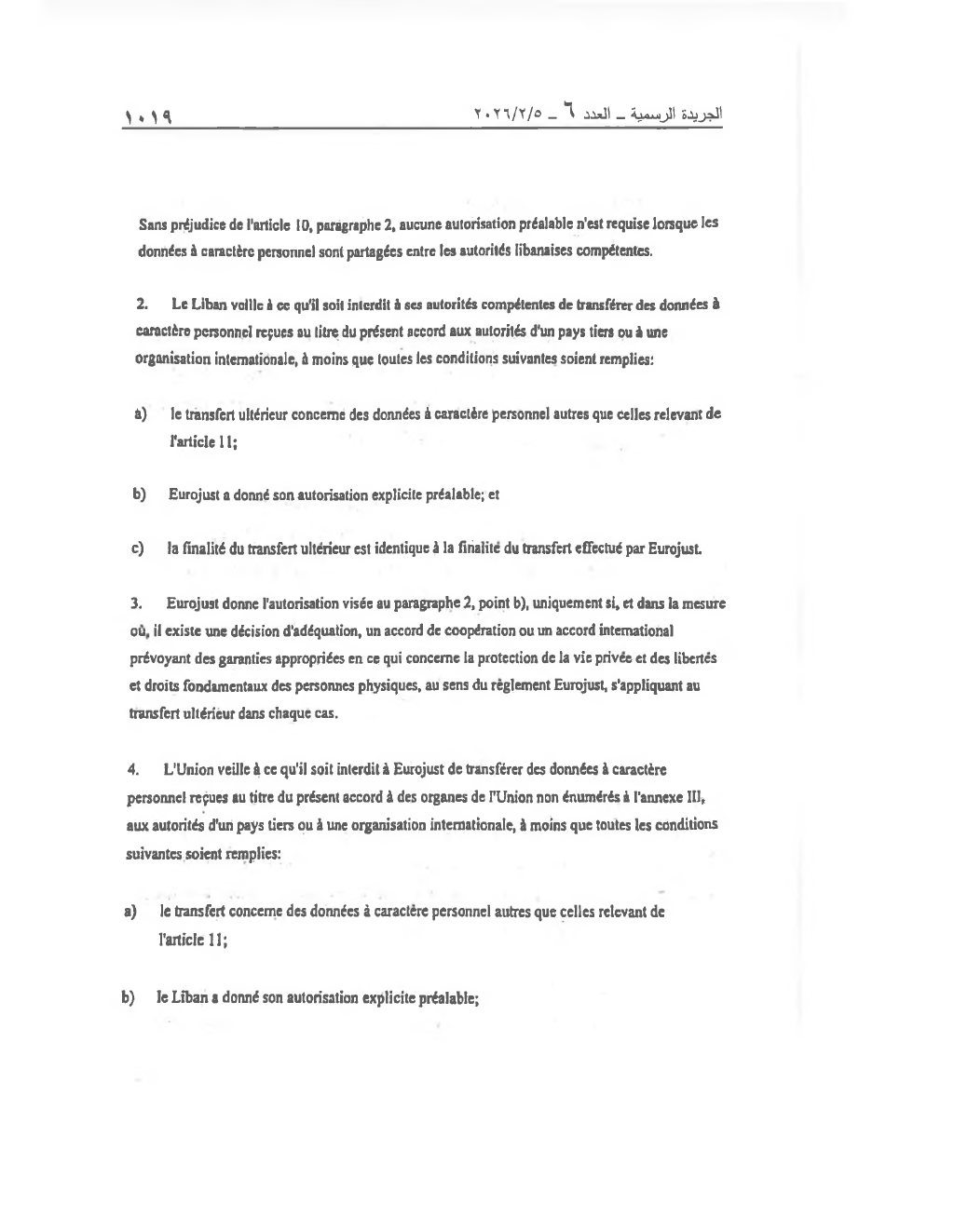
ومع عدم الإخلال بالمادة ۱۰ (۲)، لا يلزم الحصول على تصريح مسبق عند مشاركة البيانات الشخصية بين السلطات المختصة في لبنان.
2. يضمن لبنان أن سلطاته المختصة ممنوعة من نقل البيانات الشخصية التي يتلقاها بموجب هذه الاتفاقية إلى سلطات دولة ثالثة، أو إلى منظمة دولية، ما لم يتم استيفاء جميع الشروط التالية:
(أ) يتعلق النقل اللاحق ببيانات شخصية أخرى غير تلك المنصوص عليها في المادة ١١؛
(ب) وتعطي وكالة Eurojust تصريحها الصريح المسبق؛
(ج) ويكون الغرض من النقل اللاحق هو نفس الغرض من النقل الذي قامت به وكالة Eurojust
3. لا تمنح وكالة Eurojust ترخيصها بموجب الفقرة ۲، النقطة (ب)، إلا إذا كان هناك قرار ملاءمة، أو اتفاقية تعاون، أو اتفاقية دولية تنص على ضمانات كافية فيما يتعلق بحماية الخصوصية والحقوق والحريات الأساسية للأفراد، وفقاً لمعنى لائحة Eurojust، في كل حالة تغطي النقل اللاحق.
4. يضمن الاتحاد أنه يُحظر على Eurojust نقل البيانات الشخصية التي تم تلقيها بموجب هذه الاتفاقية إلى هيئات الاتحاد غير المدرجة في الملحق الثالث، أو إلى سلطات دولة ثالثة أو إلى منظمة دولية، ما لم يتم استيفاء جميع الشروط التالية:
(أ) يتعلق النقل ببيانات شخصية غير تلك المنصوص عليها في المادة ١١؛
(ب) ويعطي لبنان موافقته الصريحة المسبقة؛
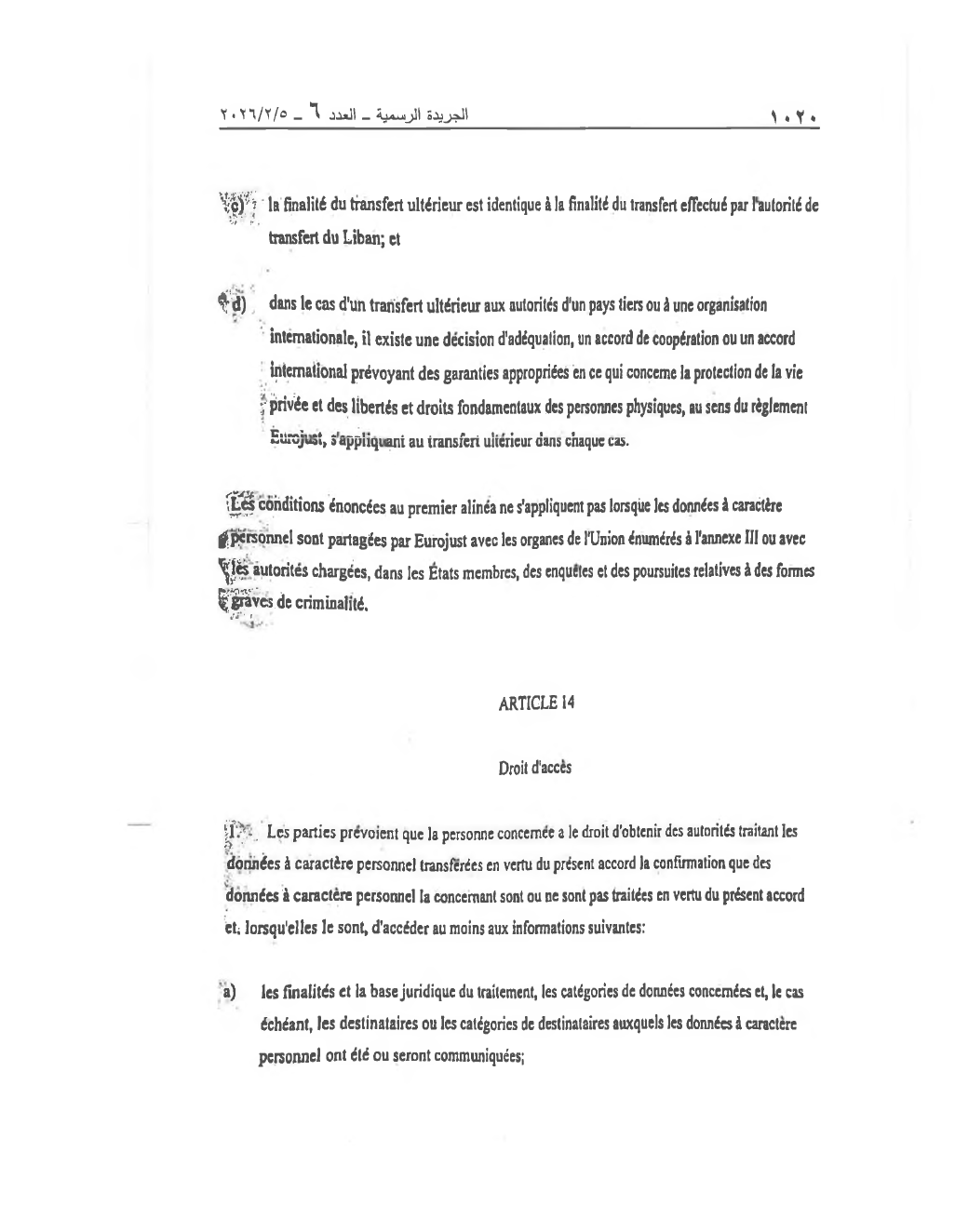
(ج) والغرض من النقل اللاحق هو نفس الغرض من النقل من قبل السلطة الناقلة في لبنان
(د) وفي حالة النقل اللاحق إلى سلطات دولة ثالثة أو منظمة دولية، يجب وجود قرار ملاءمة أو اتفاقية تعاون أو اتفاقية دولية توفر ضمانات كافية فيما يتعلق بحماية الخصوصية والحقوق والحريات الأساسية للأفراد وفقاً لمعنى لائحة Eurojust، في كل حالة تغطي النقل اللاحق.
لا تنطبق الشروط المشار إليها في الفقرة الفرعية الأولى عندما تتم مشاركة البيانات الشخصية من قبل Eurojust مع هيئات الاتحاد المدرجة في الملحق الثالث أو مع السلطات المسؤولة في الدول الأعضاء عن التحقيق في الجرائم الخطيرة ومقاضاة مرتكبيها.
المادة ١٤
حق الوصول
1. يتعين على الطرفين توفير الحق لصاحب البيانات في الحصول على تأكيد من السلطات التي تعالج البيانات الشخصية المنقولة بموجب هذه الاتفاقية بشأن ما إذا كانت البيانات الشخصية المتعلقة به تتم معالجتها بموجب هذه الاتفاقية، وفي حالة حدوث ذلك، الوصول إلى معلومات على الأقل بشأن ما يلي:
(أ) الأغراض والأساس القانوني للمعالجة، وفئات البيانات المعنية، وحيثما ينطبق ذلك، المتلقون أو فئات المتلقين الذين تم أو سيتم الكشف لهم عن البيانات الشخصية؛
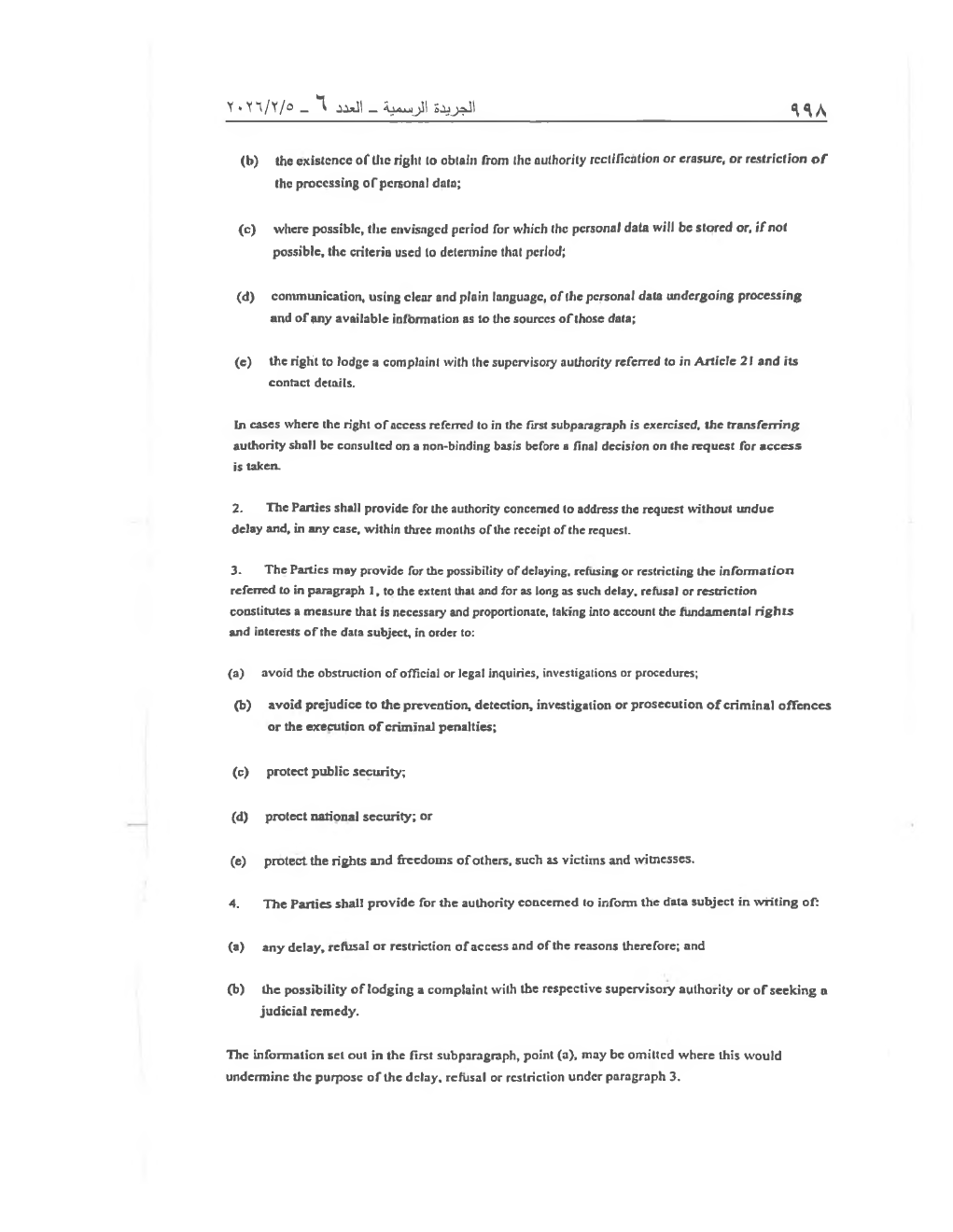
(ب) وجود الحق في الحصول من السلطة على التصحيح أو المحو أو تقييد معالجة البيانات الشخصية؛
(ج) عندما يكون ذلك ممكنا، الفترة المتوقعة لتخزين البيانات الشخصية أو، إذا لم يكن ذلك ممكنا، المعايير المستخدمة لتحديد تلك الفترة؛
(د) التواصل باستخدام لغة واضحة ومباشرة بشأن البيانات الشخصية التي تخضع للمعالجة وأي معلومات متوفرة بشأن - مصادر تلك البيانات؛
(هـ) الحق في تقديم شكوى إلى السلطة الإشرافية المنصوص عليها في المادة ٢١ وبيانات الاتصال بها.
وفي الحالات التي تتم فيها ممارسة حق الوصول المنصوص عليه في الفترة / الفقرة الفرعية الأولى، يجب استشارة السلطة الناقلة بشكل غير ملزم قبل اتخاذ القرار النهائي بشأن طلب الوصول.
2. يتعين على الطرفين توفير القدرة للسلطة المعنية على معالجة الطلب دون تأخير غير مبرر، وفي كل الأحوال، خلال ثلاثة أشهر من تاريخ استلام الطلب.
3. يجوز للطرفين إتاحة إمكانية تأخير أو رفض أو تقييد المعلومات المشار إليها في الفقرة ١، إلى الحد الذي يشكل فيه هذا التأخير أو الرفض أو التقييد تدبيرا ضروريا ومتناسبا، مع مراعاة الحقوق والمصالح الأساسية لصاحب البيانات، من أجل:
(أ) تجنب عرقلة التحقيقات أو الاستفسارات أو الإجراءات الرسمية أو القانونية؛
(ب) تجنب الإضرار بمنع الجرائم الجنائية أو اكتشافها أو التحقيق فيها أو ملاحقة مرتكبيها أو تنفيذ العقوبات الجنائية؛
(ج) حماية الأمن العام؛
(د) حماية الأمن الوطني؛ أو
(هـ) حماية حقوق وحريات الآخرين، مثل الضحايا والشهود.
4. يتعين على الطرفين منح الفرصة للسلطة المعنية لإبلاغ صاحب البيانات كتابيا بما يلي:
(أ) أي تأخير أو رفض أو تقييد للوصول والأسباب المؤدية لذلك؛
(ب) وإمكانية تقديم شكوى إلى السلطة الإشرافية المختصة أو طلب الانتصاف القضائي.
يجوز حذف المعلومات المنصوص عليها في الفترة / الفقرة الفرعية الأولى، النقطة (أ)، إذا كان ذلك من شأنه أن يقوض غرض التأخير أو الرفض أو التقييد بموجب الفقرة ٣.
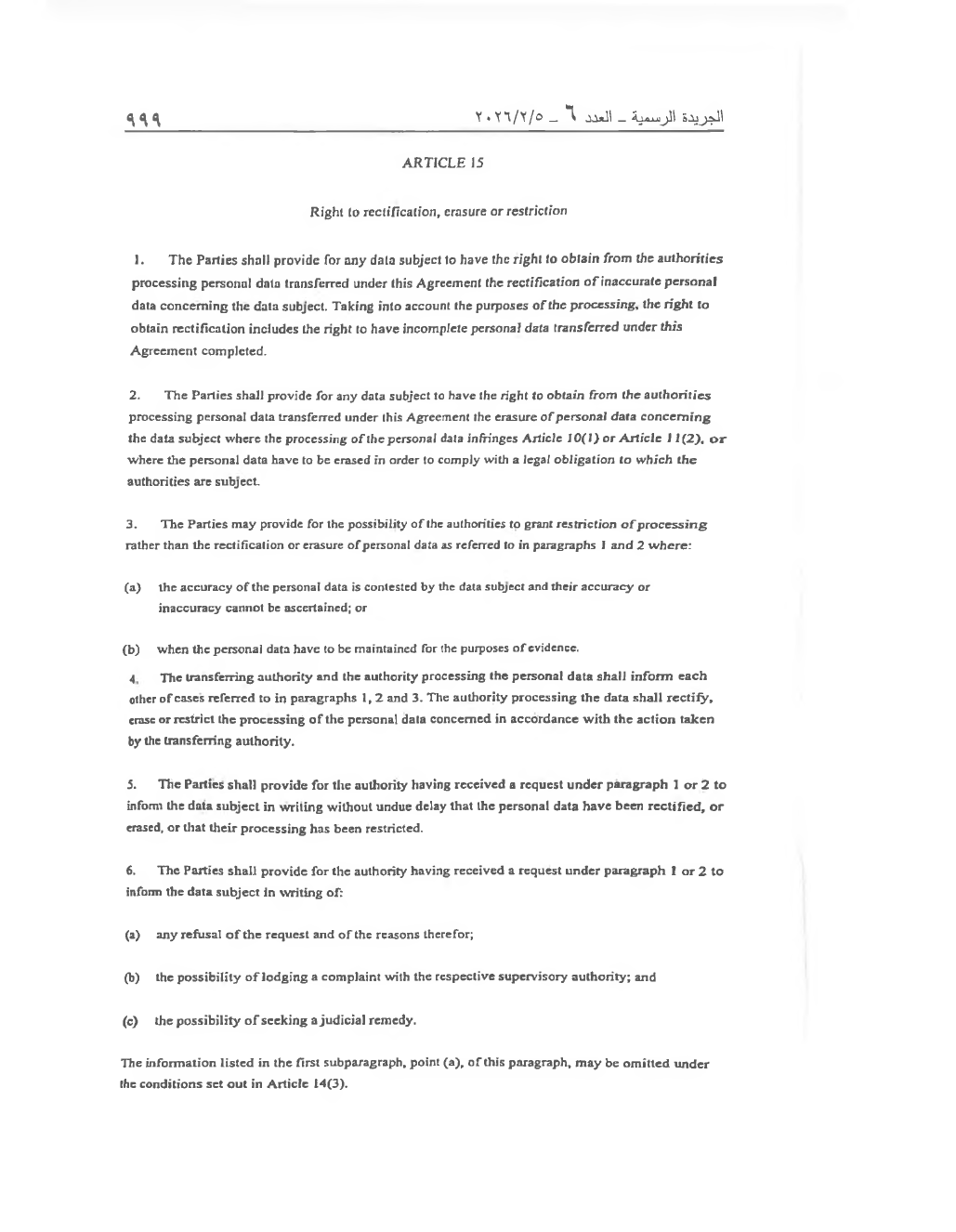
المادة ١٥
الحق في التصحيح أو المحو أو التقييد
1. يتعهد الطرفان بأن يكون لأي صاحب بيانات الحق في الحصول من السلطات التي تعالج البيانات الشخصية المنقولة بموجب هذه الاتفاقية على إمكانية تصحيح البيانات الشخصية غير الدقيقة المتعلقة بصاحب البيانات، مع الأخذ بعين الاعتبار أغراض المعالجة، فإن الحق في الحصول على التصحيح يشمل الحق في استكمال البيانات الشخصية غير المكتملة المنقولة بموجب هذه الاتفاقية.
2. يتعهد الطرفان بأن يكون لأي صاحب بيانات الحق في الحصول من السلطات التي تعالج البيانات الشخصية المنقولة بموجب هذه الاتفاقية على إمكانية محو البيانات الشخصية المتعلقة بصاحب البيانات حيث تنتهك معالجة البيانات الشخصية المادة ١٠ (١) أو (۲)۱۱، / ١١(٢)، أو حيث يتعين محو البيانات الشخصية من أجل الامتثال لالتزام قانوني تخضع له السلطات.
3. يجوز للطرفين القيام باللازم من أجل إمكانية قيام السلطات بمنح تقييد المعالجة بدلاً من تصحيح أو محو البيانات الشخصية كما هو مذكور في الفقرتين 1 و2 حيث:
(أ) يتم الطعن في دقة البيانات الشخصية من قبل صاحب البيانات ولا يمكن التأكد من دقتها أو عدم دقتها؛ أو
(ب) عندما يتعين الاحتفاظ بالبيانات الشخصية لأغراض الإثبات.
4. يجب على السلطة الناقلة والسلطة المعالجة للبيانات الشخصية إبلاغ بعضهما البعض بالحالات المشار إليها في الفقرات 1 و2 و3. يجب على السلطة التي تتولى معالجة البيانات أن تقوم بتصحيح أو محو / مسح أو تقييد معالجة البيانات الشخصية المعنية وفقا للإجراءات التي اتخذتها السلطة الناقلة.
5. يلتزم الطرفان بتوفير ما يلزم للسلطة التي تلقت طلبا بموجب الفقرة 1 أو 2 بإبلاغ صاحب البيانات كتابيا دون تأخير غير مبرر بأن البيانات الشخصية قد تم تصحيحها أو محوها أو أن معالجتها قد تم تقييدها.
6. يلتزم الطرفان بتوفير ما يلزم للسلطة التي تلقت طلبا بموجب الفقرة 1 أو 2 بإبلاغ صاحب البيانات كتابيا بما يأتي: / يلي:
(أ) أي رفض للطلب وأسبابه؛
(ب) وإمكانية تقديم شكوى إلى السلطة الإشرافية المختصة؛
(ج) وإمكانية اللجوء إلى القضاء لطلب الانتصاف القضائي؛
يجوز حذف المعلومات المذكورة في الفقرة الفرعية الأولى (أ) من هذه الفقرة وفقا للشروط المنصوص عليها في المادة ١٤(٣).
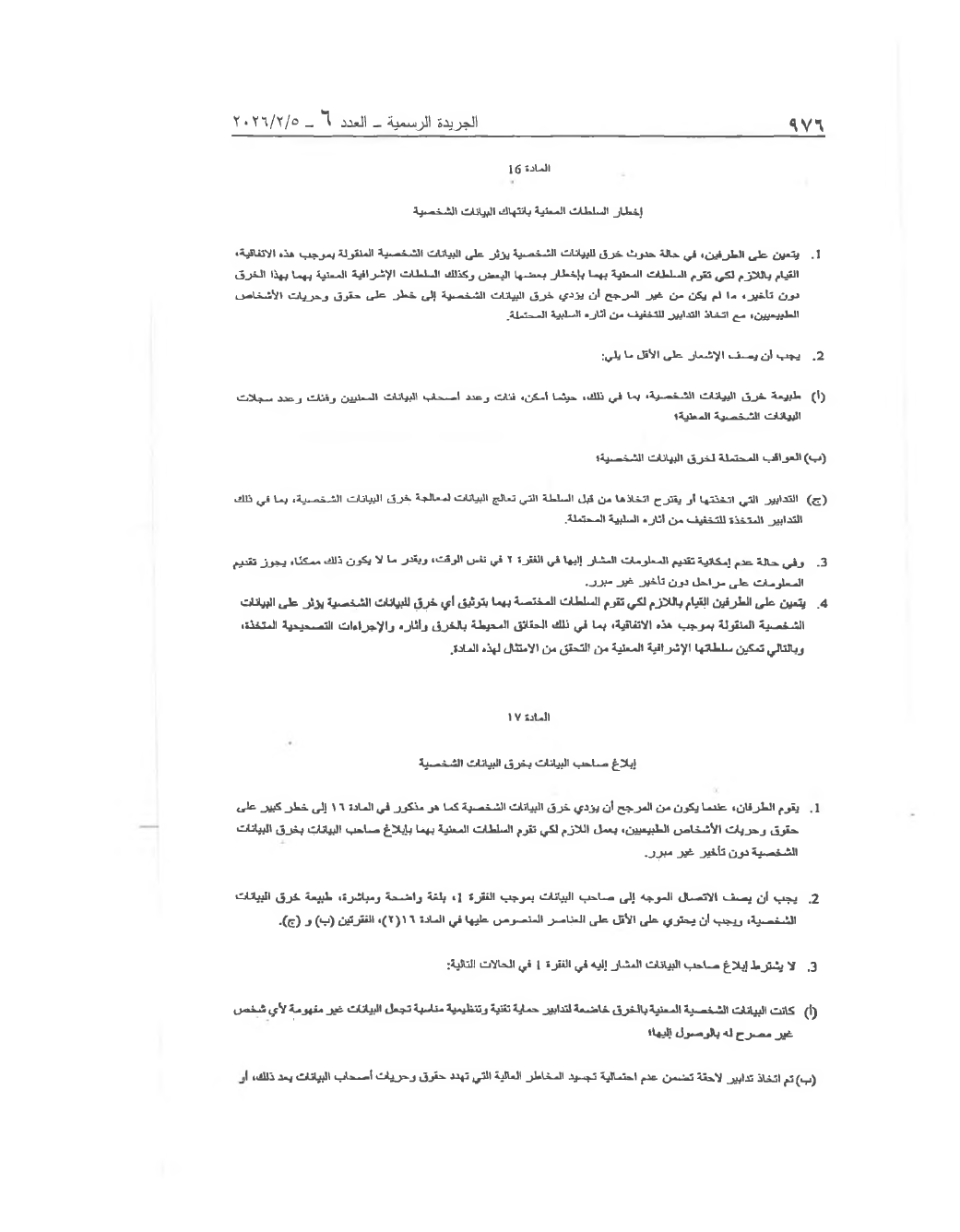
المادة 16
إخطار السلطات المعنية بانتهاك البيانات الشخصية
1. يتعين على الطرفين، في حالة حدوث خرق للبيانات الشخصية يؤثر على البيانات الشخصية المنقولة بموجب هذه الاتفاقية، القيام باللازم لكي تقوم السلطات المعنية بهما بإخطار بعضها البعض وكذلك السلطات الإشرافية المعنية بهما بهذا الخرق دون تأخير، ما لم يكن من غير المرجح أن يؤدي خرق البيانات الشخصية إلى خطر على حقوق وحريات الأشخاص الطبيعيين، مع اتخاذ التدابير للتخفيف من آثاره السلبية المحتملة.
2. يجب أن يصف الإشعار على الأقل ما يلي:
(أ) طبيعة خرق البيانات الشخصية، بما في ذلك، حيثما أمكن، فئات وعدد أصحاب البيانات المعنيين وفئات وعدد سجلات البيانات الشخصية المعنية؛
(ب) العواقب المحتملة لخرق البيانات الشخصية؛
(ج) التدابير التي اتخذتها أو يقترح اتخاذها من قبل السلطة التي تعالج البيانات لمعالجة خرق البيانات الشخصية، بما في ذلك التدابير المتخذة للتخفيف من آثاره السلبية المحتملة.
3. وفي حالة عدم إمكانية تقديم المعلومات المشار إليها في الفقرة 2 في نفس الوقت، وبقدر ما لا يكون ذلك ممكنا، يجوز تقديم المعلومات على مراحل دون تأخير غير مبرر.
4. يتعين على الطرفين القيام باللازم لكي تقوم السلطات المختصة بهما بتوثيق أي خرق للبيانات الشخصية يؤثر على البيانات الشخصية المنقولة بموجب هذه الاتفاقية، بما في ذلك الحقائق المحيطة بالخرق وآثاره والإجراءات التصحيحية المتخذة، وبالتالي تمكين سلطاتها الإشرافية المعنية من التحقق من الامتثال لهذه المادة.
المادة 17
إبلاغ صاحب البيانات بخرق البيانات الشخصية
1. يقوم الطرفان، عندما يكون من المرجح أن يؤدي خرق البيانات الشخصية كما هو مذكور في المادة 16 إلى خطر كبير على حقوق وحريات الأشخاص الطبيعيين، بعمل اللازم لكي تقوم السلطات المعنية بهما بإبلاغ صاحب البيانات بخرق البيانات الشخصية دون تأخير غير مبرر.
2. يجب أن يصف الاتصال الموجه إلى صاحب البيانات بموجب الفقرة 1، بلغة واضحة ومباشرة، طبيعة خرق البيانات الشخصية، ويجب أن يحتوي على الأقل على العناصر المنصوص عليها في المادة 16 (2)، الفقرتين (ب) و (ج).
3. لا يشترط إبلاغ صاحب البيانات المشار إليه في الفقرة 1 في الحالات التالية:
(أ) كانت البيانات الشخصية المعنية بالخرق خاضعة لتدابير حماية تقنية وتنظيمية مناسبة تجعل البيانات غير مفهومة لأي شخص غير مصرح له بالوصول إليها؛
(ب) تم اتخاذ تدابير لاحقة تضمن عدم احتمالية تجسيد المخاطر العالية التي تهدد حقوق وحريات أصحاب البيانات بعد ذلك، أو
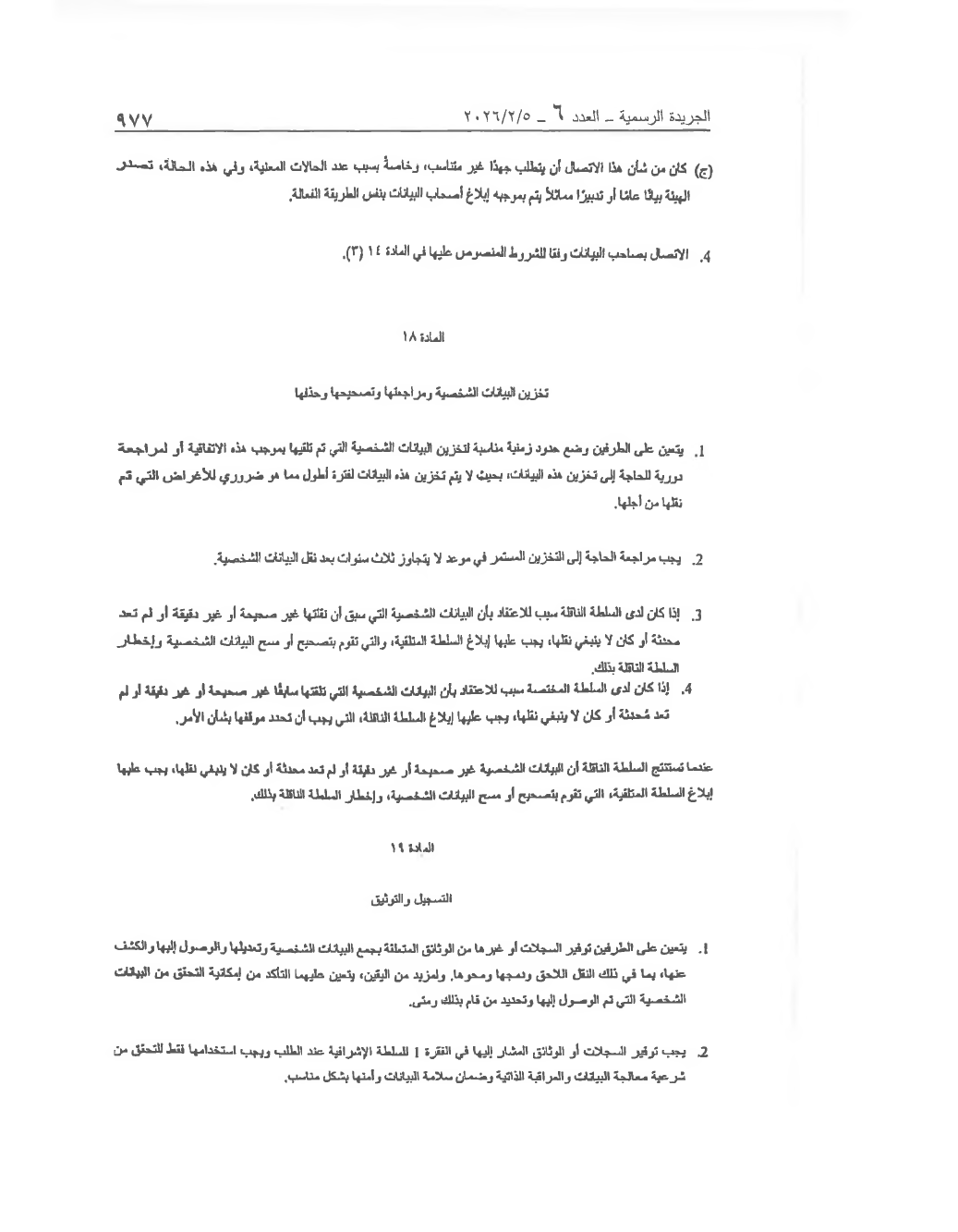
(ج) كان من شأن هذا الاتصال أن يتطلب جهدًا غير متناسب، وخاصةً بسبب عدد الحالات المعنية، وفي هذه الحالة، تصدر الهيئة بيانًا عامًا أو تدبيرًا مماثلاً يتم بموجبه إبلاغ أصحاب البيانات بنفس الطريقة الفعالة.
4. الاتصال بصاحب البيانات وفقا للشروط المنصوص عليها في المادة ١٤ (٣).
المادة ١٨
تخزين البيانات الشخصية ومراجعتها وتصحيحها وحذفها
1. يتعين على الطرفين وضع حدود زمنية مناسبة لتخزين البيانات الشخصية التي تم تلقيها بموجب هذه الاتفاقية أو لمراجعة دورية للحاجة إلى تخزين هذه البيانات، بحيث لا يتم تخزين هذه البيانات لفترة أطول مما هو ضروري للأغراض التي تم نقلها من أجلها.
2. يجب مراجعة الحاجة إلى التخزين المستمر في موعد لا يتجاوز ثلاث سنوات بعد نقل البيانات الشخصية.
3. إذا كان لدى السلطة الناقلة سبب للاعتقاد بأن البيانات الشخصية التي سبق أن نقلتها غير صحيحة أو غير دقيقة أو لم تعد محدثة أو كان لا ينبغي نقلها، يجب عليها إبلاغ السلطة المتلقية، والتي تقوم بتصحيح أو مسح البيانات الشخصية وإخطار السلطة الناقلة بذلك.
4. إذا كان لدى السلطة المختصة سبب للاعتقاد بأن البيانات الشخصية التي تلقتها سابقا غير صحيحة أو غير دقيقة أو لم تعد محدثة أو كان لا ينبغي نقلها، يجب عليها إبلاغ السلطة الناقلة، التي يجب أن تحدد موقفها بشأن الأمر.
عندما تستنتج السلطة الناقلة أن البيانات الشخصية غير صحيحة أو غير دقيقة أو لم تعد محدثة أو كان لا ينبغي نقلها، يجب عليها إبلاغ السلطة المتلقية، التي تقوم بتصحيح أو مسح البيانات الشخصية، وإخطار السلطة الناقلة بذلك.
المادة ١٩
التسجيل والتوثيق
1. يتعين على الطرفين توفير السجلات أو غيرها من الوثائق المتعلقة بجمع البيانات الشخصية وتعديلها والوصول إليها والكشف عنها، بما في ذلك النقل اللاحق ودمجها ومحوها. ولمزيد من اليقين، يتعين عليهما التأكد من إمكانية التحقق من البيانات الشخصية التي تم الوصول إليها وتحديد من قام بذلك ومتى.
2. يجب توفير السجلات أو الوثائق المشار إليها في الفقرة 1 للسلطة الإشرافية عند الطلب ويجب استخدامها فقط للتحقق من شرعية معالجة البيانات والمراقبة الذاتية وضمان سلامة البيانات وأمنها بشكل مناسب.
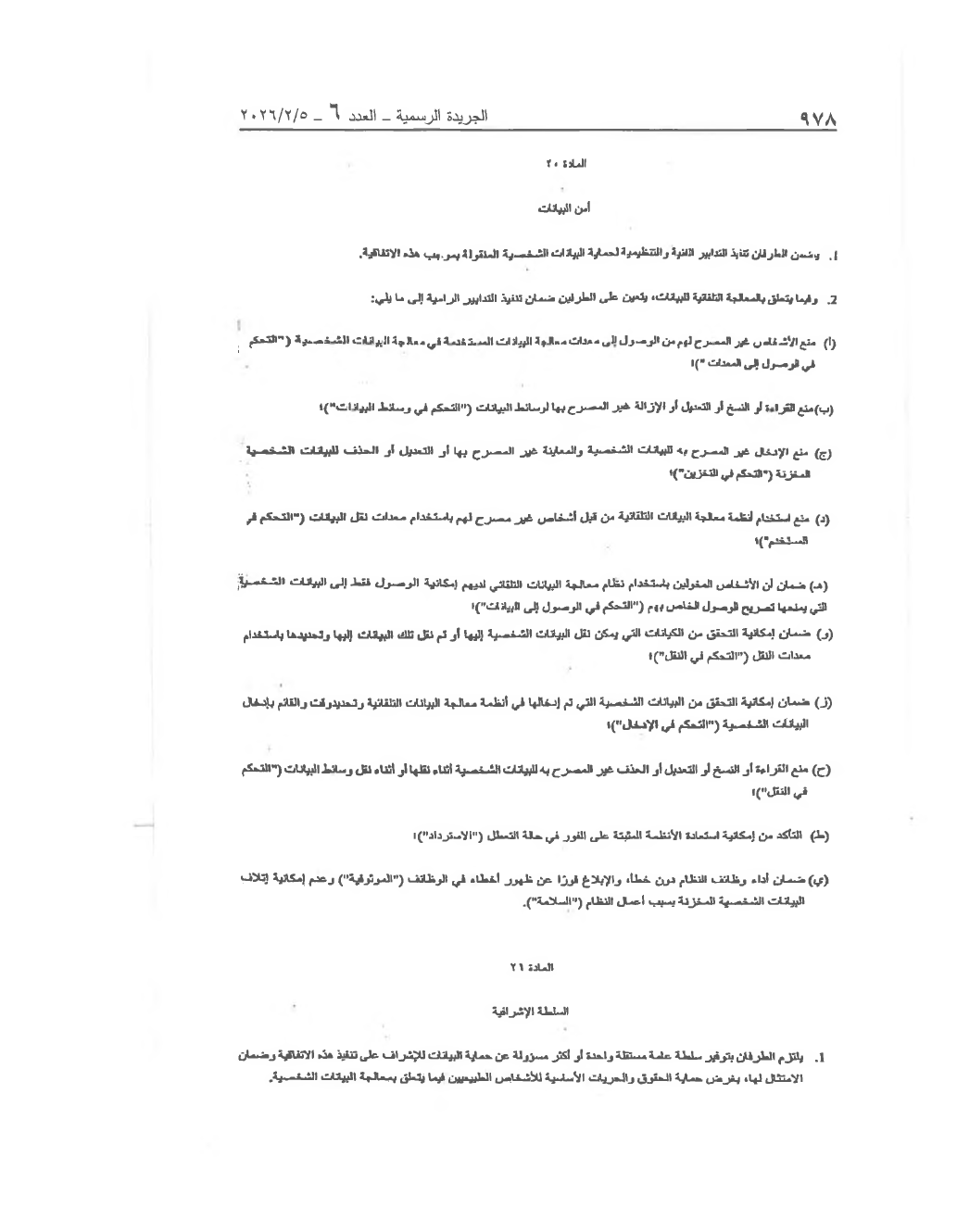
المادة ٢٠
أمن البيانات
1. يضمن الطرفان تنفيذ التدابير الفنية والتنظيمية لحماية البيانات الشخصية المنقولة بموجب هذه الاتفاقية.
2. وفيما يتعلق بالمعالجة التلقائية للبيانات، يتعين على الطرفين ضمان تنفيذ التدابير الرامية إلى ما يلي:
(أ) منع الأشخاص غير المصرح لهم من الوصول إلى معدات معالجة البيانات المستخدمة في معالجة البيانات الشخصية ("التحكم في الوصول إلى المعدات")!
(ب) منع القراءة أو النسخ أو التعديل أو الإزالة غير المصرح بها لوسائط البيانات ("التحكم في وسائط البيانات")!
(ج) منع الإدخال غير المصرح به للبيانات الشخصية والمعاينة غير المصرح بها أو التعديل أو الحذف للبيانات الشخصية المخزنة ("التحكم في التخزين")!
(د) منع استخدام أنظمة معالجة البيانات التلقائية من قبل أشخاص غير مصرح لهم باستخدام معدات نقل البيانات ("التحكم في المستخدم")!
(هـ) ضمان أن الأشخاص المخولين باستخدام نظام معالجة البيانات التلقائي لديهم إمكانية الوصول فقط إلى البيانات الشخصية التي يمنحها تصريح الوصول الخاص بهم ("التحكم في الوصول إلى البيانات")!
(و) ضمان إمكانية التحقق من الكيانات التي يمكن نقل البيانات الشخصية إليها أو تم نقل تلك البيانات إليها وتحديدها باستخدام معدات النقل ("التحكم في النقل")!
(ز) ضمان إمكانية التحقق من البيانات الشخصية التي تم إدخالها في أنظمة معالجة البيانات التلقائية وتحديد وقت والقائم بإدخال البيانات الشخصية ("التحكم في الإدخال")!
(ح) منع القراءة أو النسخ أو التعديل أو الحذف غير المصرح به للبيانات الشخصية أثناء نقلها أو أثناء نقل وسائط البيانات ("التحكم في النقل")!
(ط) التأكد من إمكانية استعادة الأنظمة المثبتة على الفور في حالة التعطل ("الاسترداد")!
(ي) ضمان أداء وظائف النظام دون خطأ، والإبلاغ فورا عن ظهور أخطاء في الوظائف ("الموثوقية") وعدم إمكانية إتلاف البيانات الشخصية المخزنة بسبب أعمال النظام ("السلامة").
المادة ٢١
السلطة الإشرافية
1. يلتزم الطرفان بتوفير سلطة عامة مستقلة واحدة أو أكثر مسؤولة عن حماية البيانات للإشراف على تنفيذ هذه الاتفاقية وضمان الامتثال لها، بغرض حماية الحقوق والحريات الأساسية للأشخاص الطبيعيين فيما يتعلق بمعالجة البيانات الشخصية.
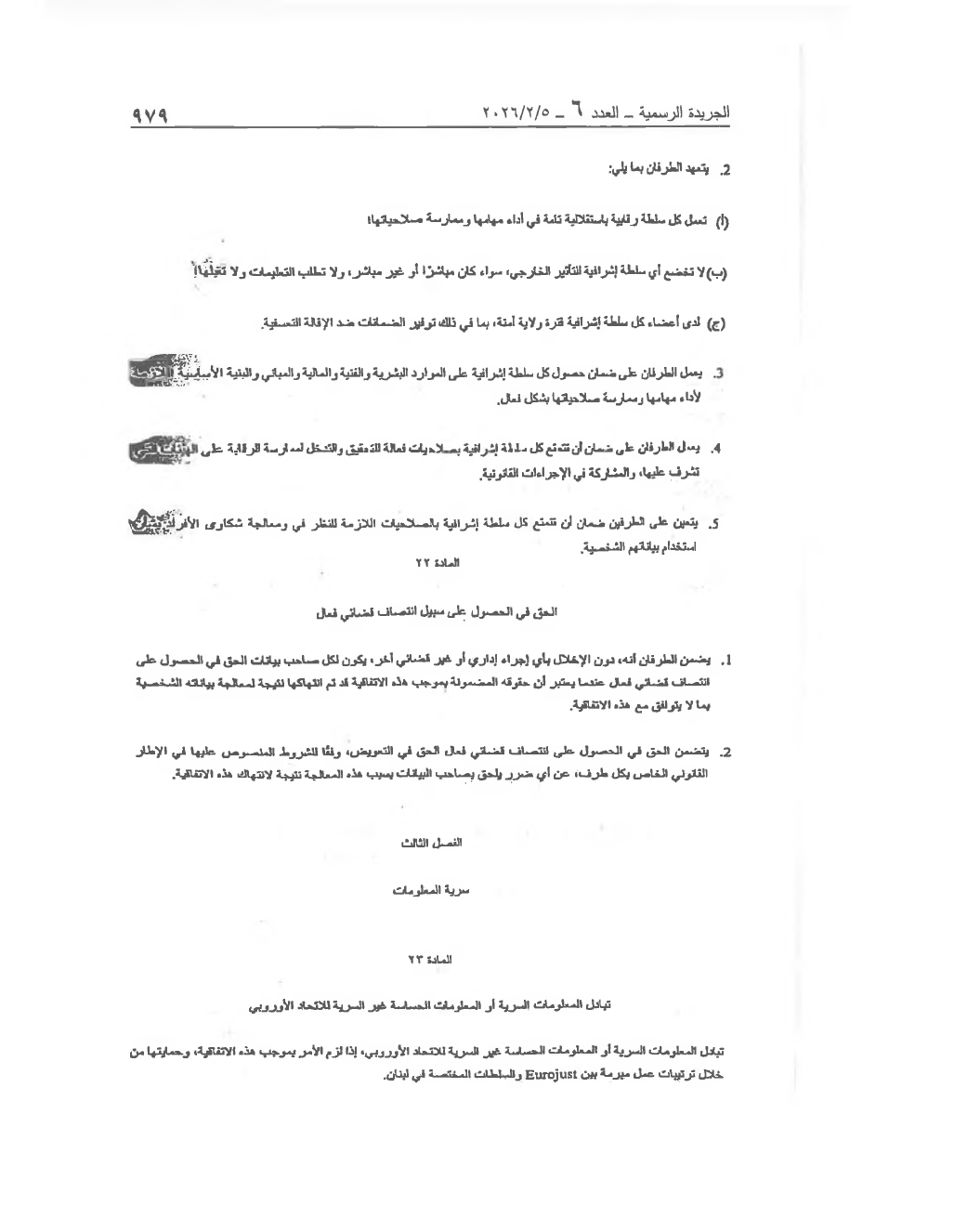
2. يتعهد الطرفان بما يلي:
(أ) تعمل كل سلطة رقابية باستقلالية تامة في أداء مهامها وممارسة صلاحياتها؛
(ب) لا تخضع أي سلطة إشرافية للتأثير الخارجي، سواء كان مباشرا أو غير مباشر، ولا تطلب التعليمات ولا تقبلها؛
(ج) لدى أعضاء كل سلطة إشرافية فترة ولاية آمنة، بما في ذلك توفير الضمانات ضد الإقالة التعسفية.
3. يعمل الطرفان على ضمان حصول كل سلطة إشرافية على الموارد البشرية والفنية والمالية والمباني والبنية الأساسية اللازمة لأداء مهامها وممارسة صلاحياتها بشكل فعال.
4. يعمل الطرفان على ضمان أن تتمتع كل سلطة إشرافية بصلاحيات فعالة للتحقيق والتدخل لممارسة الرقابة على الهيئات التي تشرف عليها، والمشاركة في الإجراءات القانونية.
5. يتعين على الطرفين ضمان أن تتمتع كل سلطة إشرافية بالصلاحيات اللازمة للنظر في ومعالجة شكاوى الأفراد بشأن استخدام بياناتهم الشخصية.
المادة ٢٢
الحق في الحصول على سبيل انتصاف قضائي فعال
1. يضمن الطرفان أنه، دون الإخلال بأي إجراء إداري أو غير قضائي آخر، يكون لكل صاحب بيانات الحق في الحصول على انتصاف قضائي فعال عندما يعتبر أن حقوقه المضمونة بموجب هذه الاتفاقية قد تم انتهاكها نتيجة لمعالجة بياناته الشخصية بما لا يتوافق مع هذه الاتفاقية.
2. يتضمن الحق في الحصول على انتصاف قضائي فعال الحق في التعويض، وفقًا للشروط المنصوص عليها في الإطار القانوني الخاص بكل طرف، عن أي ضرر يلحق بصاحب البيانات بسبب هذه المعالجة نتيجة لانتهاك هذه الاتفاقية.
الفصل الثالث
سرية المعلومات
المادة ٢٣
تبادل المعلومات السرية أو المعلومات الحساسة غير السرية للاتحاد الأوروبي
تبادل المعلومات السرية أو المعلومات الحساسة غير السرية للاتحاد الأوروبي، إذا لزم الأمر بموجب هذه الاتفاقية، وحمايتها من خلال ترتيبات عمل مبرمة بين Eurojust والسلطات المختصة في لبنان.
الفصل الرابع
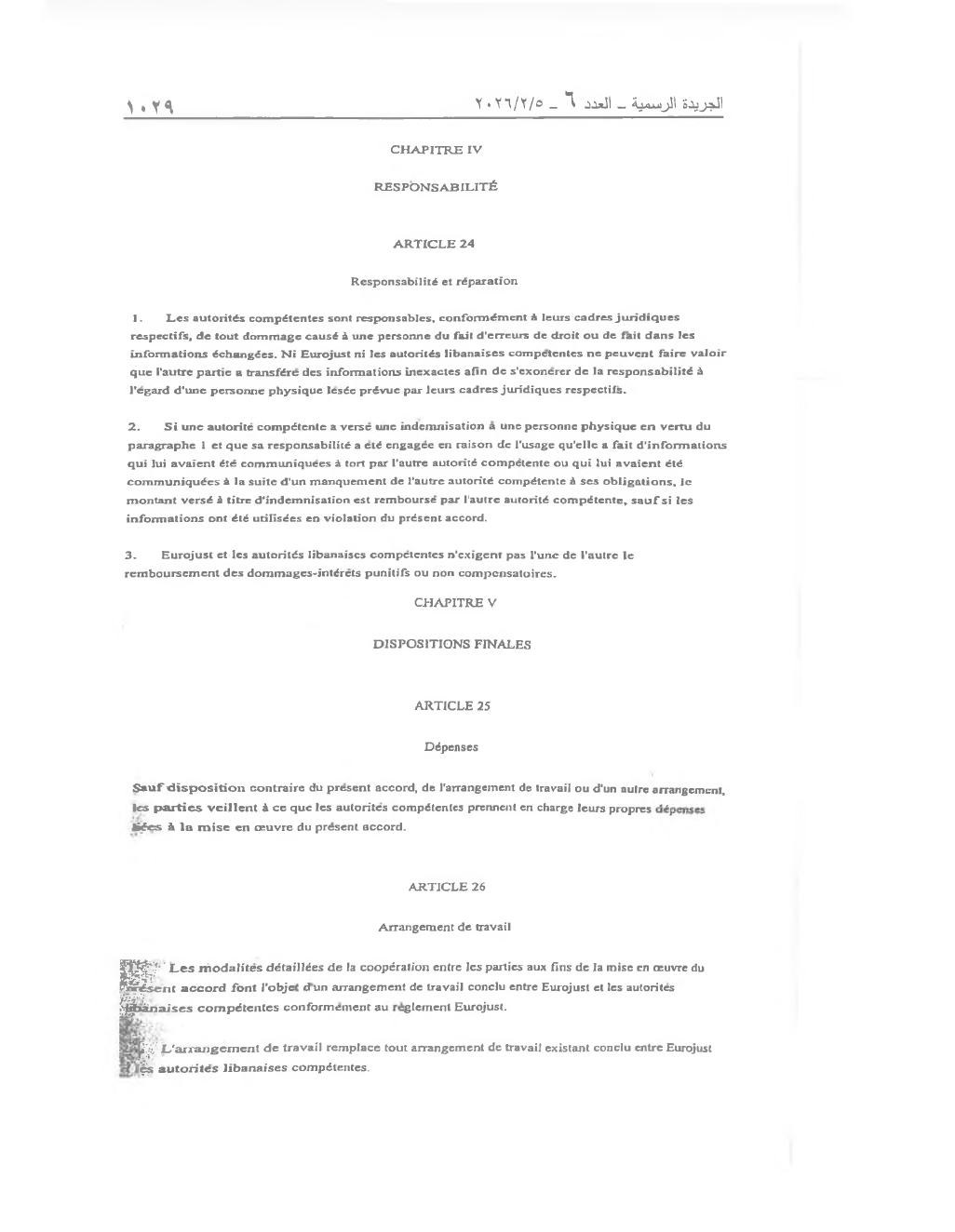
المسؤولية
المادة ٢٤
المسؤولية والتعويض
1. تتحمل الجهة / الجهات المختصة المسؤولية، وفقاً لأطرها القانونية الخاصة، عن أي ضرر يلحق بالفرد نتيجة لأخطاء قانونية أو واقعية في المعلومات المتبادلة. ومن أجل تجنب المسؤولية بموجب الأطر القانونية الخاصة بكل منها تجاه الفرد المتضرر، لا يجوز لأي من Eurojust أو السلطات المختصة في لبنان الادعاء بأن الطرف الآخر قد نقل معلومات غير دقيقة.
2. إذا دفعت سلطة مختصة تعويضاً لفرد بموجب الفقرة 1، وكانت مسؤوليتها ناجمة عن استخدامها معلومات تم إبلاغها بشكل خاطئ من قبل السلطة المختصة الأخرى أو تم إرسالها نتيجة لفشل السلطة المختصة الأخرى في الامتثال لالتزاماتها، فيجب على السلطة المختصة الأخرى سداد المبلغ المدفوع كتعويض، ما لم يتم استخدام المعلومات بشكل ينتهك هذه الاتفاقية.
3. لا يجوز لوكالة Eurojust والسلطات المختصة في لبنان أن تطلب من بعضها البعض سداد تعويضات عن الأضرار العقابية أو غير التعويضية.
الفصل الخامس
الأحكام النهائية
المادة ٢٥
النفقات
يضمن الطرفان أن تتحمل السلطات المختصة نفقاتها التي تنشأ أثناء تنفيذ هذه الاتفاقية، ما لم ينص على خلاف ذلك في هذه الاتفاقية أو في ترتيبات العمل أو في ترتيبات منفصلة.
المادة ٢٦
ترتيب العمل
1. تخضع تفاصيل التعاون بين الطرفين لتنفيذ هذه الاتفاقية لترتيبات العمل المبرمة بين Eurojust والسلطات المختصة في لبنان وفقاً للائحة Eurojust.
2. يحل ترتيب العمل هذا محل أي ترتيب عمل قائم تم إبرامه بين Eurojust والسلطات المختصة في لبنان.
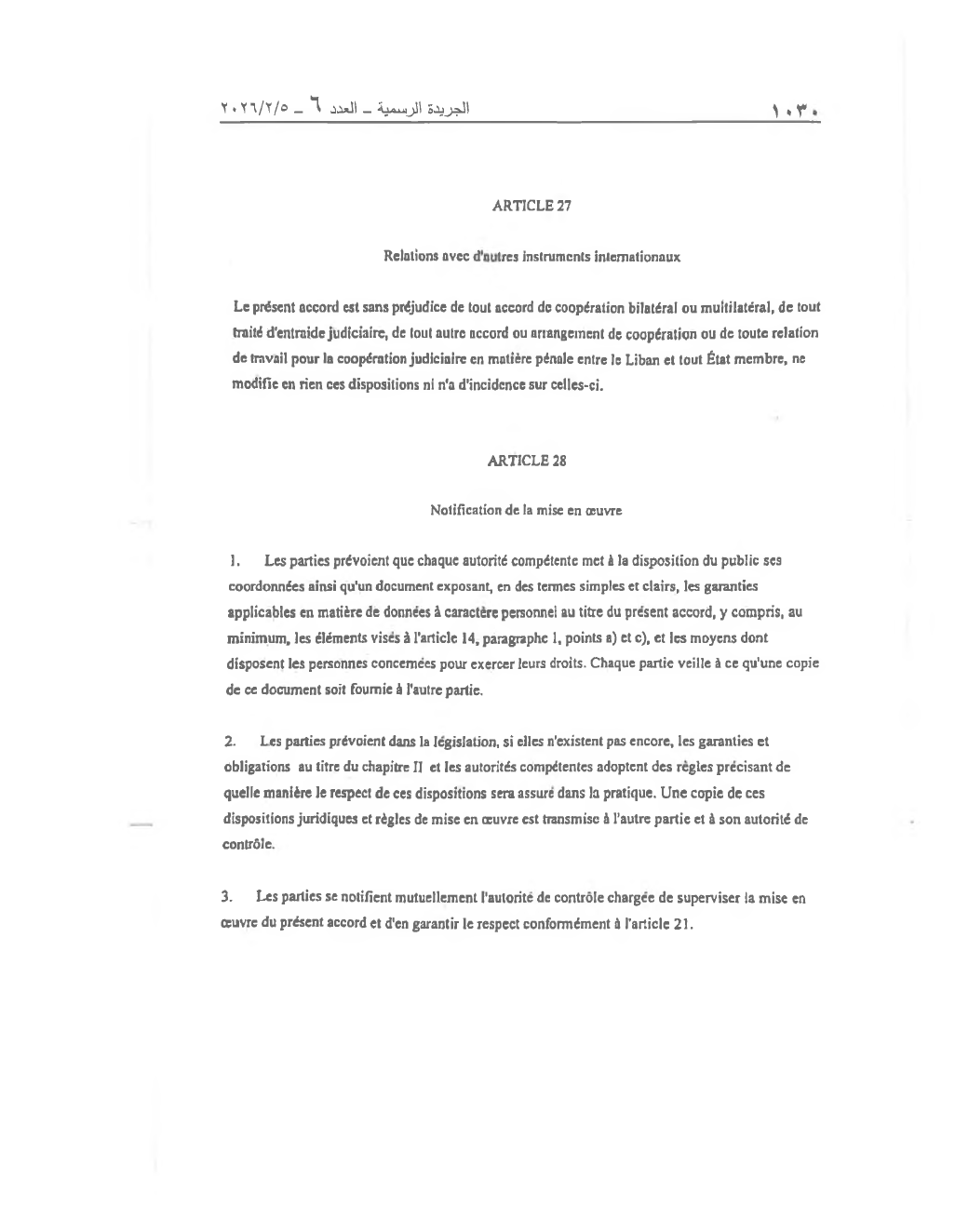
المادة ٢٧
العلاقة بالصكوك الدولية الأخرى
لا يمس هذا الاتفاق بأي اتفاقية ثنائية أو متعددة الأطراف بشأن التعاون أو معاهدة المساعدة القانونية المتبادلة، أو أي اتفاقية أو ترتيب تعاون آخر، أو علاقة تعاون قضائي على مستوى العمل في المسائل الجنائية بين لبنان وأي دولة عضو، ولا يؤثر عليها بأي شكل آخر.
المادة ٢٨
إشعار التنفيذ
1. يلتزم الطرفان بالقيام بما يلزم لكي تقوم كل سلطة مختصة بتوفير تفاصيل الاتصال الخاصة بها للجمهور، فضلاً عن وثيقة تحدد، باستخدام لغة واضحة ومباشرة، المعلومات المتعلقة بالضمانات الخاصة والبيانات / بالبيانات الشخصية المكفولة بموجب هذه الاتفاقية، بما في ذلك المعلومات التي تغطي على الأقل العناصر المشار إليها في المادة ١٤(١)، الفقرتين (أ) و (ج)، والوسائل المتاحة لممارسة حقوق أصحاب البيانات. ويلتزم كل طرف بضمان توفير نسخة من هذه الوثيقة للطرف الآخر.
2. يتعين على الطرفين توفير الضمانات والالتزامات المنصوص عليها في الفصل الثاني بموجب القانون، إذا لم تكن موجودة بالفعل، ويتعين على السلطات المختصة اعتماد قواعد تحدد كيفية إنفاذ الامتثال لهذه الأحكام في الممارسة العملية. ويجب إرسال نسخة من تلك الأحكام القانونية وقواعد التنفيذ إلى الطرف الآخر والسلطة الإشرافية المختصة لديه.
3. يخطر الطرفان بعضهما البعض بالسلطة الإشرافية المسؤولة عن الإشراف على تنفيذ هذه الاتفاقية وضمان الامتثال لها وفقاً للمادة ٢١.
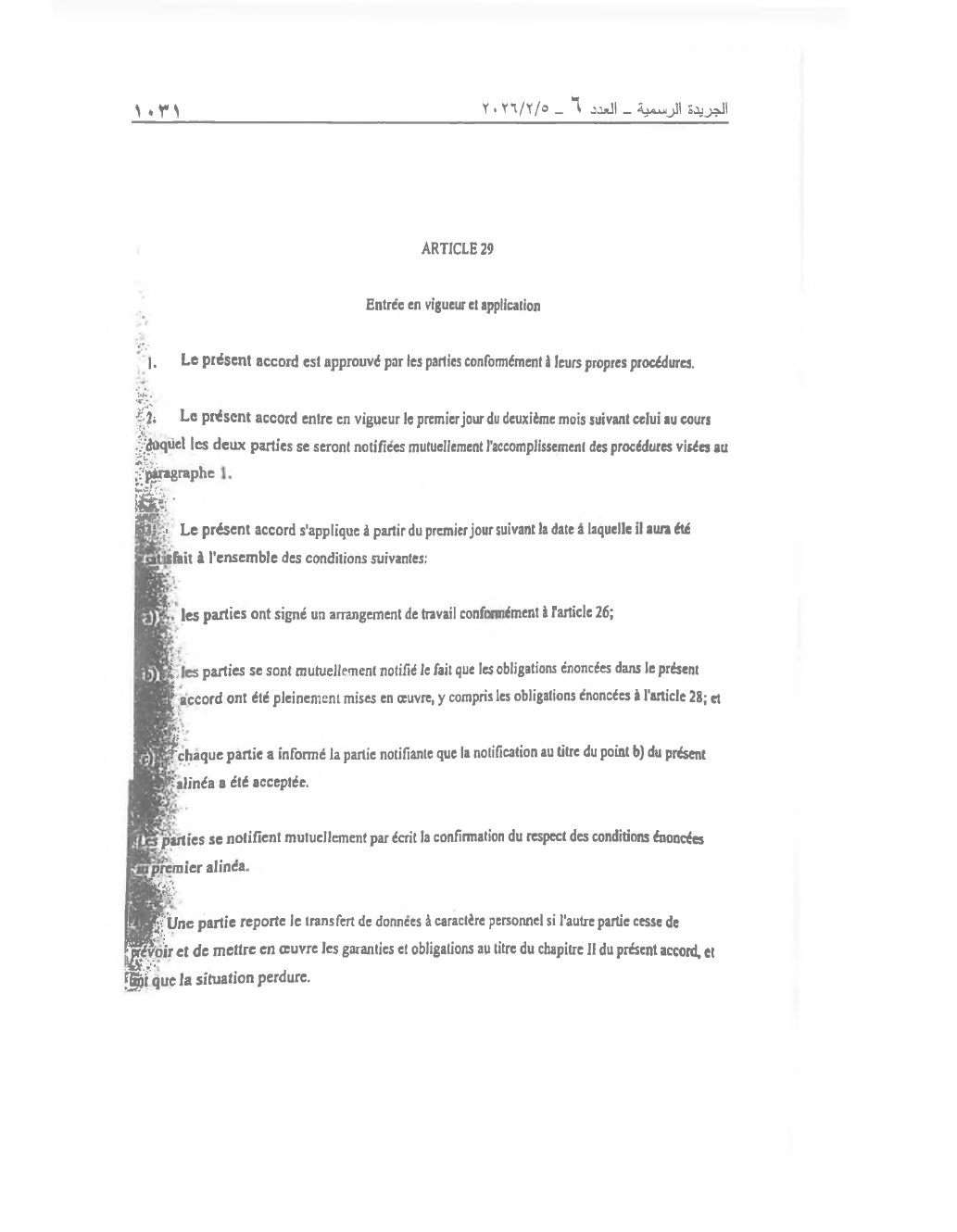
المادة ٢٩
الدخول حيز التنفيذ والتطبيق
1. يجب أن تتم الموافقة على هذه الاتفاقية من قبل الطرفين وفقاً للإجراءات الخاصة لديهما.
2. تدخل هذه الاتفاقية حيز التنفيذ في اليوم الأول من الشهر الثاني التالي للشهر الذي أخطر فيه كل طرف الطرف الآخر باستكمال الإجراءات المنصوص عليها في الفقرة 1.
3. تسري هذه الاتفاقية اعتباراً من اليوم الأول بعد تاريخ استيفاء جميع الشروط التالية:
(أ) توقيع الطرفين على ترتيب العمل المشار إليه في المادة ٢٦؛
(ب) ويخطر الطرفان بعضهما البعض بأن الالتزامات المنصوص عليها في هذه الاتفاقية قد تم تنفيذها بالكامل، بما في ذلك تلك المنصوص عليها في المادة ٢٨؛
(ج) وإبلاغ كل طرف الطرف المخطر بأن الإشعار وفقاً للنقطة (ب) من هذه الفقرة الفرعية قد تم قبوله.
يخطر الطرفان بعضهما البعض كتابياً بتأكيد استيفاء الشروط المنصوص عليها في الفقرة الفرعية الأولى.
4. يجوز لأحد الطرفين تأجيل نقل البيانات الشخصية في حالة توقف الطرف الآخر عن توفير وتنفيذ الضمانات والالتزامات المنصوص عليها في الفصل الثاني من هذه الاتفاقية، وذلك طالما استمر هذا الوضع.
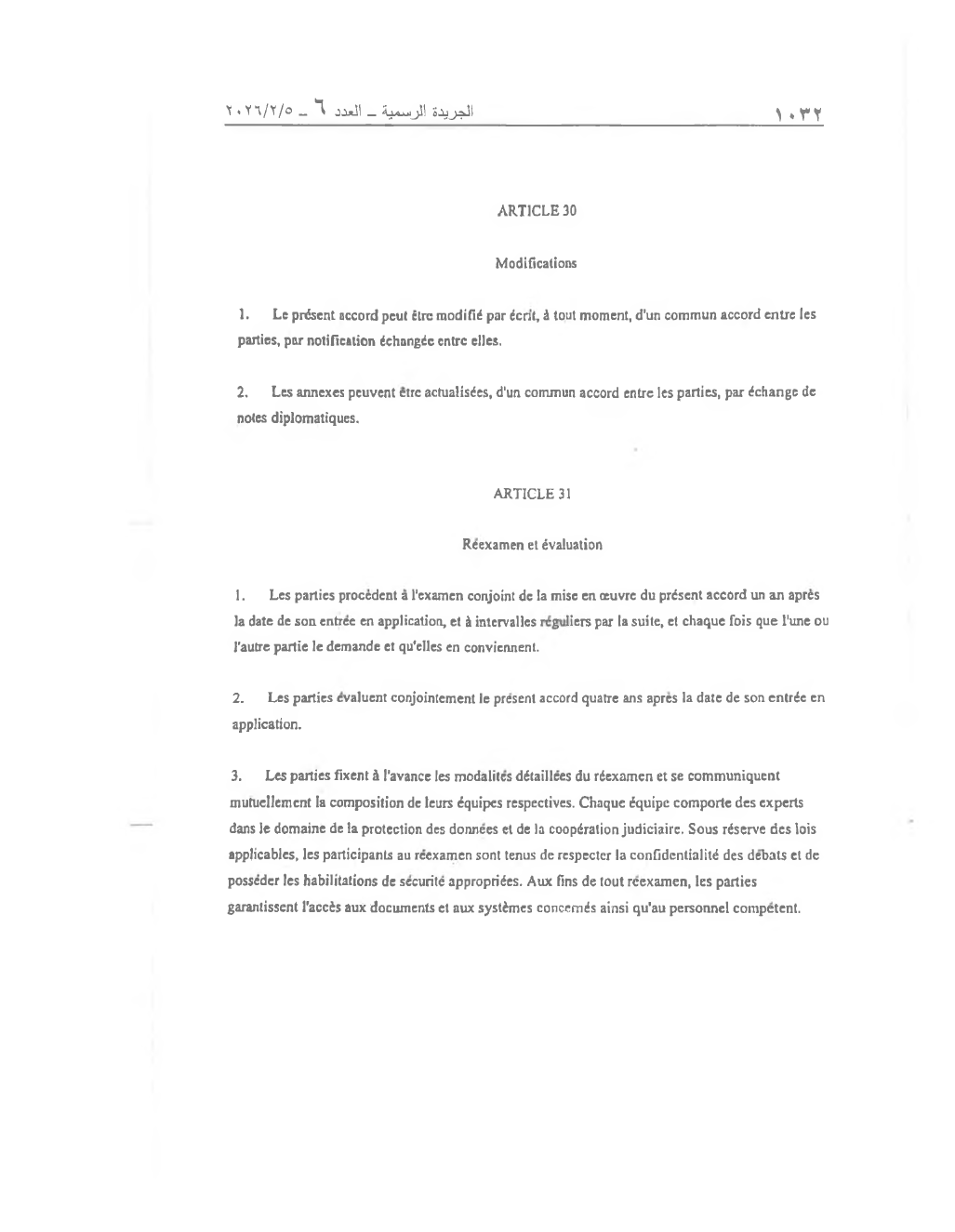
المادة ٣٠
التعديلات
1. يجوز تعديل هذه الاتفاقية كتابياً في أي وقت، بموافقة متبادلة بين الطرفين عن طريق إشعار متبادل بينهما.
2. يجوز الاتفاق بين الطرفين على تحديثات الملاحق، من خلال تبادل المذكرات الدبلوماسية.
المادة ٣١
المراجعة والتقييم
1. يقوم الطرفان بمراجعة تنفيذ هذه الاتفاقية بشكل مشترك بعد مرور عام واحد على تاريخ دخولها حيز التنفيذ، وعبر فترات منتظمة بعد ذلك، وكلما طلب أي من الطرفين ذلك وبموافقة الطرفين.
2. يقوم الطرفان بتقييم هذه الاتفاقية بشكل مشترك بعد مرور أربع سنوات على تاريخ دخولها حيز التنفيذ.
3. يقرر الطرفان مسبقاً تفاصيل المراجعة ويتبادلان المعلومات بشأن تشكيل فرقهما المعنية. ويجب / يجب أن يضم كل فريق خبراء مختصين في مجال حماية البيانات والتعاون القضائي بموجب القوانين المعمول بها، ويتعين على جميع المشاركين في المراجعة احترام سرية المناقشات والحصول على التصاريح الأمنية المناسبة. لأغراض أي مراجعة، يتعين على الطرفين ضمان الوصول إلى الوثائق والأنظمة والموظفين ذوي الصلة.
المادة ٣٢
تسوية النزاعات والتعليق
1. إذا نشأ نزاع فيما يتصل بتفسير أو تطبيق أو تنفيذ هذه الاتفاقية، وأي مسائل تتعلق بها، يتعين على ممثلي الطرفين الدخول في مشاورات ومفاوضات بهدف التوصل إلى حل مقبول للطرفين.
2. وبغض النظر عن الفقرة 1، يحق لأي طرف تعليق نقل البيانات الشخصية إلى الطرف الآخر إذا كان لديه أدلة جوهرية على أن الطرف الآخر يرتكب انتهاكاً منهجياً أو مادياً لشروط هذه الاتفاقية أو في حالة وجود خرق مادي وشيك. ويجب على الطرف الذي يقوم بالتعليق إبلاغ الطرف الآخر بذلك على الفور.
3. بغض النظر عن الفقرتين 1 و2، في حالة حدوث خرق مادي أو عدم الوفاء بالالتزامات بموجب هذه الاتفاقية أو إذا كان هناك مؤشر على أن مثل هذا الخرق المادي أو عدم الوفاء بالالتزامات من المرجح أن يحدث في المستقبل القريب، يجوز لأي من الطرفين تعليق تطبيق هذه الاتفاقية كلياً أو جزئياً عن طريق إشعار كتابي يتم إرساله للطرف الآخر.
ولا يجوز تقديم مثل هذا الإشعار الكتابي إلا بعد أن يكون الطرفان قد انخرطا في مشاورات خلال فترة زمنية معقولة دون التوصل إلى حل. ويدخل التعليق حيز التنفيذ بعد مرور 20 يوماً من تاريخ استلام هذا الإشعار. ويجوز رفع هذا التعليق من قبل الطرف الذي يقوم بالتعليق بموجب إشعار كتابي يتم إرساله إلى الطرف الآخر. ويتم رفع التعليق فوراً عند استلام هذا الإشعار.
4. بغض النظر عن أي تعليق بموجب الفقرة 2 أو 3، فإن المعلومات التي تندرج ضمن نطاق هذه الاتفاقية والتي تم نقلها قبل تعليقها ستستمر في الخضوع للمعالجة وفقاً لهذه الاتفاقية.
المادة ٢٣ / ٣٣
إنهاء الاتفاقية
1. يجوز لأي طرف إخطار الطرف الآخر كتابيًا بنيته إنهاء هذه الاتفاقية. ويصبح الإنهاء ساري المفعول بعد مرور ثلاثة أشهر من تاريخ استلام الإشعار.
2. تستمر معالجة المعلومات التي تندرج ضمن نطاق هذه الاتفاقية والتي تم نقلها قبل انتهاء سريان الاتفاقية وفقًا لهذه الاتفاقية كما لو كانت ، سارية المفعول في تاريخ انتهاء سريانها.
3. في حالة إنهاء الاتفاقية، يتفق الطرفان على الاستمرار في استخدام وتخزين المعلومات التي تم تبادلها بينهما بالفعل. إذا لم يتم التوصل إلى اتفاق، يحق لأي طرف أن يطلب إتلاف المعلومات التي أرسلها أو إعادتها إليه.
المادة ٢٤ / ٣٤
الإشعارات
1. يجب إرسال الإشعارات المقدمة وفقًا لهذه الاتفاقية:
(أ) بالنسبة للبنان، إلى وزارة العدل اللبنانية.
(ب) بالنسبة للاتحاد، إلى المفوضية الأوروبية.
2. يجوز تحديث المعلومات المتعلقة بمتلقي الإشعارات المشار إليها في الفقرة 1 من خلال القنوات الدبلوماسية.
المادة ٢٥ / ٣٥
النصوص الأصلية
تمت صياغة هذه الاتفاقية من نسختين باللغات البلغارية والتشيكية والكرواتية والدنماركية والهولندية والإنجليزية والإستونية والفنلندية والفرنسية والألمانية واليونانية والمجرية والإيرلندية والإيطالية واللاتفية والليتوانية والمالطية والبولندية والبرتغالية والرومانية والسلوفاكية والسلوفينية والإسبانية والسويدية والعربية، وكل النصوص متساوية في الأصالة. وفي حالة الاختلاف، فإن النص الإنجليزي هو النص الذي يسود.
وإثباتًا لذلك، قام المفوضون الموقعون أدناه، والمخولون حسب الأصول لهذا الغرض، بالتوقيع على هذه الاتفاقية.
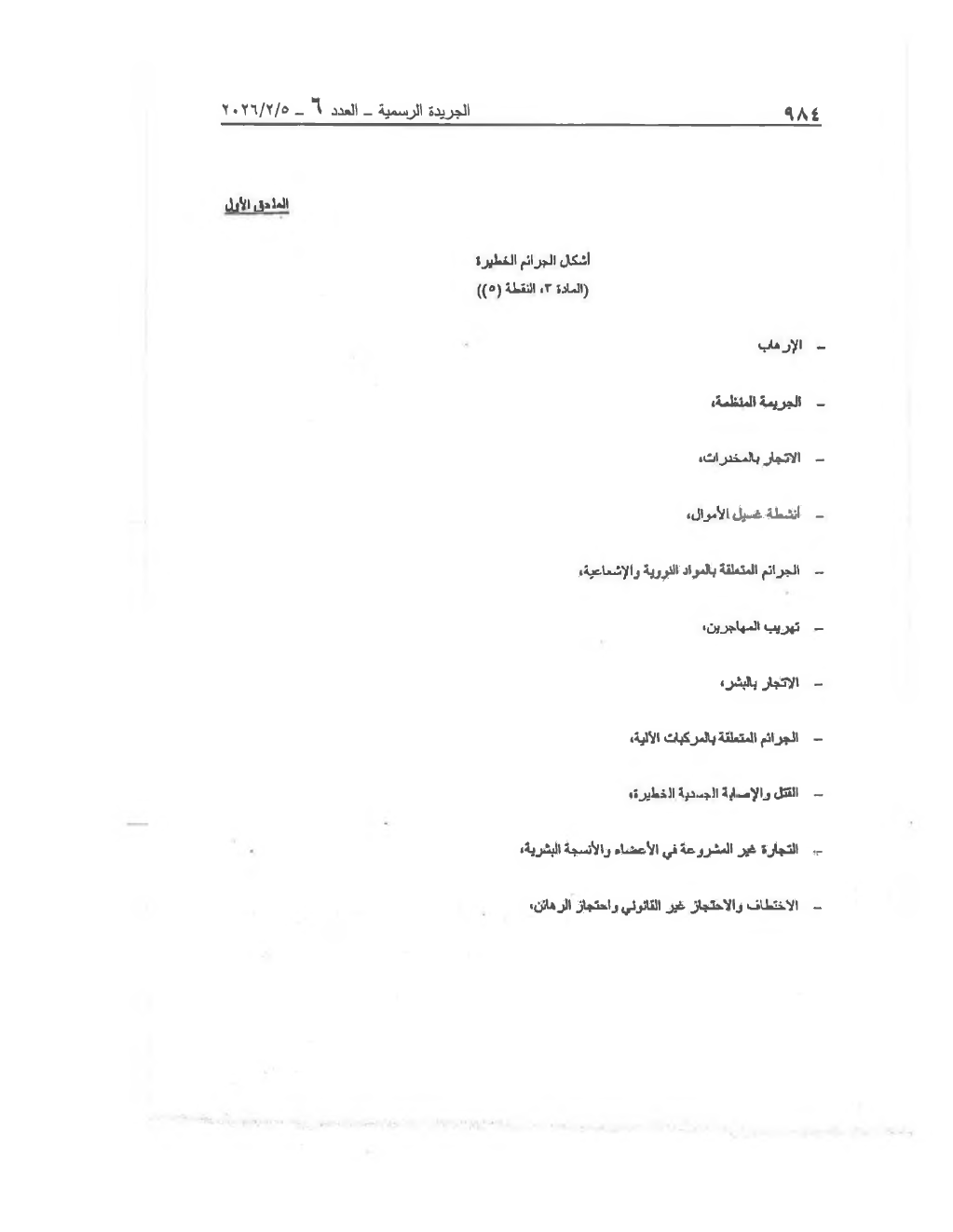
أشكال الجرائم الخطيرة
(المادة ٣، النقطة (٥))
- الإرهاب
- الجريمة المنظمة،
- الاتجار بالمخدرات،
- أنشطة غسيل الأموال،
- الجرائم المتعلقة بالمواد النووية والإشعاعية،
- تهريب المهاجرين،
- الاتجار بالبشر،
- الجرائم المتعلقة بالمركبات الآلية،
- القتل والإصابة الجسدية الخطيرة،
- التجارة غير المشروعة في الأعضاء والأنسجة البشرية،
- الاختطاف والاحتجاز غير القانوني واحتجاز الرهائن،
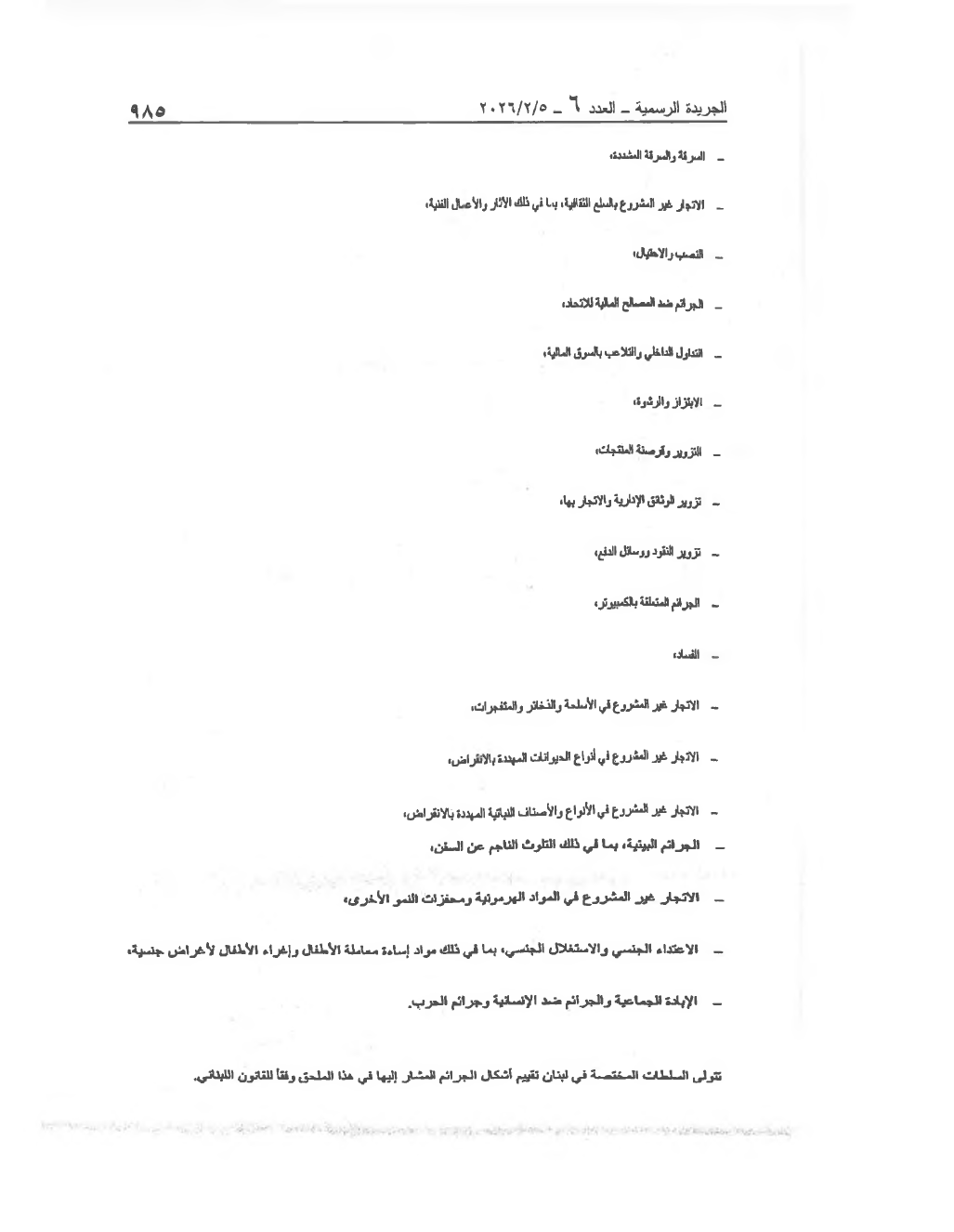
- السرقة والسرقة المشددة،
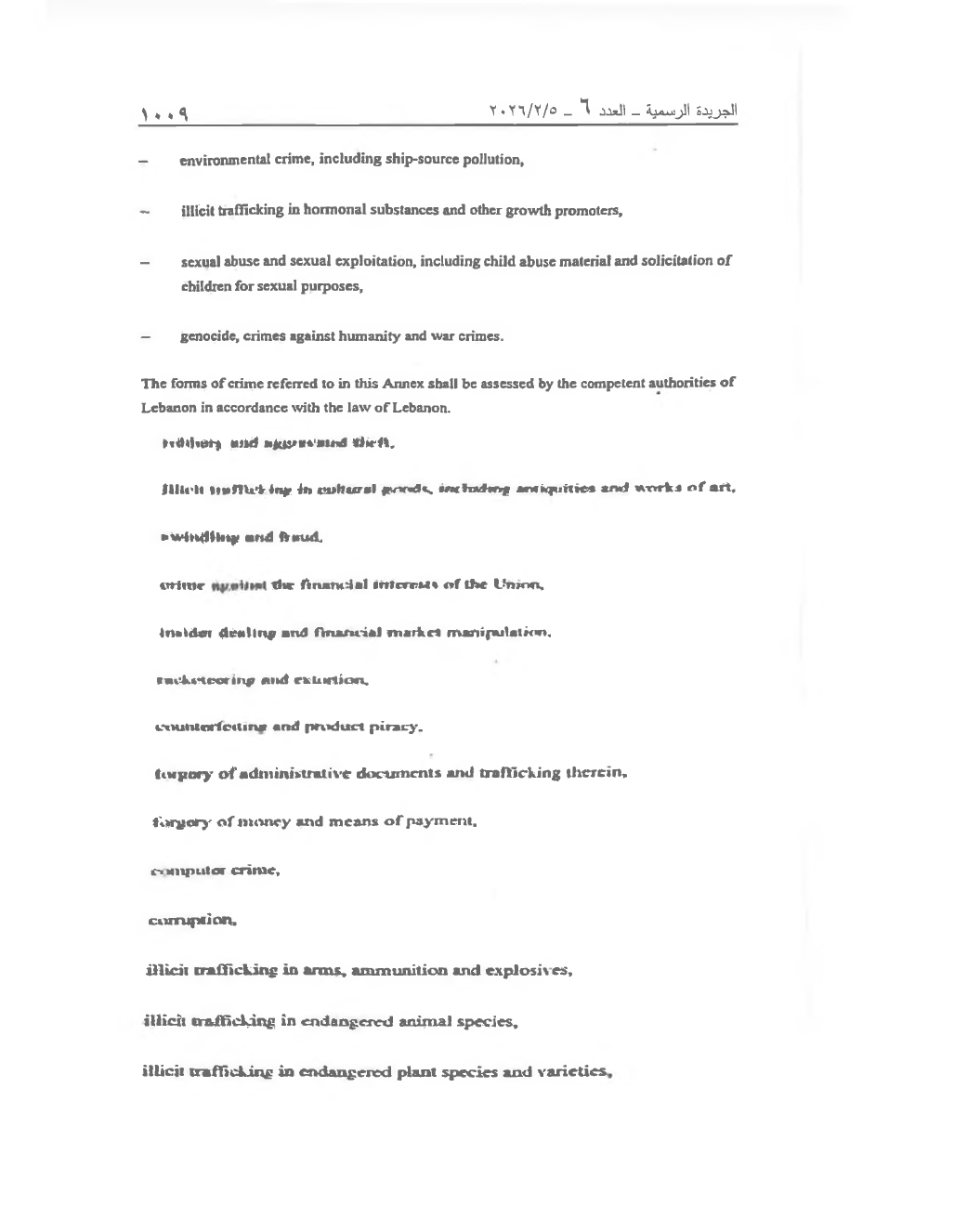
- الاتجار غير المشروع بالسلع الثقافية، بما في ذلك الآثار والأعمال الفنية،
- النصب والاحتيال،
- الجرائم ضد المصالح المالية للاتحاد،
- التداول الداخلي والتلاعب بالسوق المالية،
- الابتزاز والرشوة،
- التزوير وقرصنة المنتجات،
- تزوير الوثائق الإدارية والاتجار بها،
- تزوير النقود ووسائل الدفع،
- الجرائم المتعلقة بالكمبيوتر،
- الفساد،
- الاتجار غير المشروع في الأسلحة والذخائر والمتفجرات،
- الاتجار غير المشروع في أنواع الحيوانات المهددة بالانقراض،
- الاتجار غير المشروع في الأنواع والأصناف النباتية المهددة بالانقراض،
- الجرائم البيئية، بما في ذلك التلوث الناجم عن السفن،
- الاتجار غير المشروع في المواد الهرمونية ومحفزات النمو الأخرى،
- الاعتداء الجنسي والاستغلال الجنسي، بما في ذلك مواد إساءة معاملة ا
- الإبادة الجماعية والجرائم ضد الإنسانية وجرائم الحرب.
تتولى السلطات المختصة في لبنان تقييم أشكال الجرائم المشار إليها في هذا
لأطفال وإغراء الأطفال لأغراض جنسية،
الملحق وفقاً للقانون اللبناني.
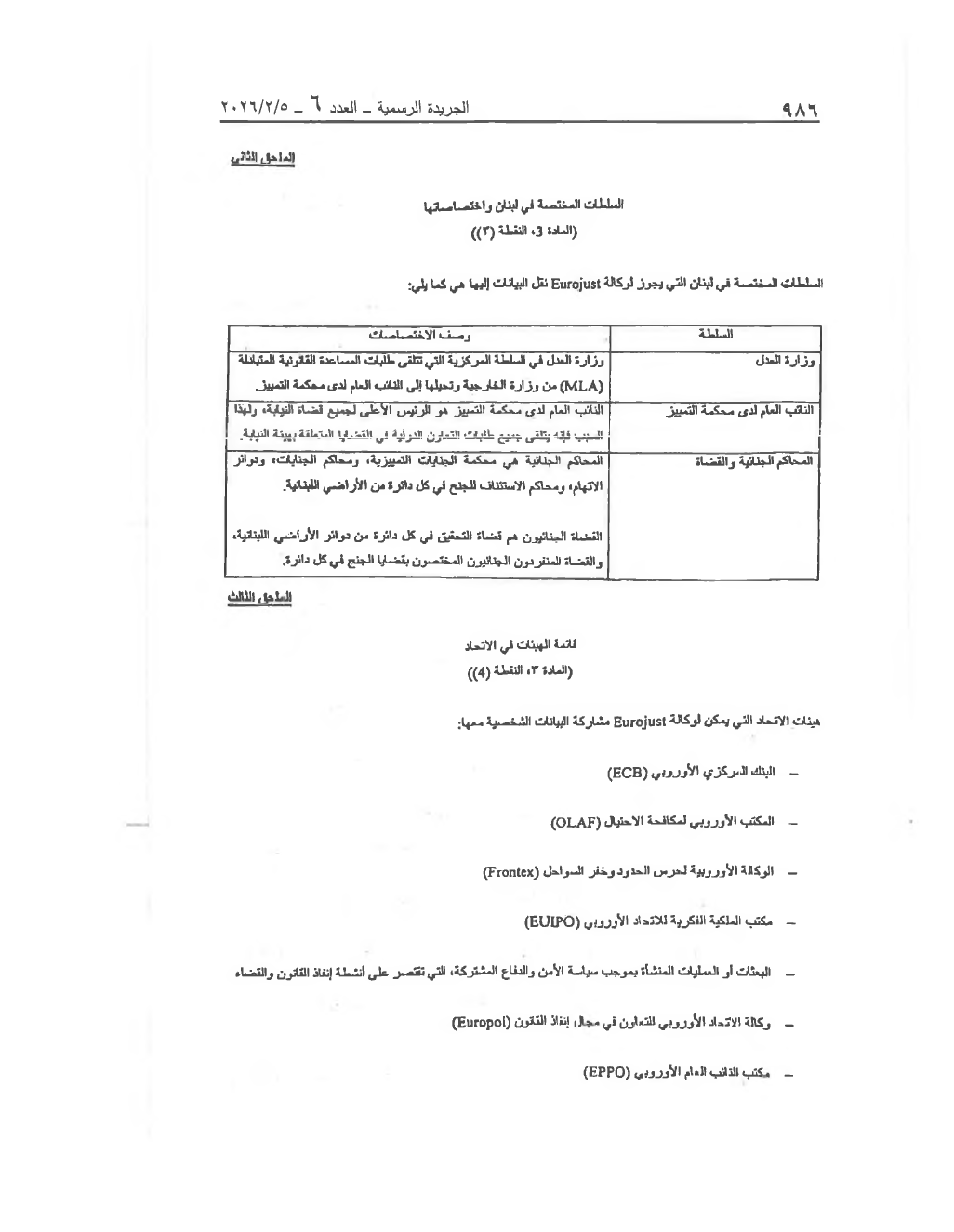
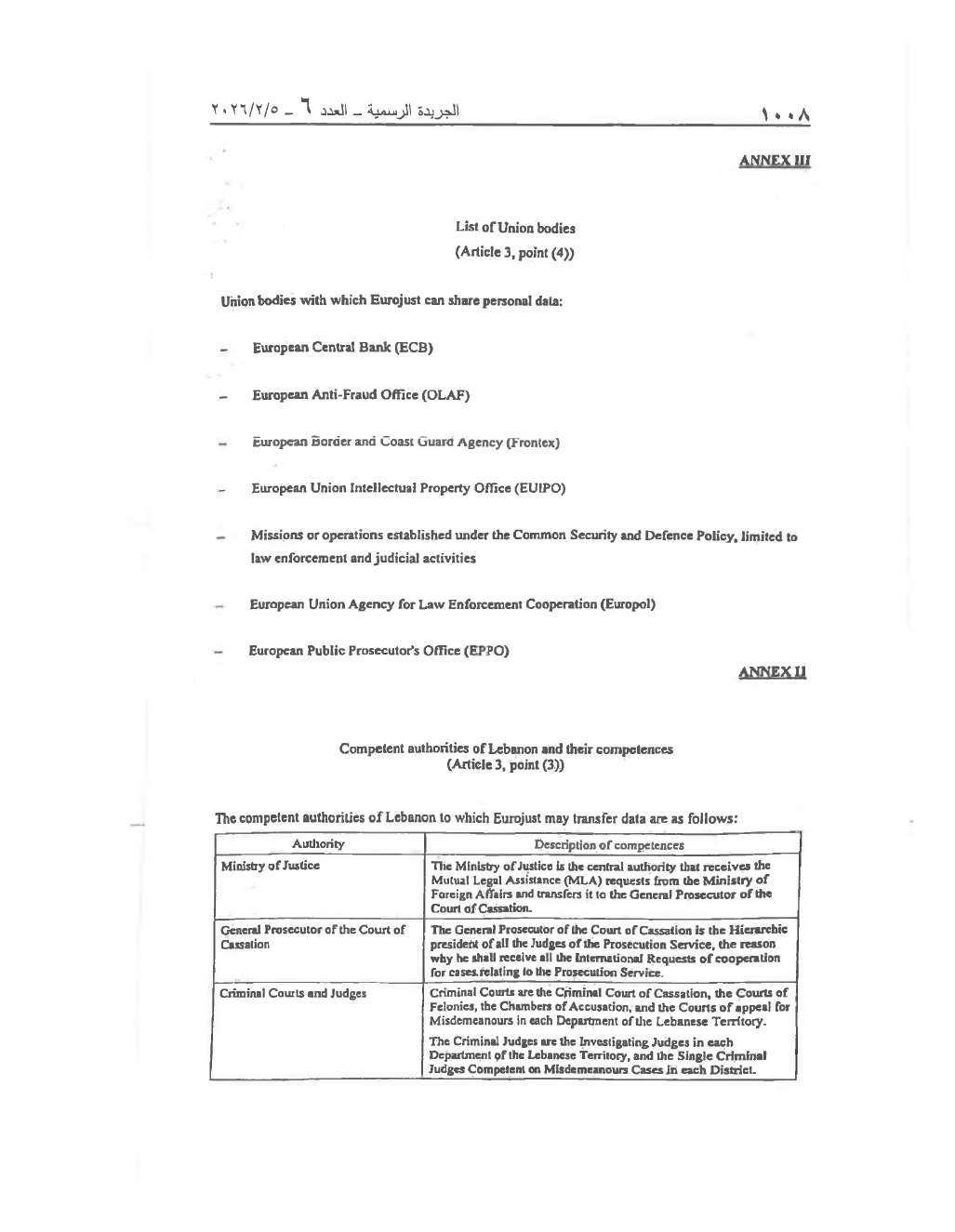
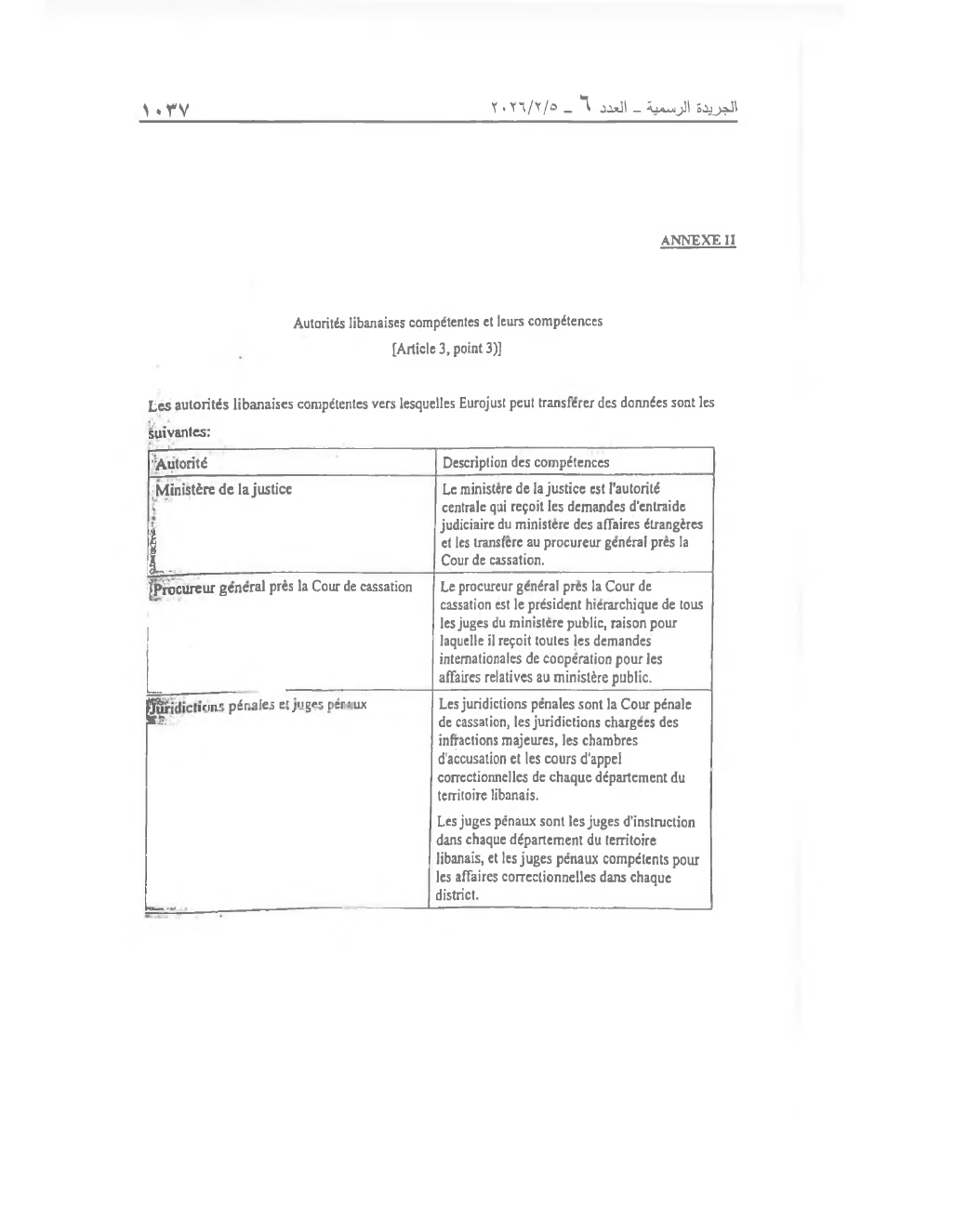
الملحق الثاني
السلطات المختصة في لبنان واختصاصاتها
(المادة 3، النقطة (3))
السلطات المختصة في لبنان التي يجوز لوكالة Eurojust نقل البيانات إليها هي كما يلي:
السلطة | وصف الاختصاصات
وزارة العدل | وزارة العدل هي السلطة المركزية التي تتلقى طلبات المساعدة القانونية المتبادلة (MLA) من وزارة الخارجية وتحيلها إلى النائب العام لدى محكمة التمييز.
النائب العام لدى محكمة التمييز | النائب العام لدى محكمة التمييز هو الرئيس الأعلى لجميع قضاة النيابة، ولهذا السبب فإنه يتلقى جميع طلبات التعاون الدولية في القضايا المتعلقة بهيئة النيابة.
المحاكم الجنائية والقضاة | المحاكم الجنائية هي محكمة الجنايات التمييزية، ومحاكم الجنايات، ودوائر الاتهام، ومحاكم الاستئناف للجنح في كل دائرة من الأراضي اللبنانية. القضاة الجنائيون هم قضاة التحقيق في كل دائرة من دوائر الأراضي اللبنانية، والقضاة المنفردون الجنائيون المختصون بقضايا الجنح في كل دائرة.
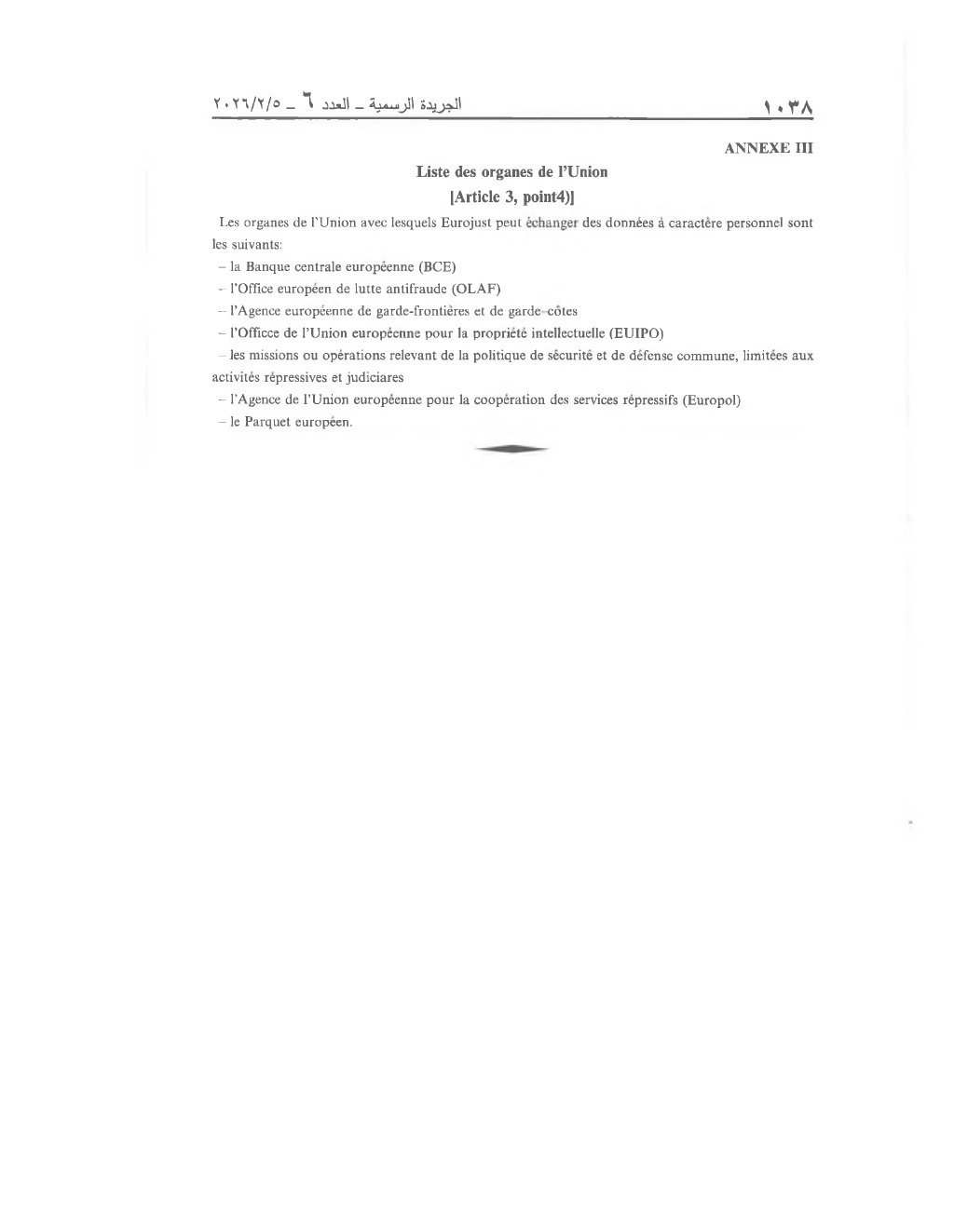
الملحق الثالث
قائمة الهيئات في الاتحاد
(المادة 3، النقطة (4))
هيئات الاتحاد التي يمكن لوكالة Eurojust مشاركة البيانات الشخصية معها:
- البنك المركزي الأوروبي (ECB)
- المكتب الأوروبي لمكافحة الاحتيال (OLAF)
- الوكالة الأوروبية لحرس الحدود وخفر السواحل (Frontex)
- مكتب الملكية الفكرية للاتحاد الأوروبي (EUIPO)
- البعثات أو العمليات المنشأة بموجب سياسة الأمن والدفاع المشتركة، التي تقتصر على أنشطة إنفاذ القانون والقضاء
- وكالة الاتحاد الأوروبي للتعاون في مجال إنفاذ القانون (Europol)
- مكتب النائب العام الأوروبي (EPPO)
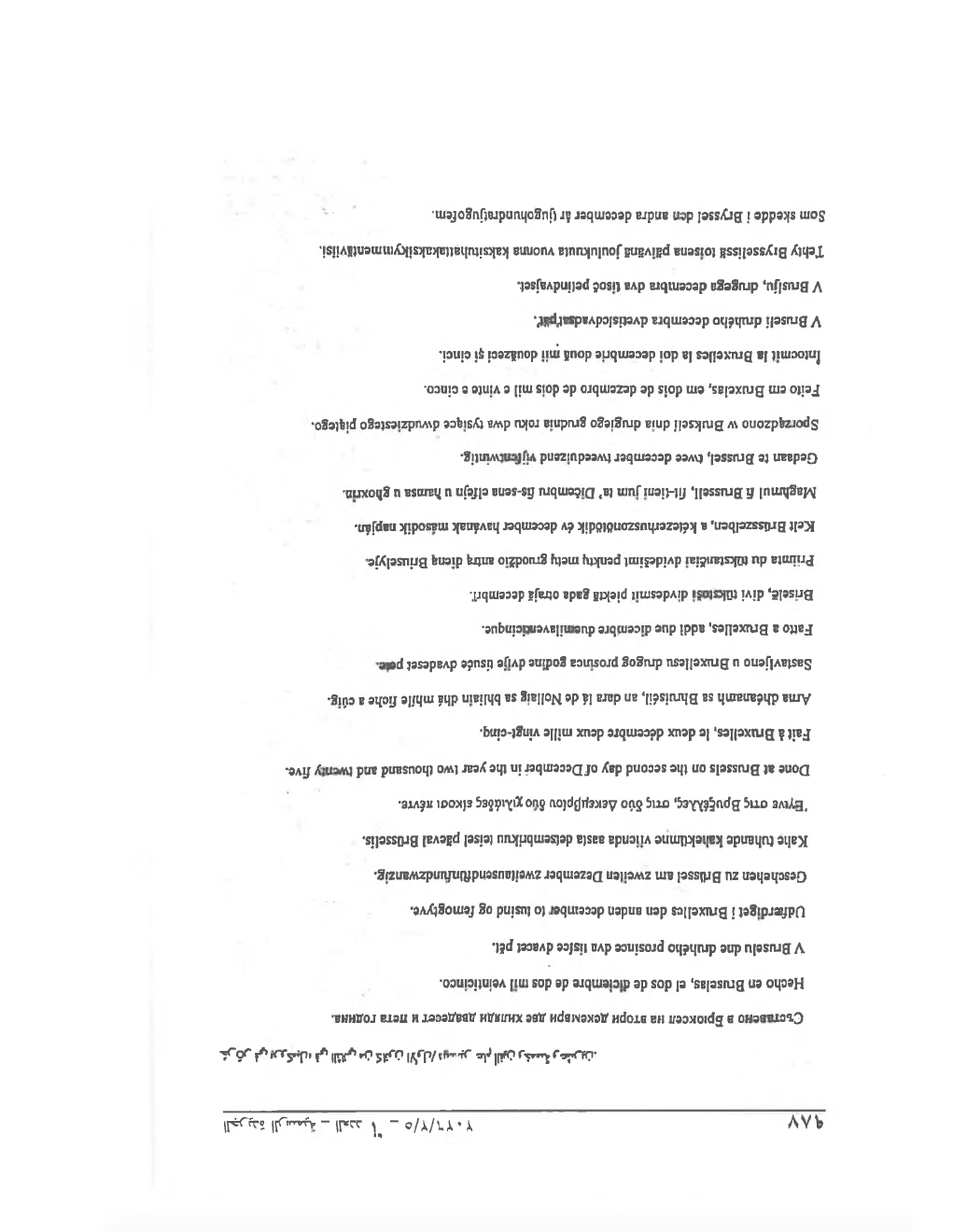
حرر في بروكسل في الثاني من كانون الأول/ديسمبر / الأول/ ديسمبر عام ألفين وخمسة وعشرين.
Съставено в Брюксел на втори декември две хиляди двадесет и пета година.
Hecho en Bruselas, el dos de diciembre de dos mil veinticinco.
V Bruselu dne druhého prosince dva tisíce dvacet pět.
Udfærdiget i Bruxelles den anden december to tusind og femogtyve.
Geschehen zu Brüssel am zweiten Dezember zweitausendundfünfundzwanzig. / zweitausendfünfundzwanzig.
Kahe tuhande kahekümne viienda aasta detsembrikuu teisel päeval Brüsselis.
Έγινε στις Βρυξέλλες, στις δύο Δεκεμβρίου δύο χιλιάδες είκοσι πέντε.
Done at Brussels on the second day of December in the year two thousand and twenty five.
Fait à Bruxelles, le deux décembre deux mille vingt-cinq.
Arna dhéanamh sa Bhruiséil, an dara lá de Nollaig sa bhliain dhá mhíle fiche a cúig.
Sastavljeno u Bruxellesu drugog prosinca … / godine dvije tisuće dvadeset pete.
Fatto a Bruxelles, addì due dicembre duemilaventicinque.
Briselē, divi tūkstoši divdesmit piektā gada otrajā decembrī.
Priimta du tūkstančiai dvidešimt penktų metų gruodžio antrą dieną Briuselyje.
Kelt Brüsszelben, a kétezer-huszonötödik év december havának második napján.
Magħmul fi Brussell, fit-tieni jum ta' Diċembru fis-sena elfejn u ħamsa u għoxrin.
Gedaan te Brussel, twee december tweeduizend vijfentwintig.
Sporządzono w Brukseli dnia drugiego grudnia roku dwa tysiące dwudziestego piątego.
Feito em Bruxelas, em dois de dezembro de dois mil e vinte e cinco.
Întocmit la Bruxelles la doi decembrie două mii douăzeci și cinci.
V Bruseli druhého decembra dvetisícdvadsaťpäť.
V Bruslju, drugega decembra dva tisoč petindvajset.
Tehty Brysselissä toisena päivänä joulukuuta vuonna kaksituhattakaksikymmentäviisi
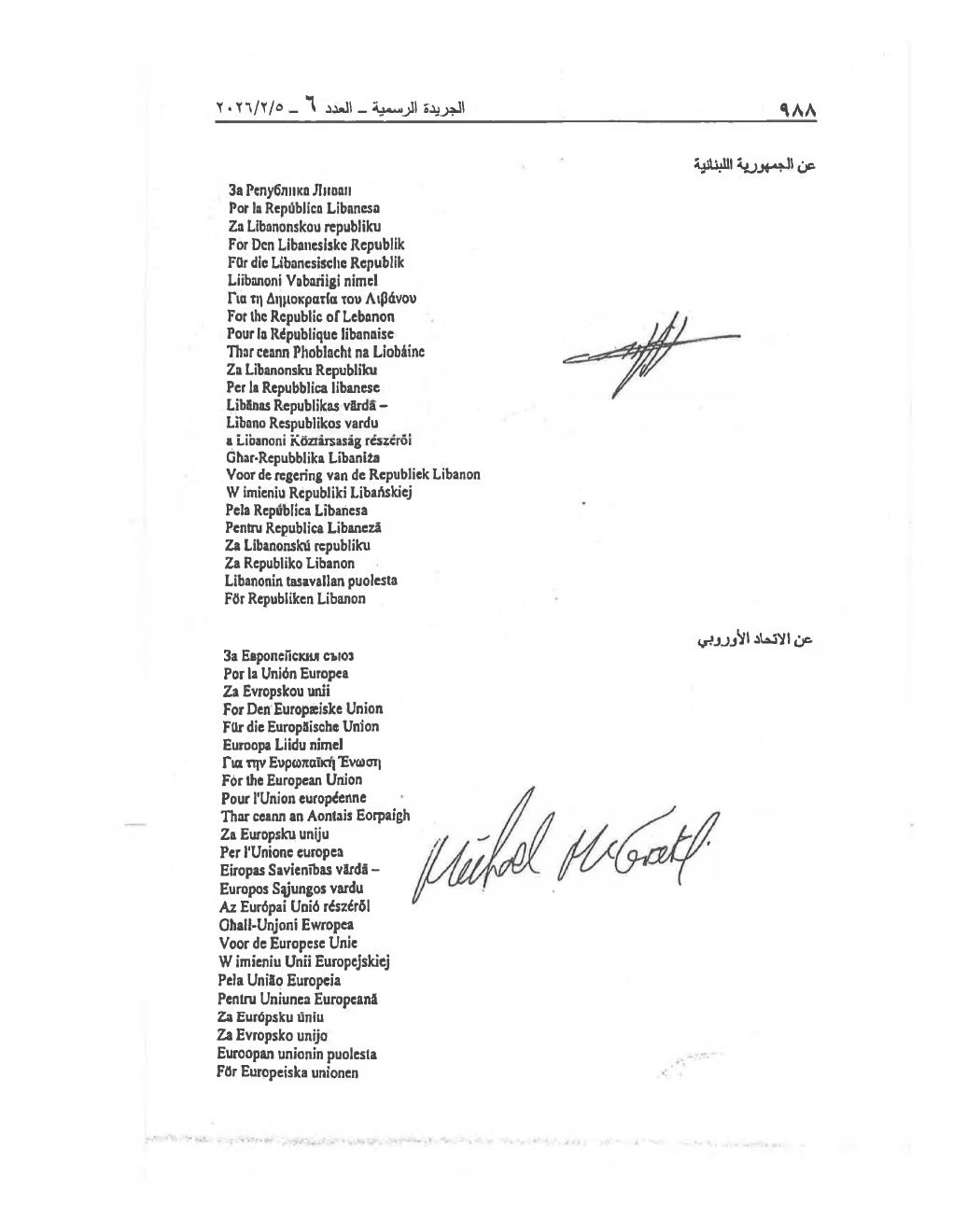
عن الجمهورية اللبنانية
عن الاتحاد الأوروبي
За Република Ливан
Por la República Libanesa
Za Libanonskou republiku
For Den Libanesiske Republik
Für die Libanesische Republik
Liibanoni Vabariigi nimel
Για τη Δημοκρατία του Λιβάνου
For the Republic of Lebanon
Pour la République libanaise
Thar ceann Phoblacht na Liobáine
Za Libanonsku Republiku
Per la Repubblica libanese
Libānas Republikas vārdā –
Libano Respublikos vardu
a Libanoni Köztársaság részéről
Għar-Repubblika Libaniża
Voor de regering van de Republiek Libanon
W imieniu Republiki Libańskiej
Pela República Libanesa
Pentru Republica Libaneză
Za Libanonskú republiku
Za Republiko Libanon
Libanonin tasavallan puolesta
För Republiken Libanon
За Европейския съюз
Por la Unión Europea
Za Evropskou unii
For Den Europæiske Union
Für die Europäische Union
Euroopa Liidu nimel
Για την Ευρωπαϊκή Ένωση
For the European Union
Pour l'Union européenne
Thar ceann an Aontais Eorpaigh
Za Europsku uniju
Per l'Unione europea
Eiropas Savienības vārdā –
Europos Sąjungos vardu
Az Európai Unió részéről
Għall-Unjoni Ewropea
Voor de Europese Unie
W imieniu Unii Europejskiej
Pela União Europeia
Pentru Uniunea Europeană
Za Európsku úniu
Za Evropsko unijo
Euroopan unionin puolesta
För Europeiska unionen
AGREEMENT
BETWEEN THE LEBANESE REPUBLIC AND THE EUROPEAN UNION
ON THE COOPERATION BETWEEN THE EUROPEAN UNION AGENCY FOR CRIMINAL JUSTICE COOPERATION (EUROJUST) AND THE AUTHORITIES OF THE LEBANESE REPUBLIC COMPETENT FOR JUDICIAL COOPERATION IN CRIMINAL MATTERS
THE LEBANESE REPUBLIC, hereinafter referred to as "Lebanon",
and
THE EUROPEAN UNION, hereinafter referred to as "the Union",
hereinafter jointly referred to as "the Parties",
HAVING REGARD to Regulation (EU) 2018/1727 of the European Parliament and of the Council of 14 November 2018 on the European Union Agency for Criminal Justice Cooperation (Eurojust) and replacing and repealing Council Decision 2002/187/JHA¹ ("the Eurojust Regulation"), as applied in accordance with the Treaty on European Union and the Treaty on the Functioning of the European Union, in particular Article 47, Article 52 (1) and Article 56 (2) of the Eurojust Regulation,
HAVING REGARD, in particular, to Article 56 (2), point (c), of the Eurojust Regulation, which sets out the general principles for the transfer of personal data from Eurojust to third countries and international organisations, and pursuant to which Eurojust may transfer personal data to a third country based on an international agreement concluded between the Union and that third country pursuant to Article 218 of the Treaty on the Functioning of the European Union,
1 Regulation (EU) 2018/1727 of the European Parliament and of the Council of 14 November 2018 on the European Union Agency for Criminal Justice Cooperation (Eurojust), and replacing and repealing Council Decision 2002/187/JHA (OJ EU L 295, 21.11.2018, p. 138).
CONSIDERING the interests of both Eurojust and Lebanon in developing a close and dynamic judicial cooperation in criminal matters to address the challenges posed by serious crime, in particular organised crime and terrorism, while ensuring appropriate safeguards with respect to fundamental rights and freedoms of individuals, including privacy and the protection of personal data,
CONVINCED that judicial cooperation between Eurojust and Lebanon will be mutually beneficial and help develop the Union's area of Freedom, Security and Justice, as well as help Lebanon in tackling, in particular, corruption, money laundering and financial crime,
RESPECTING the Council of Europe Convention (ETS No. 5) for the Protection of Human Rights and Fundamental Freedoms done at Rome on 4 November 1950, which is reflected in the Charter of Fundamental Rights of the European Union, and in the Constitution of Lebanon,
HAVE AGREED AS FOLLOWS:
CHAPTER I
OBJECTIVES, SCOPE AND COMMON PROVISIONS
ARTICLE 1
Objectives
1. The overall objective of this Agreement is to enhance judicial cooperation between Eurojust and the competent authorities of Lebanon in combating serious crime.
2. This Agreement allows for the transfer of personal data between Eurojust and the competent authorities of Lebanon, in order to support and strengthen the action by the competent authorities of the Member States of the Union and those of Lebanon, as well as their cooperation in investigating and prosecuting serious crime, in particular organised crime and terrorism, while ensuring appropriate safeguards with respect to fundamental rights and freedoms of individuals, including privacy and the protection of personal data.
ARTICLE 2
Scope
The Parties shall ensure that Eurojust and the competent authorities of Lebanon cooperate in the fields of activities and within the competence and tasks of Eurojust, as set out in the Eurojust Regulation, as applied in accordance with the Treaty on European Union and the Treaty on the Functioning of the European Union, and in this Agreement.
ARTICLE 3
Definitions
For the purpose of this Agreement the following definitions apply:
(1) "Eurojust" means the European Union Agency for Criminal Justice Cooperation, established by the Eurojust Regulation including any subsequent amendments thereto;
(2) "Member States" means the Member States of the Union;
(3) "competent authority" means, for the Union, Eurojust and, for Lebanon a domestic authority with responsibilities under domestic law relating to the investigation and prosecution of criminal offences, including the implementation of judicial cooperation instruments in criminal matters, as listed in Annex II to this Agreement;
(4) "Union bodies" means institutions, bodies, offices and agencies as well as missions or operations established under the Common Security and Defence Policy, set up by, or on the basis of, the Treaty on European Union and the Treaty on the Functioning of the European Union, as listed in Annex III to this Agreement;
(5) "serious crime" means the forms of crime with respect to which Eurojust is competent, in particular those listed in Annex I to this Agreement, including related criminal offences;
(6) "related criminal offences" means the criminal offences committed in order to procure the means of committing serious crimes, in order to facilitate or commit serious crimes or in order to ensure impunity for those committing serious crimes;
(7) "Assistant" means a person who may assist a National Member, as referred to in Chapter II, Section II, of the Eurojust Regulation, and the National Member's Deputy, or the Liaison Prosecutor, as referred to in the Eurojust Regulation and in Article 5 of this Agreement, respectively;
(8) "Liaison Prosecutor" means a person who holds the function of a public prosecutor, a judge or a person with equivalent competence in Lebanon in accordance with its domestic law and is seconded by Lebanon to Eurojust pursuant to Article 5 of this Agreement;
(9) "Liaison Magistrate" means a magistrate as referred to in the Eurojust Regulation, posted by Eurojust to Lebanon pursuant to Article 8 of this Agreement;
(10) "personal data" means any data relating to a data subject;
(11) "processing" means any operation or set of operations which is performed upon personal data or sets of personal data, whether or not by automated means, such as collection, recording, organisation, structuring, storage, adaptation or alteration, retrieval, consultation, use, disclosure by transmission, dissemination or otherwise making available, alignment or combination, restriction, erasure or destruction;
(12) "data subject" means an identified or identifiable natural person; an identifiable natural person is one who can be identified, directly or indirectly, in particular by reference to an identifier such as a name, an identification number, location data or an online identifier or to one or more factors specific to the physical, physiological, genetic, mental, economic, cultural or social identity of that person;
(13) "genetic data" means personal data relating to the genetic characteristics of an individual that have been inherited or acquired, which give unique information about the physiology or the health of that individual, resulting in particular from an analysis of a biological sample from the individual in question;
(14) "biometric data" means personal data resulting from specific technical processing relating to the physical, physiological or behavioural characteristics of a natural person, which allow or confirm the unique identification of that natural person, such as facial images or dactyloscopic data;
(15) "information" means personal and non-personal data;
(16) "personal data breach" means a breach of security leading to the accidental or unlawful destruction, loss, alteration, unauthorised disclosure of, or access to, personal data transmitted, stored or otherwise processed;
(17) "Supervisory authority" means, for the Union, the European Data Protection Supervisor and, for Lebanon, a domestic independent public authority responsible for data protection in accordance with Article 21, and which has been subject to notification pursuant to Article 28(3).
ARTICLE 4
Contact points
1. Lebanon shall designate at least one contact point within its domestic competent authorities to facilitate the communication and cooperation between Eurojust and the competent authorities of Lebanon. Lebanon shall designate that contact point as its contact point also for terrorism matters. The Liaison Prosecutor shall not be a contact point.
2. The contact point for Lebanon shall be notified to the Union. Lebanon shall inform Eurojust in the event that a contact point changes.
ARTICLE 5
Liaison Prosecutor and staff
1. To facilitate the cooperation provided for in this Agreement, Lebanon shall second a Liaison Prosecutor to Eurojust.
2. The Minister of Justice of Lebanon shall appoint the Liaison Prosecutor and his/her Assistants. The mandate and the duration of the secondment of the Liaison Prosecutor shall be determined by Lebanon in agreement with Eurojust.
3. The Liaison Prosecutor may be assisted by one or more Assistants and other support staff, depending on the workload and in agreement with Eurojust. When necessary, the Assistants may replace the Liaison Prosecutor or act on the Liaison Prosecutor's behalf.
4. Lebanon shall ensure that the Liaison Prosecutor and the Liaison Prosecutor's Assistants are competent to act in relation to foreign judicial authorities.
5. The Liaison Prosecutor and the Liaison Prosecutor's Assistants shall have access to the information contained in the domestic criminal records, registers of arrested persons, investigation registers, DNA registers or any other register of public authorities of Lebanon where such information is necessary to fulfil their tasks, in accordance with the domestic law.
6. The Liaison Prosecutor and the Liaison Prosecutor's Assistants shall have the power to contact the competent authorities of Lebanon directly.
7. Lebanon shall inform Eurojust of the exact nature and extent of the judicial powers conferred to the Liaison Prosecutor and the Liaison Prosecutor's Assistants within Lebanon to carry out their tasks in accordance with this Agreement.
8. The details of the tasks of the Liaison Prosecutor and the Liaison Prosecutor's Assistants, their rights and obligations and the costs involved for Eurojust shall be governed by a working arrangement concluded between Eurojust and the competent authorities of Lebanon in accordance with Article 26.
9. The working documents of the Liaison Prosecutor and the Liaison Prosecutor's Assistants shall be held inviolable by Eurojust.
ARTICLE 6
Operational and strategic meetings
1. The Liaison Prosecutor, the Liaison Prosecutor's Assistants, and other representatives of competent authorities of Lebanon, including the contact points referred to in Article 4, may participate in meetings with regard to strategic matters upon the invitation of the President of Eurojust, and in meetings with regard to operational matters with the approval of the National Members concerned.
2. National Members, their Deputies and Assistants, the Administrative Director of Eurojust and Eurojust staff may attend meetings organised by the Liaison Prosecutor, the Liaison Prosecutor's Assistants, or other representatives of competent authorities of Lebanon, including the contact points referred to in Article 4.
ARTICLE 7
Joint Investigation Teams
1. Eurojust may assist Lebanon to establish joint investigation teams (JITs) with the national authorities of a Member State pursuant to the legal basis applicable between them, enabling judicial cooperation in criminal matters, such as agreements on mutual assistance.
2. Eurojust may be requested to provide financial or technical assistance to operate a JIT that it supports operationally.
ARTICLE 8
Liaison Magistrate
1. For the purpose of facilitating judicial cooperation with Lebanon, Eurojust may post a Liaison Magistrate to Lebanon in accordance with the Eurojust Regulation.
2. The details of the Liaison Magistrate's tasks, the Liaison Magistrate's rights and obligations and the costs involved shall be governed by a working arrangement concluded between Eurojust and the competent authorities of Lebanon as referred to in Article 26.
CHAPTER II
INFORMATION EXCHANGE AND DATA PROTECTION
ARTICLE 9
Purposes of processing personal data
1. Personal data requested and received under this Agreement shall be processed only for the purposes of the prevention, investigation, detection or prosecution of criminal offences or the execution of criminal penalties, within the limits of Article 10(6) and the respective mandates of the competent authorities.
2. The competent authorities shall clearly indicate, at the latest at the moment of the transfer of personal data, the specific purpose or purposes for which the data are transferred.
ARTICLE 10
General data protection principles
1. Each Party shall provide for personal data transferred and subsequently processed under this Agreement to be:
(a) processed fairly, lawfully, in a transparent manner and only for the purposes for which they have been transferred in accordance with Article 9;
(b) adequate, relevant and not excessive in relation to the purpose(s) for which they are processed;
(c) accurate and where necessary, kept up to date; each Party shall provide that the competent authorities take every reasonable step to ensure that personal data that are inaccurate, having regard to the purposes for which they are processed, are erased or rectified without undue delay;
(d) kept in a form which permits identification of data subjects for no longer than is necessary for the purposes for which the personal data are processed;
(e) processed in a manner that ensures appropriate security of the personal data, including protection against unauthorised or unlawful processing and against accidental loss, destruction or damage, using appropriate technical or organisational measures.
2. The competent authority transferring the personal data (the "transferring authority") may indicate, at the moment of transferring personal data, any restriction on access thereto or the use to be made thereof, in general or specific terms, including as regards their onward transfer, erasure or destruction after a certain period of time, or their further processing. Where the need for such restrictions becomes apparent after the transfer of personal data, the transferring authority shall inform the competent authority receiving the personal data (the "receiving authority") accordingly.
3. Each Party shall ensure that the receiving authority complies with any restriction of the access to or the use of the personal data indicated by the transferring authority as referred to in paragraph 2.
4. Each Party shall provide that its competent authorities implement appropriate technical and organisational measures in order to be able to demonstrate that the data processing complies with this Agreement and that the rights of the data subjects concerned are protected.
5. Each Party shall comply with the safeguards provided for in this Agreement regardless of the nationality of the data subject concerned and without discrimination.
6. Each Party shall ensure that personal data transferred under this Agreement have not been obtained in violation of human rights recognised by international law binding on the Parties.
Each Party shall ensure that the personal data received are not used to request, hand down or execute a death penalty or any form of cruel or inhuman treatment. To that end, Lebanon shall notify Eurojust of the list of criminal offences that are punishable by death in accordance with its national legal system, as well as any subsequent changes to that list.
7. Each Party shall ensure that a record is kept of all transfers of personal data under this Article and of the purposes of such transfers.
ARTICLE 11
Categories of data subjects and special categories of personal data
1. The transfer of personal data in respect of victims of a criminal offence, witnesses or other persons who can provide information concerning criminal offences shall be allowed only where strictly necessary and proportionate in individual cases for investigating and prosecuting a serious crime.
2. The transfer of personal data revealing racial or ethnic origin, political opinions, religious or philosophical beliefs, or trade union membership, genetic data, biometric data processed for the purpose of uniquely identifying a natural person, data concerning health or data concerning a natural person's sex life or sexual orientation shall be allowed only where strictly necessary and proportionate in individual cases for investigating and prosecuting a serious crime.
3. The Parties shall ensure that the processing of personal data under paragraphs 1 and 2 is subject to additional safeguards, including restrictions of access, additional security measures and restrictions of onward transfers.
ARTICLE 12
Automated processing of personal data
Decisions based solely on automated processing of transferred personal data, including profiling, which produce an adverse legal effect on the data subject or significantly affect him or her, shall be prohibited, unless authorised by law for the investigation and prosecution of serious crime which provides appropriate safeguards for the rights and freedoms of the data subject, including at least the right to obtain human intervention.
ARTICLE 13
Onward transfer of the personal data received
1. Lebanon shall ensure that its competent authorities are prohibited from transferring personal data received under this Agreement to other authorities of Lebanon unless all of the following conditions are fulfilled:
(a) Eurojust has given its prior explicit authorisation;
(b) the onward transfer is only for the purposes for which the data were transferred in accordance with Article 9; and
(c) the transfer is subject to the same conditions and safeguards as those applying to the original transfer.
Without prejudice to Article 10(2), no prior authorisation is needed when personal data are shared among competent authorities of Lebanon.
2. Lebanon shall ensure that its competent authorities are prohibited from transferring personal data received under this Agreement to the authorities of a third country or to an international organisation, unless all of the following conditions are fulfilled:
(a) the onward transfer concerns personal data other than those covered by Article 11;
(b) Eurojust has given its prior explicit authorisation; and
(c) the purpose of the onward transfer is the same as the purpose of the transfer by Eurojust.
3. Eurojust shall give its authorisation pursuant to paragraph 2, point (b), only if and insofar as an adequacy decision, a cooperation agreement or an international agreement providing for adequate safeguards with respect to the protection of privacy and fundamental rights and freedoms of individuals, within the meaning of the Eurojust Regulation, in each case covering the onward transfer, is in place.
4. The Union shall ensure that Eurojust is prohibited from transferring personal data received under this Agreement to Union bodies not listed in Annex III, to the authorities of a third country or to an international organisation, unless all of the following conditions are fulfilled:
(a) the transfer concerns personal data other than those covered by Article 11;
(b) Lebanon has given its prior explicit authorisation;
(c) the purpose of the onward transfer is the same as the purpose of the transfer by the transferring authority of Lebanon; and
(d) in the case of an onward transfer to the authorities of a third country or to an international organisation, an adequacy decision, a cooperation agreement or an international agreement providing for adequate safeguards with respect to the protection of privacy and fundamental rights and freedoms of individuals within the meaning of the Eurojust Regulation, in each case covering the onward transfer, is in place.
The conditions referred to in the first subparagraph do not apply when the personal data are shared by Eurojust with Union bodies listed in Annex III or with authorities responsible in the Member States for investigating and prosecuting serious crime.
ARTICLE 14
Right of access
1. The Parties shall provide for the right of the data subject to obtain confirmation from the authorities processing the personal data transferred under this Agreement as to whether personal data relating to him or her are processed under this Agreement, and, where that is the case, access to at least information on the following:
(a) the purposes and legal basis for the processing, the categories of data concerned, and, where applicable, the recipients or categories of recipients to whom the personal data have been or will be disclosed;
(b) the existence of the right to obtain from the authority rectification or erasure, or restriction of the processing of personal data;
(c) where possible, the envisaged period for which the personal data will be stored or, if not possible, the criteria used to determine that period;
(d) communication, using clear and plain language, of the personal data undergoing processing and of any available information as to the sources of those data;
(e) the right to lodge a complaint with the supervisory authority referred to in Article 21 and its contact details.
In cases where the right of access referred to in the first subparagraph is exercised, the transferring authority shall be consulted on a non-binding basis before a final decision on the request for access is taken.
2. The Parties shall provide for the authority concerned to address the request without undue delay and, in any case, within three months of the receipt of the request.
3. The Parties may provide for the possibility of delaying, refusing or restricting the information referred to in paragraph 1, to the extent that and for as long as such delay, refusal or restriction constitutes a measure that is necessary and proportionate, taking into account the fundamental rights and interests of the data subject, in order to:
(a) avoid the obstruction of official or legal inquiries, investigations or procedures;
(b) avoid prejudice to the prevention, detection, investigation or prosecution of criminal offences or the execution of criminal penalties;
(c) protect public security;
(d) protect national security; or
(e) protect the rights and freedoms of others, such as victims and witnesses.
4. The Parties shall provide for the authority concerned to inform the data subject in writing of:
(a) any delay, refusal or restriction of access and of the reasons therefore; and
(b) the possibility of lodging a complaint with the respective supervisory authority or of seeking a judicial remedy.
The information set out in the first subparagraph, point (a), may be omitted where this would undermine the purpose of the delay, refusal or restriction under paragraph 3.
ARTICLE 15
Right to rectification, erasure or restriction
1. The Parties shall provide for any data subject to have the right to obtain from the authorities processing personal data transferred under this Agreement the rectification of inaccurate personal data concerning the data subject. Taking into account the purposes of the processing, the right to obtain rectification includes the right to have incomplete personal data transferred under this Agreement completed.
2. The Parties shall provide for any data subject to have the right to obtain from the authorities processing personal data transferred under this Agreement the erasure of personal data concerning the data subject where the processing of the personal data infringes Article 10(1) or Article 11(2), or where the personal data have to be erased in order to comply with a legal obligation to which the authorities are subject.
3. The Parties may provide for the possibility of the authorities to grant restriction of processing rather than the rectification or erasure of personal data as referred to in paragraphs 1 and 2 where:
(a) the accuracy of the personal data is contested by the data subject and their accuracy or inaccuracy cannot be ascertained; or
(b) when the personal data have to be maintained for the purposes of evidence.
4. The transferring authority and the authority processing the personal data shall inform each other of cases referred to in paragraphs 1, 2 and 3. The authority processing the data shall rectify, erase or restrict the processing of the personal data concerned in accordance with the action taken by the transferring authority.
5. The Parties shall provide for the authority having received a request under paragraph 1 or 2 to inform the data subject in writing without undue delay that the personal data have been rectified, or erased, or that their processing has been restricted.
6. The Parties shall provide for the authority having received a request under paragraph 1 or 2 to inform the data subject in writing of:
(a) any refusal of the request and of the reasons therefor;
(b) the possibility of lodging a complaint with the respective supervisory authority; and
(c) the possibility of seeking a judicial remedy.
The information listed in the first subparagraph, point (a), of this paragraph, may be omitted under the conditions set out in Article 14(3).
ARTICLE 16
Notification of a personal data breach to the authorities concerned
1. The Parties shall provide, in the event of a personal data breach affecting personal data transferred under this Agreement, for their respective authorities to notify each other as well as their respective supervisory authority of that breach without delay, unless the personal data breach is unlikely to result in a risk to the rights and freedoms of natural persons, and to take measures to mitigate its possible adverse effects.
2. The notification shall at least describe:
(a) the nature of the personal data breach, including, where possible, the categories and number of data subjects concerned and the categories and number of personal data records concerned;
(b) the likely consequences of the personal data breach;
(c) the measures taken or proposed to be taken by the authority processing the data to address the personal data breach, including the measures taken to mitigate its possible adverse effects.
3. Where, and in so far as, it is not possible to provide the information referred to in paragraph 2 at the same time, the information may be provided in phases without undue further delay.
4. The Parties shall provide for their respective authorities to document any personal data breach affecting personal data transferred under this Agreement, including the facts surrounding the breach, its effects and the remedial action taken, thereby enabling their respective supervisory authority to verify compliance with this Article.
ARTICLE 17
Communication of a personal data breach to the data subject
1. The Parties shall, where a personal data breach as referred to in Article 16 is likely to result in a high risk to the rights and freedoms of natural persons, provide for their respective authorities to communicate the personal data breach to the data subject without undue delay.
2. The communication to the data subject pursuant to paragraph 1 shall describe in clear and plain language the nature of the personal data breach and contain at least the elements provided for in Article 16 (2), points (b) and (c).
3. The communication to the data subject referred to in paragraph 1 shall not be required if:
(a) the personal data concerned by the breach were subject to appropriate technological and organisational protection measures that render the data unintelligible to any person who is not authorised to access them;
(b) subsequent measures have been taken which ensure that the high risk to the rights and freedoms of data subjects is no longer likely to materialise; or
(c) such communication would involve disproportionate effort, in particular owing to the number of cases involved, in which case, the authority shall issue a public communication or similar measure whereby the data subjects are informed in an equally effective manner.
4. The communication to the data subject may be delayed, restricted or omitted under the conditions set out in Article 14(3).
ARTICLE 18
Storage, review, correction and deletion of personal data
1. The Parties shall provide for appropriate time limits to be established for the storage of personal data received under this Agreement or for a periodic review of the need for the storage of such data, so that such data are stored for no longer than is necessary for the purposes for which they are transferred.
2. In any case, the need for continued storage shall be reviewed no later than three years after the transfer of the personal data.
3. Where a transferring authority has reason to believe that personal data previously transferred by it are incorrect, inaccurate, no longer up to date, or should not have been transferred, it shall inform the receiving authority, which shall rectify or erase the personal data and provide notification thereof to the transferring authority.
4. Where a competent authority has reason to believe that personal data previously received by it are incorrect, inaccurate, no longer up to date, or should not have been transferred, it shall inform the transferring authority, which shall provide its position on the matter.
Where the transferring authority concludes that the personal data are incorrect, inaccurate, no longer up to date, or should not have been transferred, it shall inform the receiving authority, which shall rectify or erase the personal data, and provide notification thereof to the transferring authority.
ARTICLE 19
Logging and documentation
1. The Parties shall provide for the keeping of logs or other documentation of the collection of, alteration of, access to, disclosure of, including onward transfer, combination and erasure of personal data. For greater certainty, they shall ensure that it is possible to verify and establish what personal data have been accessed, by whom and when.
2. The logs or documentation referred to in paragraph 1 shall be made available to the supervisory authority on request and shall be used only for verification of the lawfulness of data processing, self-monitoring and ensuring proper data integrity and security.
ARTICLE 20
Data security
1. The Parties shall ensure the implementation of technical and organisational measures to protect personal data transferred under this Agreement.
2. In respect of automated data processing, the Parties shall ensure the implementation of measures designed to:
(a) deny unauthorised persons access to data processing equipment used for processing personal data ("equipment access control");
(b) prevent the unauthorised reading, copying, modification or removal of data media ("data media control");
(c) prevent the unauthorised input of personal data and the unauthorised inspection, modification or deletion of stored personal data ("storage control");
(d) prevent the use of automated data processing systems by unauthorised persons using data-communication equipment ("user control");
(e) ensure that persons authorised to use an automated data processing system have access only to the personal data covered by their access authorisation ("data access control");
(f) ensure that it is possible to verify and establish to which entities personal data may be or have been transmitted using data communication equipment ("communication control");
(g) ensure that it is possible to verify and establish which personal data have been input into automated data processing systems and when and by whom the personal data were input ("input control");
(h) prevent the unauthorised reading, copying, modification or deletion of personal data during their transfer or during transportation of data media ("transport control");
(i) ensure that installed systems may, in the event of interruption, be restored immediately ("recovery");
(j) ensure that the functions of the system perform without fault, that the appearance of faults in the functions is immediately reported ("reliability") and that stored personal data cannot be corrupted by system malfunctions ("integrity").
ARTICLE 21
Supervisory authority
1. The Parties shall provide for one or more independent public authorities responsible for data protection to oversee the implementation of, and ensure compliance with this Agreement, for the purpose of protecting the fundamental rights and freedoms of natural persons in relation to the processing of personal data.
2. The Parties shall ensure that:
(a) each supervisory authority acts with complete independence in performing its tasks and exercising its powers;
(b) each supervisory authority is free from external influence, whether direct or indirect, and neither seeks nor accepts instructions;
(c) the members of each supervisory authority have a secure term of office, including safeguards against arbitrary removal.
3. The Parties shall ensure that each supervisory authority has the human, technical and financial resources, premises, and infrastructure necessary for the effective performance of its tasks and exercise of its powers.
4. The Parties shall ensure that each supervisory authority has effective powers of investigation and intervention to exercise oversight over the bodies it supervises, and to engage in legal proceedings.
5. The Parties shall ensure that each supervisory authority has powers to hear and address complaints from individuals about the use of their personal data.
ARTICLE 22
Right to an effective judicial remedy
1. The Parties shall ensure that, without prejudice to any other administrative or non-judicial remedy, each data subject has the right to an effective judicial remedy where he or she considers that his or her rights guaranteed under this Agreement have been infringed as a result of the processing of his or her personal data in non-compliance with this Agreement.
2. The right to an effective judicial remedy shall include the right to compensation, under the conditions set out in the respective legal framework of each Party, for any damage caused to the data subject by such processing as a result of a violation of this Agreement.
CHAPTER III
CONFIDENTIALITY OF INFORMATION
ARTICLE 23
Exchange of EU classified or sensitive non-classified information
The exchange of EU classified or sensitive non-classified information, if necessary under this Agreement, and its protection shall be regulated by a working arrangement concluded between Eurojust and the competent authorities of Lebanon.
CHAPTER IV
LIABILITY
ARTICLE 24
Liability and compensation
1. The competent authorities shall be liable, in accordance with their respective legal frameworks, for any damage caused to an individual as a result of legal or factual errors in information exchanged. In order to avoid liability under their respective legal frameworks vis-à-vis an injured individual, neither Eurojust nor the competent authorities of Lebanon may plead that the other had transferred inaccurate information.
2. If a competent authority has paid compensation to an individual under paragraph 1, and its liability was a result of its use of information which had been erroneously communicated by the other competent authority or communicated as a result of a failure on the part of the other competent authority to comply with its obligations, the amount paid as compensation shall be repaid by the other competent authority, unless the information was used in breach of this Agreement.
3. Eurojust and the competent authorities of Lebanon shall not require each other to repay compensation for punitive or non-compensatory damages.
CHAPTER V
FINAL PROVISIONS
ARTICLE 25
Expenses
The Parties shall ensure that the competent authorities bear their own expenses which arise during the implementation of this Agreement, unless otherwise stipulated in this Agreement, in the working arrangement or in a separate arrangement.
ARTICLE 26
Working arrangement
1. The details of the cooperation between the Parties to implement this Agreement shall be governed by a working arrangement concluded between Eurojust and the competent authorities of Lebanon in accordance with the Eurojust Regulation.
2. The working arrangement shall replace any existing working arrangement concluded between Eurojust and the competent authorities of Lebanon.
ARTICLE 27
Relation to other international instruments
This Agreement is without prejudice to, and shall not otherwise affect or impact, any bilateral or multilateral agreement on cooperation or mutual legal assistance treaty, any other cooperation agreement or arrangement, or working level judicial cooperation relationship in criminal matters between Lebanon and any Member State.
ARTICLE 28
Notification of implementation
1. The Parties shall provide for each competent authority to make publiclyavailable its contact details as well as a document setting out, using clear and plain language, information regarding the safeguards for personal data guaranteed under this Agreement, including information covering at least the items referred to in Article 14(1), points (a) and (c), and the means available for the exercise of the rights of data subjects. Each Party shall ensure that a copy of that document be provided to the other.
2. Where not already in place, the Parties shall provide by law for the safeguards and obligations under Chapter II, and the competent authorities shall adopt rules specifying how compliance with such provisions will be enforced in practice. A copy of those legal provisions and implementation rules shall be sent to the other Party and their respective supervisory authority.
3. The Parties shall notify each other of the supervisory authority responsible for overseeing the implementation of, and ensuring compliance with, this Agreement in accordance with Article 21.
ARTICLE 29
Entry into force and application
1. This Agreement shall be approved by the Parties in accordance with their own procedures.
2. This Agreement shall enter into force on the first day of the second month following the month during which both Parties have notified each other that the procedures referred to in paragraph 1 have been completed.
3. This Agreement shall apply as from the first day after the date on which all of the following conditions have been fulfilled:
(a) the Parties have signed a working arrangement referred to in Article 26;
(b) the Parties have notified each other that the obligations laid down in this Agreement have been fully implemented, including those laid down in Article 28; and
(c) each Party has informed the notifying Party that the notification pursuant to point (b) of this subparagraph has been accepted.
The Parties shall notify each other in writing confirming the fulfilment of the conditions set out in the first subparagraph.
4. A Party shall postpone the transfer of personal data in the event that, and for as long as, the other Party ceases to provide for, and implement, the safeguards and obligations under Chapter II of this Agreement.
ARTICLE 30
Amendments
1. This Agreement may be amended in writing, at any time, by mutual consent between the Parties by notification exchanged between them.
2. Updates to the Annexes may be agreed between the Parties, by exchange of diplomatic notes.
ARTICLE 31
Review and evaluation
1. The Parties shall jointly review the implementation of this Agreement one year after the date of entry into application, and at regular intervals thereafter, and whenever requested by either Party and agreed between the Parties.
2. The Parties shall jointly evaluate this Agreement four years after the date of entry into application.
3. The Parties shall decide in advance on the details of the review and shall communicate to each other the composition of their respective teams. Each team shall include relevant experts on data protection and judicial cooperation. Subject to applicable laws, any participants in the review shall be required to respect the confidentiality of the discussions and to have appropriate security clearances. For the purposes of any review, the Parties shall ensure access to relevant documentation, systems and staff.
ARTICLE 32
Settlement of disputes and suspension
1. If a dispute arises in connection with the interpretation, application or implementation of this Agreement, and any matters related thereto, the representatives of the Parties shall enter into consultations and negotiations with a view to reaching a mutually agreeable solution.
2. Notwithstanding paragraph 1, a Party is entitled to suspend the transfer of personal data to another Party if it has substantial evidence that the other Party is in systematic or material breach of the terms of this Agreement or that a material breach is imminent. The suspending Party shall immediately inform the other Party thereof.
3. Notwithstanding paragraphs 1 and 2, in the event of a material breach or of non-fulfilment of obligations under this Agreement or, if there is an indication that such a material breach or non-fulfilment of obligations is likely to occur in the near future, either Party may suspend the application of this Agreement in whole or in part by written notification to the other Party.
Such written notification shall not be made until after the Parties have engaged in consultations during a reasonable period without reaching a resolution. Suspension shall take effect 20 days from the date of receipt of such notification. Such suspension may be lifted by the suspending Party upon written notification to the other Party. The suspension shall be lifted immediately upon receipt of such notification.
4. Notwithstanding any suspension pursuant to paragraph 2 or 3, information falling within the scope of this Agreement and transferred prior to its suspension shall continue to be processed in accordance with this Agreement.
ARTICLE 33
Termination
1. Either Party may notify in writing the other Party of its intention to terminate this Agreement. The termination shall take effect three months after the date of receipt of the notification.
2. Information falling within the scope of this Agreement transferred prior to its termination shall continue to be processed in accordance with this Agreement as in force on the date of termination.
3. In case of termination, the Parties shall agree on the continued use and storage of the information that has already been communicated between them. If no agreement is reached, either Party is entitled to require that the information which it has communicated be destroyed or returned to it.
ARTICLE 34
Notifications
1. Notifications made in accordance with this Agreement shall be sent:
(a) for Lebanon, to the Ministry of Justice of Lebanon;
(b) for the Union, to the European Commission.
2. The information about the addressee of notifications referred to in paragraph 1 may be updated through diplomatic channels.
ARTICLE 35
Authentic texts
This Agreement shall be drawn up in duplicate in the Arabic, Bulgarian, Czech, Croatian, Danish, Dutch, English, Estonian, Finnish, French, German, Greek, Hungarian, Irish, Italian, Latvian, Lithuanian, Maltese, Polish, Portuguese, Romanian, Slovak, Slovenian, Spanish and Swedish languages, all texts being equally authentic. In case of divergence, the English text shall prevail.]
IN WITNESS WHEREOF, the undersigned Plenipotentiaries, duly authorised to this effect, have signed this Agreement.
ANNEX III
List of Union bodies
(Article 3, point (4))
Union bodies with which Eurojust can share personal data:
- European Central Bank (ECB)
- European Anti-Fraud Office (OLAF)
- European Border and Coast Guard Agency (Frontex)
- European Union Intellectual Property Office (EUIPO)
- Missions or operations established under the Common Security and Defence Policy, limited to law enforcement and judicial activities
- European Union Agency for Law Enforcement Cooperation (Europol)
- European Public Prosecutor’s Office (EPPO)
ANNEX II
Competent authorities of Lebanon and their competences
(Article 3, point (3))
The competent authorities of Lebanon to which Eurojust may transfer data are as follows:
Authority | Description of competences
Ministry of Justice | The Ministry of Justice is the central authority that receives the Mutual Legal Assistance (MLA) requests from the Ministry of Foreign Affairs and transfers it to the General Prosecutor of the Court of Cassation.
General Prosecutor of the Court of Cassation | The General Prosecutor of the Court of Cassation is the Hierarchic president of all the Judges of the Prosecution Service, the reason why he shall receive all the International Requests of cooperation for cases relating to the Prosecution Service.
Criminal Courts and Judges | Criminal Courts are the Criminal Court of Cassation, the Courts of Felonies, the Chambers of Accusation, and the Courts of appeal for Misdemeanours in each Department of the Lebanese Territory. The Criminal Judges are the Investigating Judges in each Department of the Lebanese Territory, and the Single Criminal Judges Competent on Misdemeanours Cases in each District.
- environmental crime, including ship-source pollution,
- illicit trafficking in hormonal substances and other growth promoters,
- sexual abuse and sexual exploitation, including child abuse material and solicitation of children for sexual purposes,
- genocide, crimes against humanity and war crimes.
The forms of crime referred to in this Annex shall be assessed by the competent authorities of Lebanon in accordance with the law of Lebanon.
robbery and aggravated theft,
illicit trafficking in cultural goods, including antiquities and works of art,
swindling and fraud,
crime against the financial interests of the Union,
insider dealing and financial market manipulation,
racketeering and extortion,
counterfeiting and product piracy,
forgery of administrative documents and trafficking therein,
forgery of money and means of payment,
computer crime,
corruption,
illicit trafficking in arms, ammunition and explosives,
illicit trafficking in endangered animal species,
illicit trafficking in endangered plant species and varieties,
Forms of serious crime
(Article 3, point (5))
- terrorism,
- organised crime,
- drug trafficking,
- money-laundering activities,
- crime connected with nuclear and radioactive substances,
- immigrant smuggling,
- trafficking in human beings,
- motor vehicle crime,
- murder and grievous bodily injury,
- illicit trade in human organs and tissue,
- kidnapping, illegal restraint and hostage taking,
- racism and xenophobia,
ACCORD
ENTRE LA RÉPUBLIQUE LIBANAISE
ET L'UNION EUROPÉENNE
SUR LA COOPÉRATION ENTRE L'AGENCE DE L'UNION EUROPÉENNE POUR LA COOPÉRATION JUDICIAIRE EN MATIÈRE PÉNALE (EUROJUST) ET LES AUTORITÉS DE LA RÉPUBLIQUE LIBANAISE COMPÉTENTES DANS LE DOMAINE DE LA COOPÉRATION JUDICIAIRE EN MATIÈRE PÉNALE
LA RÉPUBLIQUE LIBANAISE, ci-après dénommée "Liban",
et
L'UNION EUROPÉENNE, ci-après dénommée "Union",
ci-après dénommées conjointement "parties",
VU le règlement (UE) 2018/1727 du Parlement européen et du Conseil du 14 novembre 2018 relatif à l'Agence de l'Union européenne pour la coopération judiciaire en matière pénale (Eurojust) et remplaçant et abrogeant la décision 2002/187/JAI du Conseil¹ (ci-après dénommé "règlement Eurojust"), tel qu'il est appliqué conformément au traité sur l'Union européenne et au traité sur le fonctionnement de l'Union européenne, et notamment son article 47, son article 52, paragraphe 1, et son article 56, paragraphe 2, du règlement Eurojust,
VU, en particulier, l'article 56, paragraphe 2, point c), du règlement Eurojust, qui énonce les principes généraux applicables au transfert de données à caractère personnel d'Eurojust vers des pays tiers ou des organisations internationales, Eurojust pouvant transférer des données à caractère personnel vers un pays tiers sur la base d'un accord international conclu entre l'Union et ledit pays tiers en application de l'article 218 du traité sur le fonctionnement de l'Union européenne,
CONSIDÉRANT l'intérêt tant d'Eurojust que du Liban à mettre en place une coopération judiciaire étroite et dynamique en matière pénale afin de relever les défis que posent les formes graves de criminalité, en particulier la criminalité organisée et le terrorisme, tout en offrant des garanties appropriées concernant les libertés et droits fondamentaux des personnes physiques, y compris le respect de la vie privée et la protection des données à caractère personnel,
CONVAINCUES que la coopération judiciaire entre Eurojust et le Liban sera mutuellement bénéfique, contribuera au développement de l'espace de liberté, de sécurité et de justice de l'Union et aidera le Liban à lutter, en particulier, contre la corruption, le blanchiment de capitaux et la criminalité financière,
AGISSANT DANS LE RESPECT de la convention du Conseil de l'Europe de sauvegarde des droits de l'homme et des libertés fondamentales (STE n° 5), signée à Rome le 4 novembre 1950, qui se reflète dans la charte des droits fondamentaux de l'Union européenne, ainsi que dans la Constitution libanaise,
SONT CONVENUES DE CE QUI SUIT:
CHAPITRE I
OBJECTIFS, CHAMP D'APPLICATION ET DISPOSITIONS COMMUNES
ARTICLE 1
Objectifs
1. L'objectif général du présent accord est de renforcer la coopération judiciaire entre Eurojust et les autorités libanaises compétentes dans le domaine de la lutte contre les formes graves de criminalité.
2. Le présent accord permet le transfert de données à caractère personnel entre Eurojust et les autorités libanaises compétentes, aux fins d'appuyer et de renforcer l'action des autorités compétentes des États membres de l'Union et de celles du Liban, ainsi que leur coopération dans les enquêtes et les poursuites relatives aux formes graves de criminalité, en particulier la criminalité organisée et le terrorisme, tout en offrant des garanties appropriées concernant les libertés et droits fondamentaux des personnes physiques, y compris le respect de la vie privée et la protection des données à caractère personnel.
ARTICLE 2
Champ d'activité
Les parties veillent à ce qu'Eurojust et les autorités libanaises compétentes coopèrent dans les domaines d'activité et dans les limites de la compétence et des missions d'Eurojust, tels qu'ils sont définis dans le règlement Eurojust, tel qu'il est appliqué conformément au traité sur l'Union européenne et au traité sur le fonctionnement de l'Union européenne, ainsi que dans le présent accord.
ARTICLE 3
Définitions
Aux fins du présent accord, on entend par:
1) "Eurojust": l'Agence de l'Union européenne pour la coopération judiciaire en matière pénale, établie par le règlement Eurojust, toute modification ultérieure comprise;
2) "États membres": les États membres de l'Union;
3) "autorité compétente": pour l'Union, Eurojust, et pour le Liban, une autorité nationale dotée de responsabilités en vertu du droit interne en matière d'enquêtes et de poursuites relatives aux infractions pénales, y compris la mise en œuvre des instruments de coopération judiciaire en matière pénale, telle que mentionnée à l'annexe II du présent accord;
4) "organes de l'Union": les institutions, organes et organismes, ainsi que les missions ou opérations établies dans le cadre de la politique de sécurité et de défense commune, institués par le traité sur l'Union européenne et le traité sur le fonctionnement de l'Union européenne ou sur la base de ces traités, tels qu'énumérés à l'annexe III du présent accord;
5) "formes graves de criminalité": les formes de criminalité relevant de la compétence d'Eurojust, en particulier celles énumérées à l'annexe I du présent accord, y compris les infractions pénales connexes;
6) "infractions pénales connexes": les infractions pénales commises dans le but de se procurer les moyens de commettre des formes graves de criminalité, dans le but de faciliter ou de commettre des formes graves de criminalité, ou dans le but de garantir l'impunité des auteurs des formes graves de criminalité;
7) "assistant": une personne qui peut assister un membre national, tel que visé par le chapitre II, section II, du règlement Eurojust, et l'adjoint du membre national, ou le procureur de liaison, conformément, respectivement, au règlement Eurojust et à l'article 5 du présent accord;
8) "procureur de liaison": une personne qui exerce les fonctions de procureur ou de juge ou une personne ayant des compétences équivalentes au Liban, conformément au droit interne du pays, et qui est détachée par le Liban auprès d'Eurojust conformément à l'article 5 du présent accord;
9) "magistrat de liaison": un magistrat tel que visé dans le règlement Eurojust, détaché par Eurojust auprès du Liban conformément à l'article 8 du présent accord;
10) "données à caractère personnel": toute donnée se rapportant à une personne concernée;
11) "traitement": toute opération ou tout ensemble d'opérations effectuées ou non à l'aide de procédés automatisés et appliquées à des données ou des ensembles de données à caractère personnel, telles que la collecte, l'enregistrement, l'organisation, la structuration, la conservation, l'adaptation ou la modification, l'extraction, la consultation, l'utilisation, la communication par transmission, la diffusion ou toute autre forme de mise à disposition, le rapprochement ou l'interconnexion, la limitation, l'effacement ou la destruction;
12) "personne concernée": une personne physique identifiée ou identifiable; une personne physique identifiable est une personne qui peut être identifiée, directement ou indirectement, notamment par référence à un identifiant, tel qu'un nom, un numéro d'identification, des données de localisation ou un identifiant en ligne, ou à un ou plusieurs éléments spécifiques propres à son identité physique, physiologique, génétique, psychique, économique, culturelle ou sociale;
13) "données génétiques": les données à caractère personnel relatives aux caractéristiques génétiques héréditaires ou acquises d'une personne physique qui donnent des informations uniques sur la physiologie ou l'état de santé de cette personne et qui résultent, notamment, d'une analyse d'un échantillon biologique de la personne physique en question;
14) "données biométriques": les données à caractère personnel résultant d'un traitement technique spécifique, relatives aux caractéristiques physiques, physiologiques ou comportementales d'une personne physique, qui permettent ou confirment son identification unique, telles que des images faciales ou des données dactyloscopiques;
15) "informations": les données à caractère personnel et non personnel;
16) "violation de données à caractère personnel": une violation de la sécurité entraînant, de manière accidentelle ou illicite, la destruction, la perte, l'altération, la divulgation non autorisée de données à caractère personnel transmises, conservées ou traitées d'une autre manière, ou l'accès non autorisé à de telles données;
17) "autorité de contrôle": pour l'Union, le Contrôleur européen de la protection des données et, pour le Liban, une autorité publique nationale indépendante responsable de la protection des données conformément à l'article 21, qui a fait l'objet d'une notification conformément à l'article 28, paragraphe 3.
ARTICLE 4
Points de contact
1. Le Liban désigne au moins un point de contact au sein de ses autorités nationales compétente afin de faciliter la communication et la coopération entre Eurojust et les autorités libanaises compétentes. Le Liban désigne son point de contact comme point de contact pour les questions de terrorisme également. Le procureur de liaison n'est pas un point de contact.
2. Le point de contact pour le Liban est notifié à l'Union. Le Liban informe Eurojust en cas de changement du point de contact.
ARTICLE 5
Procureur de liaison et membres de son personnel
1. Afin de faciliter la coopération prévue dans le présent accord, le Liban détache un procureur de liaison auprès d'Eurojust.
2. Le ministre de la justice du Liban nomme le procureur de liaison et ses assistants. Le mandat et la durée du détachement du procureur de liaison sont fixés par le Liban en accord avec Eurojust.
3. Le procureur de liaison peut être épaulé par un ou plusieurs assistants et d'autres membres du personnel d'appui, en fonction de la charge de travail et en accord avec Eurojust. Si nécessaire, les assistants peuvent remplacer le procureur de liaison ou agir en son nom.
4. Le Liban veille à ce que le procureur de liaison et les assistants du procureur de liaison soient compétents pour agir à l'égard des autorités judiciaires étrangères.
5. Le procureur de liaison et ses assistants ont accès aux informations figurant dans les casiers judiciaires nationaux, les registres des personnes arrêtées, les registres d'enquêtes, les registres d'ADN ou d'autres registres des autorités publiques libanaises lorsque ces informations sont nécessaires à l'accomplissement de leurs tâches, conformément aux dispositions du droit interne.
6. Le procureur de liaison et ses assistants sont habilités à contacter directement les autorités libanaises compétentes.
7. Le Liban informe Eurojust de la nature et de l'étendue exactes des pouvoirs judiciaires conférés au Liban au procureur de liaison et aux assistants de ce dernier pour leur permettre d'accomplir les missions qui leur incombent en vertu du présent accord.
8. Les tâches du procureur de liaison et de ses assistants, leurs droits et obligations ainsi que les coûts y afférents pour Eurojust sont régis par un arrangement de travail conclu entre Eurojust et les autorités libanaises compétentes conformément à l'article 26.
9. Les documents de travail du procureur de liaison et de ses assistants sont considérés par Eurojust comme étant inviolables.
ARTICLE 6
Réunions opérationnelles et stratégiques
1. Le procureur de liaison, les assistants du procureur de liaison et d'autres représentants des autorités libanaises compétentes, y compris les points de contact visés à l'article 4, peuvent participer à des réunions ayant trait à des questions stratégiques, à l'invitation du président d'Eurojust, et à des réunions ayant trait à des questions opérationnelles, sous réserve de l'approbation des membres nationaux concernés.
2. Les membres nationaux, leurs adjoints et leurs assistants, le directeur administratif d'Eurojust et le personnel d'Eurojust peuvent assister aux réunions organisées par le procureur de liaison, les assistants du procureur de liaison ou d'autres représentants des autorités libanaises compétentes, y compris les points de contact visés à l'article 4.
ARTICLE 7
Équipes communes d'enquête
1. Eurojust peut aider le Liban à mettre en place des équipes communes d'enquête (ECE) avec les autorités nationales d'un État membre, conformément à la base juridique permettant la coopération judiciaire en matière pénale applicable entre elles, par exemple un accord d'entraide.
2. Eurojust peut être invitée à fournir une assistance financière ou technique pour le fonctionnement d'une ECE qu'elle soutient sur le plan opérationnel.
ARTICLE 8
Magistrat de liaison
1. Afin de faciliter la coopération judiciaire avec le Liban, Eurojust peut détacher un magistrat de liaison auprès du Liban conformément au règlement Eurojust.
2. Les tâches du magistrat de liaison, ses droits et obligations ainsi que les coûts y afférents sont régis par un arrangement de travail conclu entre Eurojust et les autorités libanaises compétentes conformément à l'article 26.
CHAPITRE II
ÉCHANGE D'INFORMATIONS ET PROTECTION DES DONNÉES
ARTICLE 9
Finalités du traitement des données à caractère personnel
1. Les données à caractère personnel demandées et reçues au titre du présent accord ne sont traitées qu'à des fins de prévention et de détection des infractions pénales, d'enquêtes et de poursuites en la matière ou d'exécution de sanctions pénales, dans les limites de l'article 10, paragraphe 6, et des mandats respectifs des autorités compétentes.
2. Les autorités compétentes indiquent clairement, au plus tard au moment du transfert des données à caractère personnel, la ou les finalités spécifiques pour lesquelles ces données sont transférées.
ARTICLE 10
Principes généraux en matière de protection des données
1. Chaque partie prévoit que les données à caractère personnel transférées et ultérieurement traitées dans le cadre du présent accord sont:
a) traitées de manière loyale, licite et transparente et pour les seules finalités pour lesquelles elles ont été transférées conformément à l'article 9;
b) adéquates, pertinentes et non excessives au regard de la ou des finalités pour lesquelles elles sont traitées;
c) exactes et, si nécessaire, mises à jour; chaque partie veille à ce que les autorités compétentes prennent toutes les mesures raisonnables pour que les données à caractère personnel inexactes, eu égard aux finalités pour lesquelles elles sont traitées, soient effacées ou rectifiées sans retard indu;
d) conservées sous une forme permettant l'identification des personnes concernées pendant une durée n'excédant pas celle nécessaire au regard des finalités pour lesquelles elles sont traitées;
e) traitées de façon à garantir une sécurité appropriée des données à caractère personnel, y compris la protection contre le traitement non autorisé ou illicite et contre la perte, la destruction ou les dégâts d'origine accidentelle, à l'aide de mesures techniques ou organisationnelles appropriées.
2. L'autorité compétente qui transfère les données à caractère personnel (ci-après dénommée "autorité de transfert") peut indiquer, lors du transfert de ces données, toute limitation de l'accès à ces données ou de leur utilisation, en termes généraux ou spécifiques, y compris en ce qui concerne leur transfert ultérieur, leur effacement ou leur destruction après un certain délai, ou leur traitement ultérieur. Lorsque la nécessité d'appliquer de telles limitations apparaît après le transfert des données à caractère personnel, l'autorité de transfert en informe l'autorité compétente destinataire (ci-après dénommée "autorité destinataire").
3. Chaque partie veille à ce que l'autorité destinataire respecte toute limitation de l'accès aux données à caractère personnel ou de l'utilisation de celles-ci indiquée par l'autorité de transfert conformément au paragraphe 2.
4. Chaque partie veille à ce que ses autorités compétentes mettent en œuvre les mesures techniques et organisationnelles appropriées de manière à pouvoir démontrer que le traitement des données est conforme au présent accord et que les droits des personnes concernées sont protégés.
5. Chaque partie respecte les garanties prévues par le présent accord, indépendamment de la nationalité de la personne concernée et sans discrimination.
6. Chaque partie veille à ce que les données à caractère personnel transférées en vertu du présent accord n'aient pas été obtenues en violation des droits de l'homme reconnus par le droit international contraignant pour les parties.
Chaque partie veille à ce que les données à caractère personnel reçues ne soient pas utilisées pour demander, prononcer ou mettre à exécution une condamnation à la peine de mort ou toute forme de traitement cruel ou inhumain. À cette fin, le Liban notifie à Eurojust la liste des infractions pénales passibles de la peine de mort conformément à son système juridique national, ainsi que toute modification ultérieure de cette liste.
7. Chaque partie veille à ce que soit tenu un relevé de tous les transferts de données à caractère personnel effectués en vertu du présent article ainsi que des finalités desdits transferts.
ARTICLE 11
Catégories de personnes concernées et catégories particulières de données à caractère personnel
1. Le transfert de données à caractère personnel concernant des victimes d'infraction pénale, des témoins ou d'autres personnes pouvant fournir des informations sur des infractions pénales est autorisé uniquement s'il est strictement nécessaire et proportionné, dans des cas particuliers, à des fins d'enquêtes et de poursuites relatives à des formes graves de criminalité.
2. Le transfert de données à caractère personnel qui révèlent l'origine raciale ou ethnique, les opinions politiques, les convictions religieuses ou philosophiques ou l'appartenance syndicale, de données génétiques, de données biométriques traitées aux fins d'identifier une personne physique de manière unique, de données concernant la santé ou de données concernant la vie sexuelle ou l'orientation sexuelle d'une personne physique est autorisé uniquement s'il est strictement nécessaire et proportionné, dans des cas particuliers, à des fins d'enquêtes et de poursuites relatives à des formes graves de criminalité.
3. Les parties veillent à ce que le traitement des données à caractère personnel visées aux paragraphes 1 et 2 soit soumis à des garanties supplémentaires, y compris des limitations d'accès, des mesures de sécurité supplémentaires et des limitations de transfert ultérieur.
ARTICLE 12
Traitement automatisé des données à caractère personnel
Les décisions fondées exclusivement sur le traitement automatisé des données à caractère personnel transférées, y compris le profilage, qui produisent des effets juridiques défavorables pour la personne concernée ou l'affectent de manière significative sont interdites, à moins qu'elles ne soient autorisées par la loi aux fins d'enquêtes et de poursuites relatives aux formes graves de criminalité et que la loi fournisse des garanties appropriées pour les droits et libertés de la personne concernée, dont au minimum le droit d'obtenir une intervention humaine.
ARTICLE 13
Transfert ultérieur des données à caractère personnel reçues
1. Le Liban veille à ce qu'il soit interdit à ses autorités compétentes de transférer des données à caractère personnel reçues au titre du présent accord à d'autres autorités du pays, à moins que toutes les conditions suivantes soient remplies:
a) Eurojust a donné son autorisation explicite préalable;
b) le transfert ultérieur est destiné aux seules finalités pour lesquelles les données ont été transférées conformément à l'article 9; et
c) le transfert est soumis aux mêmes conditions et garanties que celles qui s'appliquent au transfert initial.
Sans préjudice de l'article 10, paragraphe 2, aucune autorisation préalable n'est requise lorsque les données à caractère personnel sont partagées entre les autorités libanaises compétentes.
2. Le Liban veille à ce qu'il soit interdit à ses autorités compétentes de transférer des données à caractère personnel reçues au titre du présent accord aux autorités d'un pays tiers ou à une organisation internationale, à moins que toutes les conditions suivantes soient remplies:
a) le transfert ultérieur concerne des données à caractère personnel autres que celles relevant de l'article 11;
b) Eurojust a donné son autorisation explicite préalable; et
c) la finalité du transfert ultérieur est identique à la finalité du transfert effectué par Eurojust.
3. Eurojust donne l'autorisation visée au paragraphe 2, point b), uniquement si, et dans la mesure où, il existe une décision d'adéquation, un accord de coopération ou un accord international prévoyant des garanties appropriées en ce qui concerne la protection de la vie privée et des libertés et droits fondamentaux des personnes physiques, au sens du règlement Eurojust, s'appliquant au transfert ultérieur dans chaque cas.
4. L'Union veille à ce qu'il soit interdit à Eurojust de transférer des données à caractère personnel reçues au titre du présent accord à des organes de l'Union non énumérés à l'annexe III, aux autorités d'un pays tiers ou à une organisation internationale, à moins que toutes les conditions suivantes soient remplies:
a) le transfert concerne des données à caractère personnel autres que celles relevant de l'article 11;
b) le Liban a donné son autorisation explicite préalable;
c) la finalité du transfert ultérieur est identique à la finalité du transfert effectué par l'autorité de transfert du Liban; et
d) dans le cas d'un transfert ultérieur aux autorités d'un pays tiers ou à une organisation internationale, il existe une décision d'adéquation, un accord de coopération ou un accord international prévoyant des garanties appropriées en ce qui concerne la protection de la vie privée et des libertés et droits fondamentaux des personnes physiques, au sens du règlement Eurojust, s'appliquant au transfert ultérieur dans chaque cas.
Les conditions énoncées au premier alinéa ne s'appliquent pas lorsque les données à caractère personnel sont partagées par Eurojust avec les organes de l'Union énumérés à l'annexe III ou avec les autorités chargées, dans les États membres, des enquêtes et des poursuites relatives à des formes graves de criminalité.
ARTICLE 14
Droit d'accès
1. Les parties prévoient que la personne concernée a le droit d'obtenir des autorités traitant les données à caractère personnel transférées en vertu du présent accord la confirmation que des données à caractère personnel la concemant / concernant sont ou ne sont pas traitées en vertu du présent accord et, lorsqu'elles le sont, d'accéder au moins aux informations suivantes:
a) les finalités et la base juridique du traitement, les catégories de données concernées et, le cas échéant, les destinataires ou les catégories de destinataires auxquels les données à caractère personnel ont été ou seront communiquées;
b) l'existence du droit d'obtenir de l'autorité la rectification, l'effacement ou la limitation du traitement des données à caractère personnel;
c) lorsque cela est possible, la durée de conservation des données à caractère personnel envisagée ou, lorsque ce n'est pas possible, les critères utilisés pour déterminer cette durée;
d) la communication, en des termes simples et clairs, des données à caractère personnel en cours de traitement ainsi que de toute information disponible quant à la source de ces données;
e) le droit d'introduire une réclamation auprès de l'autorité de contrôle visée à l'article 21 et les coordonnées de ladite autorité.
Dans les cas où le droit d'accès visé au premier alinéa est exercé, l'autorité de transfert est consultée sur une base non contraignante avant qu'une décision définitive sur la demande d'accès ne soit prise.
2. Les parties prévoient que l'autorité concernée répond à la demande sans retard indu et, en tout état de cause, dans un délai de trois mois à compter de la réception de la demande.
3. Les parties peuvent prévoir la possibilité que soit retardée, refusée ou limitée la communication des informations visées au paragraphe 1 dès lors et aussi longtemps qu'un tel retard, un tel refus ou une telle limitation constitue une mesure nécessaire et proportionnée, compte tenu des droits fondamentaux et des intérêts de la personne concernée, pour:
a) éviter de gêner des enquêtes, des recherches ou des procédures officielles ou judiciaires;
b) éviter de nuire à la prévention ou à la détection d'infractions pénales, aux enquêtes ou aux poursuites en la matière ou à l'exécution de sanctions pénales;
c) protéger la sécurité publique;
d) protéger la sécurité nationale; ou
e) protéger les droits et libertés d'autrui, par exemple des victimes et des témoins.
4. Les parties prévoient que l'autorité concernée informe la personne concernée par écrit:
a) de tout retard, de tout refus ou de toute limitation d'accès, et du motif de ceux-ci; et
b) de la possibilité d'introduire une réclamation auprès de l'autorité de contrôle compétente ou de former un recours juridictionnel.
5. Les informations visées au paragraphe 4, / premier alinéa, point a), peuvent ne pas être fournies lorsque leur communication risque de compromettre l'objectif du retard, du refus ou de la limitation visés au paragraphe 3.
ARTICLE 15
Droit de rectification, d'effacement ou de limitation
1. Les parties prévoient que toute personne concernée a le droit d'obtenir des autorités traitant des données à caractère personnel transférées en vertu du présent accord la rectification de données à caractère personnel inexactes la concernant. Compte tenu des finalités du traitement, le droit d'obtenir une telle rectification inclut le droit à ce que soient complétées des données à caractère personnel incomplètes qui ont été transférées en vertu du présent accord.
2. Les parties prévoient que toute personne concernée a le droit d'obtenir des autorités traitant des données à caractère personnel transférées en vertu du présent accord l'effacement des données à caractère personnel la concernant lorsque le traitement des données à caractère personnel enfreint l'article 10, paragraphe 1, ou l'article 11, paragraphe 2, ou lorsque les données à caractère personnel doivent être effacées pour que soit respectée une obligation légale à laquelle les autorités sont soumises.
3. Les parties peuvent prévoir la possibilité que les autorités accordent une limitation du traitement plutôt que la rectification ou l'effacement des données à caractère personnel visés aux paragraphes 1 et 2:
a) lorsque l'exactitude des données à caractère personnel est contestée par la personne concernée et qu'il ne peut être déterminé si les données sont exactes ou non; ou
b) lorsque les données à caractère personnel doivent être conservées à des fins probatoires.
4. L'autorité de transfert et l'autorité traitant les données à caractère personnel s'informent mutuellement des cas visés aux paragraphes 1, 2 et 3. L'autorité traitant les données rectifie ou efface les données à caractère personnel concernées ou en limite le traitement conformément aux mesures prises par l'autorité de transfert.
5. Les parties prévoient que l'autorité qui a reçu une demande au titre du paragraphe 1 ou 2 informe la personne concernée par écrit et sans retard indu que des données à caractère personnel ont été rectifiées ou effacées, ou que leur traitement a été limité.
6. Les parties prévoient que l'autorité qui a reçu une demande au titre du paragraphe 1 ou 2 informe la personne concernée par écrit:
a) de tout refus de la demande et des motifs de ce refus;
b) de la possibilité d'introduire une réclamation auprès de l'autorité de contrôle compétente; et
c) de la possibilité de former un recours juridictionnel.
Les informations visées au premier alinéa, point a), du présent paragraphe peuvent ne pas être communiquées, dans les conditions prévues à l'article 14, paragraphe 3.
ARTICLE 16
Notification d'une violation de données à caractère personnel aux autorités concernées
1. Les parties prévoient que, en cas de violation de données à caractère personnel transférées en vertu du présent accord, leurs autorités respectives se notifient sans retard cette violation et la notifient sans retard à leurs autorités de contrôle respectives, sauf si la violation des données à caractère personnel est peu susceptible d'entraîner un risque pour les droits et libertés de personnes physiques, et prennent des mesures pour en atténuer les éventuelles conséquences négatives.
2. La notification décrit à tout le moins:
a) la nature de la violation des données à caractère personnel, y compris, si possible, les catégories et le nombre de personnes concernées ainsi que les catégories et le nombre d'enregistrements de données à caractère personnel concernés;
b) les conséquences probables de la violation des données à caractère personnel;
c) les mesures prises ou proposées par l'autorité traitant les données pour remédier à la violation des données à caractère personnel, y compris les mesures prises pour en atténuer les éventuelles conséquences négatives.
3. Si, et dans la mesure où, il n'est pas possible de fournir les informations visées au paragraphe 2 en même temps, les informations peuvent être communiquées de manière échelonnée sans autre retard indu.
4. Les parties prévoient que leurs autorités respectives documentent toute violation de données à caractère personnel portant atteinte à des données à caractère personnel transférées en vertu du présent accord, en fournissant notamment le contexte, les effets de la violation et les mesures prises pour y remédier, permettant ainsi à leurs autorités de contrôle respectives de vérifier le respect du présent article.
ARTICLE 17
Communication d'une violation de données à caractère personnel à la personne concernée
1. Les parties prévoient que, lorsqu'une violation de données à caractère personnel visée à l'article 16 est susceptible d'engendrer un risque élevé pour les droits et libertés de personnes physiques, leurs autorités respectives communiquent sans retard indu la violation à la personne concernée.
2. La communication à la personne concernée prévue au paragraphe 1 décrit, en des termes simples et clairs, la nature de la violation de données à caractère personnel et contient au moins les éléments visés à l'article 16, paragraphe 2, points b) et c).
3. La communication à la personne concernée prévue au paragraphe 1 n'est pas nécessaire si:
a) les données à caractère personnel concernées par la violation ont fait l'objet de mesures de protection technologiques et organisationnelles appropriées qui rendent les données incompréhensibles pour toute personne qui n'est pas autorisée à y avoir accès;
b) des mesures ultérieures ont été prises et garantissent que le risque élevé pour les droits et libertés des personnes concernées n'est plus susceptible de se matérialiser; ou
c) cette communication exigerait des efforts disproportionnés, eu égard notamment au nombre de cas concernés, dans ce cas, l'autorité fait une communication publique ou prend une mesure similaire permettant aux personnes concernées d'être informées de manière aussi efficace.
4. La communication à la personne concernée peut être retardée, limitée ou omise dans les conditions prévues à l'article 14, paragraphe 3.
ARTICLE 18
Conservation, réexamen, correction et suppression de données à caractère personnel
1. Les parties prévoient la fixation de délais appropriés pour la conservation des données à caractère personnel reçues dans le cadre du présent accord ou pour le réexamen périodique de la nécessité de conserver ces données, de sorte que ces dernières ne soient pas conservées plus longtemps que nécessaire aux fins pour lesquelles elles ont été transférées.
2. En tout état de cause, la nécessité de continuer à conserver les données à caractère personnel est réexaminée au plus tard trois ans après leur transfert.
3. Lorsqu'une autorité de transfert a des raisons de croire que des données à caractère personnel qu'elle a précédemment transférées sont incorrectes, sont inexactes, ne sont plus à jour ou n'auraient pas dû être transférées, elle en informe l'autorité destinataire, qui rectifie ou efface les données à caractère personnel en question et le notifie à l'autorité de transfert.
4. Lorsqu'une autorité compétente a des raisons de croire que des données à caractère personnel qu'elle a précédemment reçues sont incorrectes, sont inexactes, ne sont plus à jour ou n'auraient pas dû être transférées, elle en informe l'autorité de transfert, qui fait part de son avis sur la question.
Lorsque l'autorité de transfert conclut que les données à caractère personnel sont incorrectes, sont inexactes, ne sont plus à jour ou n'auraient pas dû être transférées, elle en informe l'autorité destinataire, qui rectifie ou efface les données à caractère personnel en question et le notifie à l'autorité de transfert.
ARTICLE 19
Établissement de journaux et documentation
1. Les parties prévoient l'établissement de journaux ou d'autres documents dans lesquels sont consignés la collecte, la modification, la consultation, la communication, y compris le transfert ultérieur, l'interconnexion et l'effacement des données à caractère personnel. Il est entendu qu'elles veillent à ce qu'il soit possible de vérifier et d'établir quelles données à caractère personnel ont été consultées, par qui et quand.
2. Les journaux ou documents visés au paragraphe 1 sont mis, sur demande, à la disposition de l'autorité de contrôle et ne sont utilisés qu'à des fins de vérification de la licéité du traitement des données, d'autocontrôle et de garantie de l'intégrité et de la sécurité des données.
ARTICLE 20
Sécurité des données
1. Les parties veillent à la mise en œuvre des mesures techniques et organisationnelles visant à protéger les données à caractère personnel transférées dans le cadre du présent accord.
2. En ce qui concerne le traitement automatisé des données, les parties veillent à la mise en œuvre de mesures destinées à:
a) empêcher toute personne non autorisée d'accéder aux installations utilisées pour le traitement des données à caractère personnel ("contrôle de l'accès aux installations");
b) empêcher que des supports de données puissent être lus, copiés, modifiés ou supprimés de façon non autorisée ("contrôle des supports de données");
c) empêcher l'introduction non autorisée de données à caractère personnel dans le fichier, ainsi que l'inspection, la modification ou la suppression non autorisée de données à caractère personnel enregistrées ("contrôle de la conservation");
d) empêcher que les systèmes de traitement automatisé des données puissent être utilisés par des personnes non autorisées à l'aide d'installations de transmission de données.("contrôle / données ("contrôle des utilisateurs");
e) faire en sorte que les personnes autorisées à utiliser un système de traitement automatisé des données ne puissent accéder qu'aux données à caractère personnel sur lesquelles porte leur autorisation ("contrôle de l'accès aux données");
f) faire en sorte qu'il puisse être vérifié et constaté à quelles entités des données à caractère personnel peuvent être ou ont été transmises par des installations de transmission de données ("contrôle de la transmission");
g) faire en sorte qu'il puisse être vérifié et constaté quelles données à caractère personnel ont été introduites dans les systèmes de traitement automatisé des données, à quel moment et par quelle personne ("contrôle de l'introduction");
h) empêcher que, lors de la transmission de données à caractère personnel ainsi que lors du transport de supports de données, les données puissent être lues, copiées, modifiées ou supprimées de façon non autorisée ("contrôle du transport");
i) veiller à ce que les systèmes installés puissent être rétablis immédiatement en cas d'interruption ("restauration");
j) faire en sorte que les fonctions du système ne soient pas défectueuses, que les erreurs de fonctionnement soient immédiatement signalées ("fiabilité") et que les données à caractère personnel conservées ne puissent pas être corrompues par un dysfonctionnement du système ("intégrité").
ARTICLE 21
Autorité de contrôle
1. Les parties prévoient qu'une ou plusieurs autorités publiques indépendantes chargées de la protection des données supervisent la mise en œuvre du présent accord et en garantissent le respect, avec pour objectif de protéger les libertés et droits fondamentaux des personnes physiques à l'égard du traitement des données à caractère personnel.
2. Les parties veillent à ce que:
a) chaque autorité de contrôle agisse en toute indépendance dans l'exercice de ses missions et de ses pouvoirs;
b) chaque autorité de contrôle soit libre de toute influence extérieure directe ou indirecte et ne sollicite ni n'accepte aucune instruction;
c) les membres de chaque autorité de contrôle bénéficient de la sécurité de mandat, y compris de garanties contre les destitutions arbitraires.
3. Les parties veillent à ce que chaque autorité de contrôle dispose des ressources humaines, techniques et financières, des locaux et de l'infrastructure nécessaires à l'exercice effectif de ses missions et de ses pouvoirs.
4. Les parties veillent à ce que chaque autorité de contrôle soit investie de réels pouvoirs d'enquête et d'intervention pour surveiller les organismes qu'elle supervise et pour ester en justice.
5. Les parties veillent à ce que chaque autorité de contrôle ait le pouvoir de connaître des réclamations de personnes physiques sur l'utilisation de données à caractère personnel les concernant, et de les traiter.
ARTICLE 22
Droit à un recours juridictionnel effectif
1. Les parties veillent à ce que, sans préjudice de tout autre recours administratif ou extrajudiciaire, chaque personne concernée ait droit à un recours juridictionnel effectif lorsqu'elle estime que les droits que lui garantit le présent accord ont été violés du fait d'un traitement de données à caractère personnel la concernant effectué en violation du présent accord.
2. Le droit à un recours juridictionnel effectif inclut le droit à la réparation, dans les conditions prévues par le cadre juridique de chaque partie, de tout dommage causé à la personne concernée par un tel traitement du fait d'une violation du présent accord.
CHAPITRE III
CONFIDENTIALITÉ DES INFORMATIONS
ARTICLE 23
Échange d'informations classifiées ou d'informations sensibles non classifiées de l'UE
L'échange d'informations classifiées ou d'informations sensibles non classifiées de l'Ue, s'il est nécessaire dans le cadre du présent accord, et la protection de ces informations sont régis par un arrangement de travail conclu entre Eurojust et les autorités libanaises compétentes.
CHAPITRE IV
RESPONSABILITÉ
ARTICLE 24
Responsabilité et réparation
1. Les autorités compétentes sont responsables, conformément à leurs cadres juridiques respectifs, de tout dommage causé à une personne du fait d'erreurs de droit ou de fait dans les informations échangées. Ni Eurojust ni les autorités libanaises compétentes ne peuvent faire valoir que l'autre partie a transféré des informations inexactes afin de s'exonérer de la responsabilité à l'égard d'une personne physique lésée prévue par leurs cadres juridiques respectifs.
2. Si une autorité compétente a versé une indemnisation à une personne physique en vertu du paragraphe 1 et que sa responsabilité a été engagée en raison de l'usage qu'elle a fait d'informations qui lui avaient été communiquées à tort par l'autre autorité compétente ou qui lui avaient été communiquées à la suite d'un manquement de l'autre autorité compétente à ses obligations, le montant versé à titre d'indemnisation est remboursé par l'autre autorité compétente, sauf si les informations ont été utilisées en violation du présent accord.
3. Eurojust et les autorités libanaises compétentes n'exigent pas l'une de l'autre le remboursement des dommages-intérêts punitifs ou non compensatoires.
CHAPITRE V
DISPOSITIONS FINALES
ARTICLE 25
Dépenses
Sauf disposition contraire du présent accord, de l'arrangement de travail ou d'un autre arrangement, les parties veillent à ce que les autorités compétentes prennent en charge leurs propres dépenses liées à la mise en œuvre du présent accord.
ARTICLE 26
Arrangement de travail
1. Les modalités détaillées de la coopération entre les parties aux fins de la mise en œuvre du présent accord font l'objet d'un arrangement de travail conclu entre Eurojust et les autorités libanaises compétentes conformément au règlement Eurojust.
2. L'arrangement de travail remplace tout arrangement de travail existant conclu entre Eurojust et les autorités libanaises compétentes.
ARTICLE 27
Relations avec d'autres instruments internationaux
Le présent accord est sans préjudice de tout accord de coopération bilatéral ou multilatéral, de tout traité d'entraide judiciaire, de tout autre accord ou arrangement de coopération ou de toute relation de travail pour la coopération judiciaire en matière pénale entre le Liban et tout État membre, ne modifie en rien ces dispositions ni n'a d'incidence sur celles-ci.
ARTICLE 28
Notification de la mise en œuvre
1. Les parties prévoient que chaque autorité compétente met à la disposition du public ses coordonnées ainsi qu'un document exposant, en des termes simples et clairs, les garanties applicables en matière de données à caractère personnel au titre du présent accord, y compris, au minimum, les éléments visés à l'article 14, paragraphe 1, points a) et c), et les moyens dont disposent les personnes concernées pour exercer leurs droits. Chaque partie veille à ce qu'une copie de ce document soit fournie à l'autre partie.
2. Les parties prévoient dans la législation, si elles n'existent pas encore, les garanties et obligations au titre du chapitre II et les autorités compétentes adoptent des règles précisant de quelle manière le respect de ces dispositions sera assuré dans la pratique. Une copie de ces dispositions juridiques et règles de mise en œuvre est transmise à l'autre partie et à son autorité de contrôle.
3. Les parties se notifient mutuellement l'autorité de contrôle chargée de superviser la mise en œuvre du présent accord et d'en garantir le respect conformément à l'article 21.
ARTICLE 29
Entrée en vigueur et application
1. Le présent accord est approuvé par les parties conformément à leurs propres procédures.
2. Le présent accord entre en vigueur le premier jour du deuxième mois suivant celui au cours duquel les deux parties se seront notifiées mutuellement l'accomplissement des procédures visées au paragraphe 1.
3. Le présent accord s'applique à partir du premier jour suivant la date à laquelle il aura été satisfait à l'ensemble des conditions suivantes:
a) les parties ont signé un arrangement de travail conformément à l'article 26;
b) les parties se sont mutuellement notifié le fait que les obligations énoncées dans le présent accord ont été pleinement mises en œuvre, y compris les obligations énoncées à l'article 28; et
c) chaque partie a informé la partie notifiante que la notification au titre du point b) du présent alinéa a été acceptée.
Les parties se notifient mutuellement par écrit la confirmation du respect des conditions énoncées au premier alinéa.
4. Une partie reporte le transfert de données à caractère personnel si l'autre partie cesse de prévoir et de mettre en œuvre les garanties et obligations au titre du chapitre II du présent accord, et tant que la situation perdure.
ARTICLE 30
Modifications
1. Le présent accord peut être modifié par écrit, à tout moment, d'un commun accord entre les parties, par notification échangée entre elles.
2. Les annexes peuvent être actualisées, d'un commun accord entre les parties, par échange de notes diplomatiques.
ARTICLE 31
Réexamen et évaluation
1. Les parties procèdent à l'examen conjoint de la mise en œuvre du présent accord un an après la date de son entrée en application, et à intervalles réguliers par la suite, et chaque fois que l'une ou l'autre partie le demande et qu'elles en conviennent.
2. Les parties évaluent conjointement le présent accord quatre ans après la date de son entrée en application.
3. Les parties fixent à l'avance les modalités détaillées du réexamen et se communiquent mutuellement la composition de leurs équipes respectives. Chaque équipe comporte des experts dans le domaine de la protection des données et de la coopération judiciaire. Sous réserve des lois applicables, les participants au réexamen sont tenus de respecter la confidentialité des débats et de posséder les habilitations de sécurité appropriées. Aux fins de tout réexamen, les parties garantissent l'accès aux documents et aux systèmes concernés ainsi qu'au personnel compétent.
ARTICLE 32
Règlement des différends et clause suspensive
1. Si un différend naît au sujet de l'interprétation, de l'application ou de la mise en œuvre du présent accord et de toutes les questions y afférentes, les représentants des parties mènent des consultations et des négociations en vue de parvenir à une solution mutuellement acceptable.
2. Nonobstant le paragraphe 1, une partie a le droit de suspendre le transfert de données à caractère personnel à une autre partie si elle dispose de preuves substantielles que celle-ci viole de manière systématique ou substantielle les dispositions du présent accord ou qu'une violation substantielle est imminente. La partie qui suspend la procédure en informe immédiatement l'autre partie.
3. Nonobstant les paragraphes 1 et 2, en cas de violation substantielle ou d'inexécution des obligations prévues par le présent accord, ou s'il existe des indices qu'une telle violation substantielle ou inexécution des obligations est susceptible de se produire dans un avenir proche, chaque partie peut suspendre l'application du présent accord, en tout ou en partie, par notification écrite adressée à l'autre partie.
Une telle notification écrite n'intervient qu'en cas d'échec de consultations menées pendant une durée raisonnable entre les parties pour trouver une solution. La suspension prend effet 20 jours après la date de réception de ladite notification. Une telle suspension peut être levée par la partie qui en est à l'origine, moyennant notification écrite à l'autre partie. La suspension est levée dès réception de cette notification.
4. Nonobstant toute suspension conformément au paragraphe 2 ou 3, les informations relevant du champ d'application du présent accord et transférées avant sa suspension continuent d'être traitées conformément à celui-ci.
ARTICLE 33
Dénonciation
1. Chaque partie peut notifier par écrit à l'autre partie son intention de dénoncer le présent accord. La dénonciation prend effet trois mois après la date de réception de la notification.
2. Les informations relevant du champ d'application du présent accord transférées avant sa dénonciation continuent d'être traitées conformément au présent accord tel qu'en vigueur à la date de la dénonciation.
3. En cas de dénonciation, les parties s'accordent sur la poursuite de l'utilisation et de la conservation des informations qu'elles se sont déjà communiquées. En l'absence d'accord, l'une ou l'autre des parties est en droit d'exiger que les informations qu'elle a communiquées soient détruites ou lui soient restituées.
ARTICLE 34
Notifications
1. Les notifications prévues conformément au présent accord sont envoyées:
a) pour le Liban, au ministère libanais de la justice;
b) pour l'Union, à la Commission européenne.
2. Les informations concernant le destinataire des notifications visées au paragraphe 1 peuvent être mises à jour par la voie diplomatique.
ARTICLE 35
Textes faisant foi
Le présent accord est rédigé en double exemplaire en langues allemande, anglaise, bulgare, croate, danoise, espagnole, estonienne, finnoise, française, grecque, hongroise, irlandaise, italienne, lettonne, lituanienne, maltaise, néerlandaise, polonaise, portugaise, roumaine, slovaque, slovène, suédoise, tchèque et arabe, tous les textes faisant également foi. En cas de divergence, la version anglaise prévaut.
EN FOI DE QUOI, les plénipotentiaires soussignés, dûment habilités à cet effet, ont signé le présent accord.
Formes graves de criminalité
[article 3, point 5)]
terrorisme,
criminalité organisée,
trafic de stupéfiants,
activités de blanchiment d'argent,
criminalité liée aux matières nucléaires et radioactives,
filière d'immigration,
traite d'êtres humains,
criminalité liée aux véhicules,
meurtre et coups et blessures graves,
trafic d'organes et de tissus humains,
enlèvement, séquestration et prise d'otage,
- racisme et xénophobie,
- vol qualifié et vol aggravé,
- trafic de biens culturels, y compris les antiquités et les œuvres d'art,
- escroquerie et fraude,
- infractions portant atteinte aux intérêts financiers de l'Union,
- délits d'initiés et manipulation des marchés financiers,
- racket et extorsion de fonds,
- contrefaçon et piratage de produits,
- falsification de documents administratifs et trafic de faux,
- faux-monnayage, falsification de moyens de paiement,
- criminalité informatique,
- corruption,
- trafic d'armes, de munitions et d'explosifs,
- trafic d'espèces animales menacées,
- trafic d'espèces et d'essences végétales menacées,
- criminalité au détriment de l'environnement, y compris la pollution causée par les navires,
- trafic de substances hormonales et d'autres facteurs de croissance,
- abus sexuels et exploitation sexuelle, y compris matériel pédopornographique et sollicitation d'enfants à des fins sexuelles,
- génocides, crimes contre l'humanité et crimes de guerre.
Les formes de criminalité énumérées dans la présente annexe sont évaluées par les autorités libanaises compétentes conformément au droit libanais.
ANNEXE II
naises compétentes et leurs compétences
[Article 3, point 3)]
vers lesquelles Eurojust peut transférer des données sont les
| Description des compétences
| Le ministère de la justice est l'autorité centrale qui reçoit les demandes d'entraide judiciaire du ministère des affaires étrangères et les transfère au procureur général près la Cour de cassation.
ssation | Le procureur général près la Cour de cassation est le président hiérarchique de tous les juges du ministère public, raison pour laquelle il reçoit toutes les demandes internationales de coopération pour les affaires relatives au ministère public.
| Les juridictions pénales sont la Cour pénale de cassation, les juridictions chargées des infractions majeures, les chambres d'accusation et les cours d'appel correctionnelles de chaque département du territoire libanais. Les juges pénaux sont les juges d'instruction dans chaque département du territoire libanais, et les juges pénaux compétents pour les affaires correctionnelles dans chaque district.
Autorités liba
Les autorités libanaises compétentes
suivantes:
Autorité
Ministère de la justice
Procureur général près la Cour de ca
Juridictions pénales et juges pénaux
ANNEXE III
Liste des organes de l'Union
[Article 3, point 4)] / point4)]
Les organes de l'Union avec lesquels Eurojust peut échanger des données à caractère personnel sont les suivants:
- la Banque centrale européenne (BCE)
-- l'Office européen de lutte antifraude (OLAF)
-- l'Agence européenne de garde-frontières et de garde-côtes
- l'Officce de l'Union européenne pour la propriété intellectuelle (EUIPO)
- les missions ou opérations relevant de la politique de sécurité et de défense commune, limitées aux activités répressives et judiciares
- l'Agence de l'Union européenne pour la coopération des services répressifs (Europol)
- le Parquet européen.