المادة 2
ينشر هذا المرسوم ويبلغ حيث تدعو الحاجة.
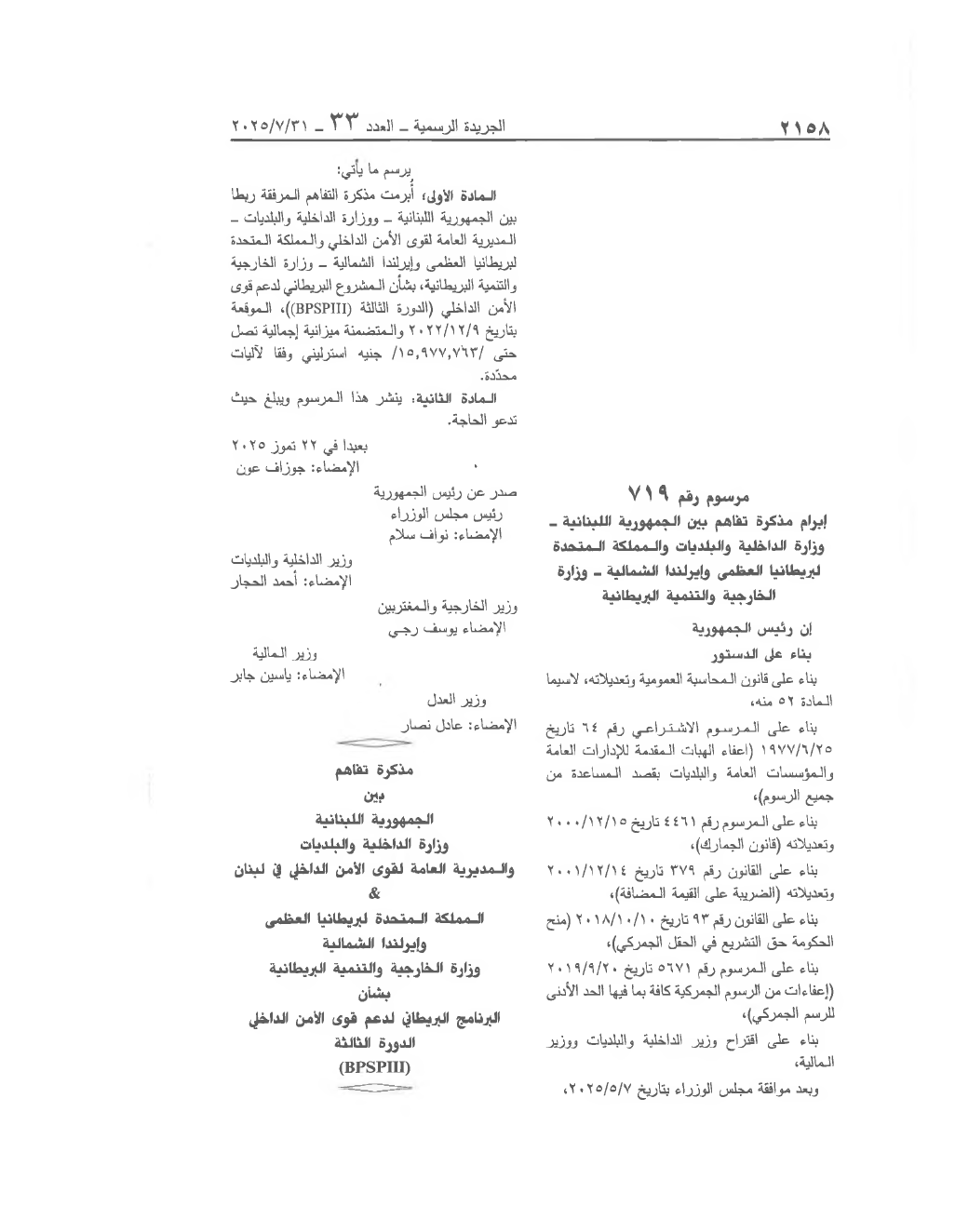
مرسوم رقم 719 22/07/2025
مرسوم رقم 719 تاريخ 22/07/2025. نشر في الجريدة الرسمية العدد 33 تاريخ 31/07/2025. عدد المواد: 1. لا إلغاء مسجل في مصادرنا. النص باللغة العربية كما نشر.
نسخة مقروءة من صفحات الجريدة الرسمية. لم تنشر الجامعة اللبنانية هذا النص بعد، فنقلناه آليًا عن صور صفحات الجريدة الرسمية. قرأته قراءتان مستقلتان وقارنّاهما كلمةً كلمة. وحيث اختلفتا نعرض القراءتين معًا مظلّلتين: راجع صور الصفحات أدناه. هذه نسخة غير رسمية، والنص الرسمي هو المنشور في الجريدة الرسمية.
إن رئيس الجمهورية
بناء على الدستور
بناء على قانون المحاسبة العمومية وتعديلاته، لاسيما المادة ٥٢ منه،
بناء على المرسوم الاشتراعي رقم ٦٤ تاريخ ١٩٧٧/٦/٢٥ (اعفاء الهبات المقدمة للإدارات العامة والمؤسسات العامة والبلديات بقصد المساعدة من جميع الرسوم)،
بناء على المرسوم رقم ٤٤٦١ تاريخ ٢٠٠٠/١٢/١٥ وتعديلاته (قانون الجمارك)،
بناء على القانون رقم ۳۷۹ تاريخ ۲۰۰۱/۱۲/۱٤ وتعديلاته (الضريبة على القيمة المضافة)،
بناء على القانون رقم ۹۳ تاريخ ۲۰۱۸/۱۰/۱۰ (منح الحكومة حق التشريع في الحقل الجمركي)،
بناء على المرسوم رقم ٥٦٧١ تاريخ ۲۰۱۹/۹/۲۰ (إعفاءات من الرسوم الجمركية كافة بما فيها الحد الأدنى للرسم الجمركي)،
بناء على اقتراح وزير الداخلية والبلديات ووزير المالية،
وبعد موافقة مجلس الوزراء بتاريخ ٢٠٢٥/٥/٧،
يرسم ما يأتي:
المادة الأولى؛ أُبرمت مذكرة التفاهم المرفقة ربطا بين الجمهورية اللبنانية - وزارة / ووزارة الداخلية والبلديات - المديرية العامة لقوى الأمن الداخلي والمملكة المتحدة لبريطانيا العظمى وإيرلندا الشمالية - وزارة الخارجية والتنمية البريطانية، بشأن المشروع البريطاني لدعم قوى الأمن الداخلي (الدورة الثالثة (BPSPIII))، الموقعة بتاريخ ۲۰۲۲/۱۲/۹ والمتضمنة ميزانية إجمالية تصل حتى /١٥,٩٧٧,٧٦٣/ جنيه استرليني وفقا لآليات محدّدة.
ينشر هذا المرسوم ويبلغ حيث تدعو الحاجة.
بعبدا في ۲۲ تموز ۲۰۲٥
الإمضاء: جوزاف عون
صدر عن رئيس الجمهورية
رئيس مجلس الوزراء
الإمضاء: نواف سلام
وزير الداخلية والبلديات
الإمضاء: أحمد الحجار
وزير الخارجية والمغتربين
الإمضاء يوسف رجي
وزير المالية
الإمضاء: ياسين جابر
وزير العدل
الإمضاء: عادل نصار
مذكرة تفاهم
بين
الجمهورية اللبنانية
وزارة الداخلية والبلديات
والمديرية العامة لقوى الأمن الداخلي في لبنان
&
المملكة المتحدة لبريطانيا العظمى
وإيرلندا الشمالية
وزارة الخارجية والتنمية البريطانية
بشأن
البرنامج البريطاني لدعم قوى الأمن الداخلي
الدورة الثالثة
(BPSPIII)
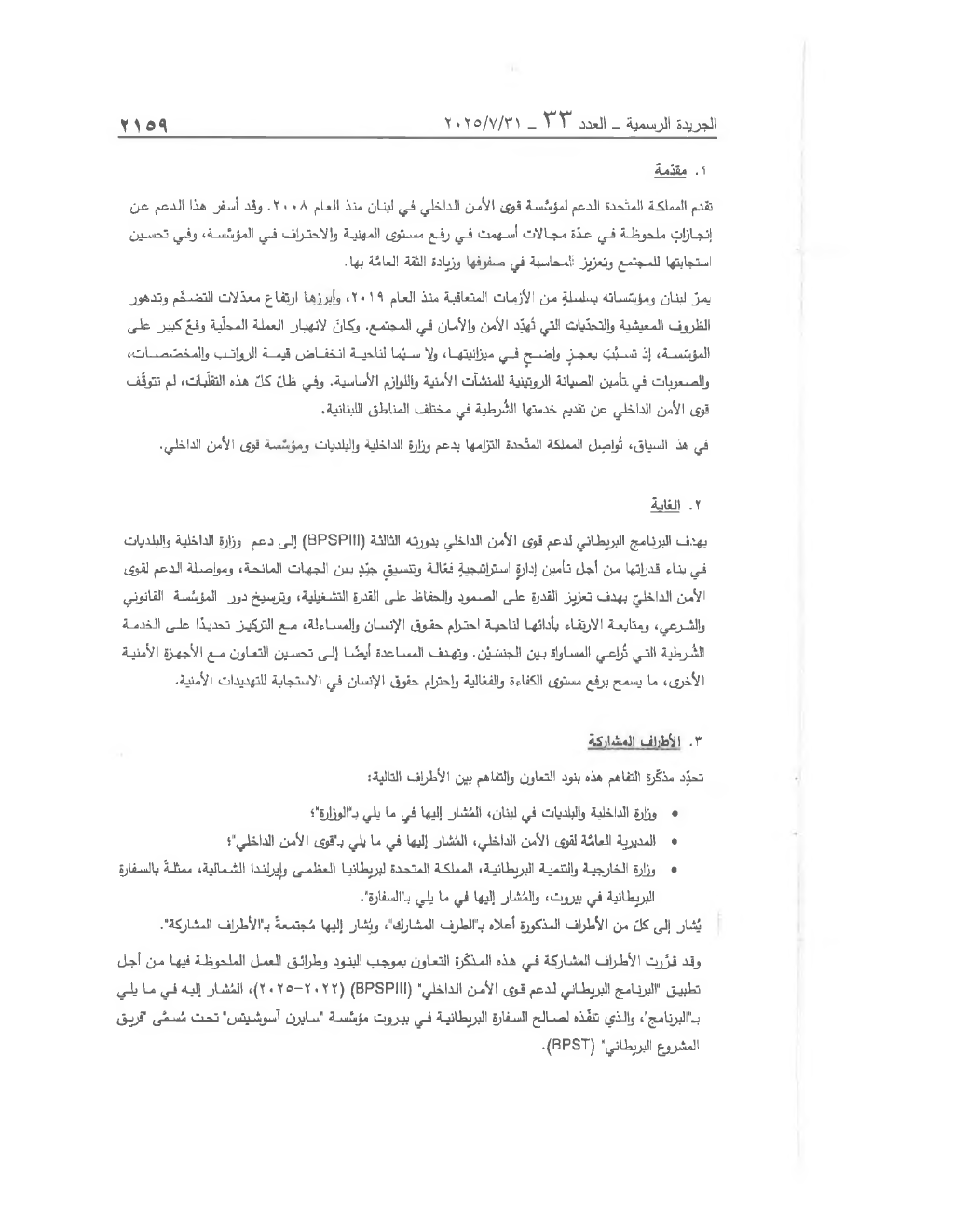
١. مقدّمة
تقدم المملكة المتحدة الدعم لمؤسسة قوى الأمن الداخلي في لبنان منذ العام ۲۰۰۸. وقد أسفر هذا الدعم عن إنجازات ملحوظة في عدّة مجالات أسهمت في رفع مستوى المهنية والاحتراف في المؤسّسة، وفي تحسين استجابتها للمجتمع وتعزيز ألمحاسبة في صفوفها وزيادة الثقة العامة بها.
يمرّ لبنان ومؤسساته بسلسلة من الأزمات المتعاقبة منذ العام ۲۰۱۹ ، وأبرزها ارتفاع معدّلات التضخّم وتدهور الظروف المعيشية والتحديات التي تُهدّد الأمن والأمان في المجتمع. وكان لانهيار العملة المحليّة وقع كبير على المؤسّسة، إذ تسبّب بعجزٍ واضح في ميزانيتها، ولا سيّما لناحية انخفاض قيمة الرواتب والمخصّصات، والصعوبات في تأمين الصيانة الروتينية للمنشآت الأمنية واللوازم الأساسية. وفي ظلّ كلّ هذه التقلّبات، لم تتوقّف قوى الأمن الداخلي عن تقديم خدمتها الشُرطية في مختلف المناطق اللبنانية.
في هذا السياق، تُواصِل المملكة المتّحدة التزامها بدعم وزارة الداخلية والبلديات ومؤسّسة قوى الأمن الداخلي.
٢. الغاية
يهدف البرنامج البريطاني لدعم قوى الأمن الداخلي بدورته الثالثة (BPSPIII) إلى دعم وزارة الداخلية والبلديات في بناء قدراتها من أجل تأمين إدارة استراتيجية فعّالة وتنسيق جيّد بين الجهات المانحة، ومواصلة الدعم لقوى الأمن الداخلي بهدف تعزيز القدرة على الصمود والحفاظ على القدرة التشغيلية، وترسيخ دور المؤسّسة القانوني والشرعي، ومتابعة الارتقاء بأدائها لناحية احترام حقوق الإنسان والمساءلة، مع التركيز تحديدًا على الخدمة الشُرطية التي تُراعي المساواة بين الجنسيْن، وتهدف المساعدة أيضًا إلى تحسين التعاون مع الأجهزة الأمنية الأخرى، ما يسمح برفع مستوى الكفاءة والفعالية واحترام حقوق الإنسان في الاستجابة للتهديدات الأمنية.
٣. الأطراف المشاركة
تحدّد مذكرة التفاهم هذه بنود التعاون والتفاهم بين الأطراف التالية:
• وزارة الداخلية والبلديات في لبنان، المُشار إليها في ما يلي بـ"الوزارة"؛
• المديرية العامة لقوى الأمن الداخلي، المُشار إليها في ما يلي بـ"قوى الأمن الداخلي"؛
• وزارة الخارجية والتنمية البريطانية، المملكة المتحدة لبريطانيا العظمى وإيرلندا الشمالية، ممثلةً بالسفارة البريطانية في بيروت، والمُشار إليها في ما يلي بـ"السفارة".
يُشار إلى كلّ من الأطراف المذكورة أعلاه بـ"الطرف المشارك"، ويُشار إليها مُجتمعةً بـ"الأطراف المشاركة".
وقد قرّرت الأطراف المشاركة في هذه المذكرة التعاون بموجب البنود وطرائق العمل الملحوظة فيها من أجل تطبيق "البرنامج البريطاني لدعم قوى الأمن الداخلي" (BPSPIII) (۲۰۲۲ - ۲۰۲۵)، / (٢٠٢٢-٢٠٢٥)، المُشار إليه في ما يلي بـ"البرنامج"، والذي تنفّذه لصالح السفارة البريطانية في بيروت مؤسسة "سايرن أسوشيتس" تحت مُسمّى "فريق المشروع البريطاني" (BPST).
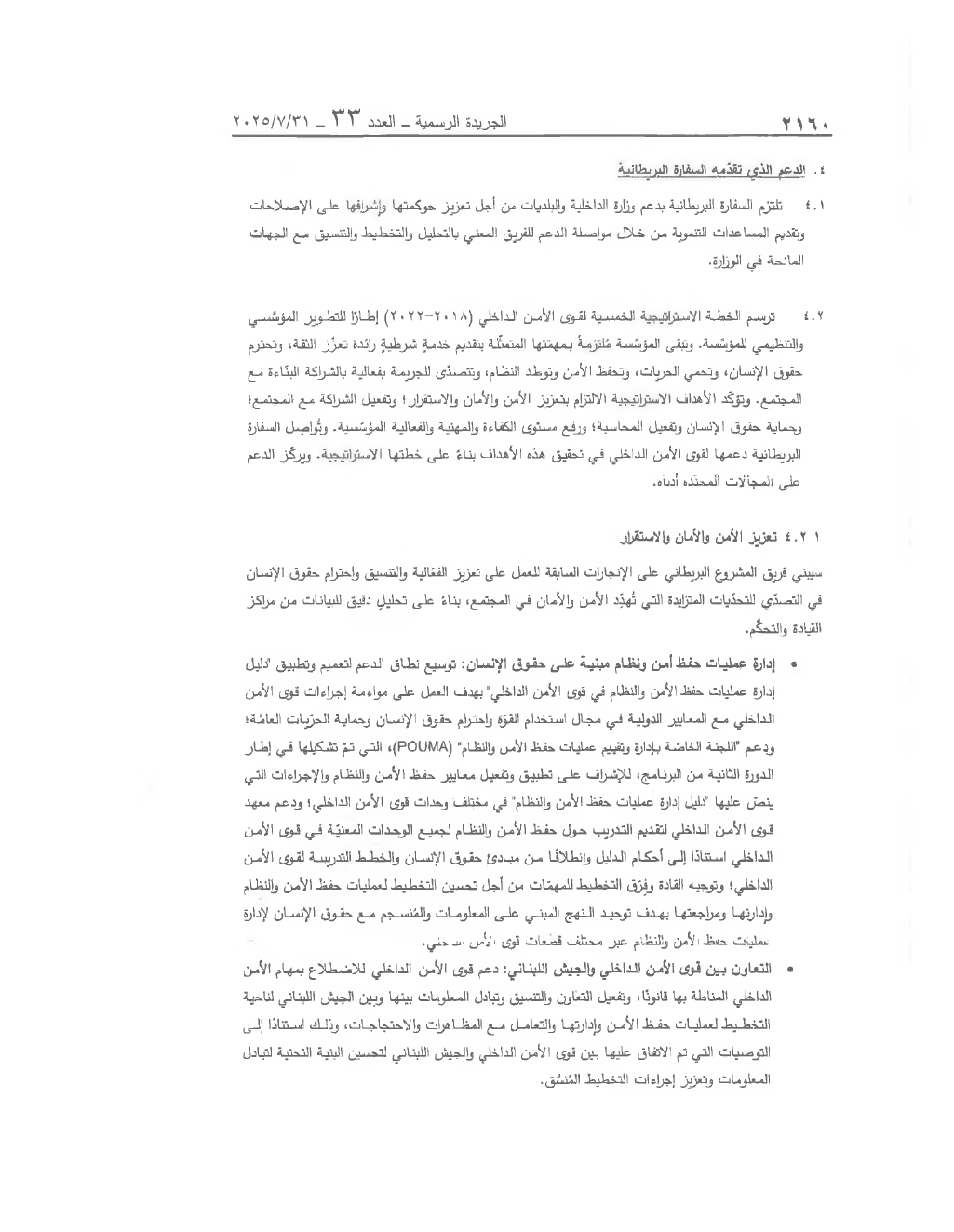
٤. الدعم الذي تقدّمه السفارة البريطانية
٤.١ تلتزم السفارة البريطانية بدعم وزارة الداخلية والبلديات من أجل تعزيز حوكمتها وإشرافها على الإصلاحات وتقديم المساعدات التنموية من خلال مواصلة الدعم للفريق المعني بالتحليل والتخطيط والتنسيق مع الجهات المانحة في الوزارة.
٤.٢ ترسم الخطة الاستراتيجية الخمسية لقوى الأمن الداخلي (٢٠١٨-٢٠٢٢) إطارًا للتطوير المؤسسي والتنظيمي للمؤسسة. وتبقى المؤسسة مُلتزمةً بمهمتها المتمثلة بتقديم خدمة شرطيةٍ رائدة تعزز الثقة، وتحترم حقوق الإنسان، وتحمي الحريات، وتحفظ الأمن وتوطد النظام، وتتصدّى للجريمة بفعالية بالشراكة البنّاءة مع المجتمع. وتؤكد الأهداف الاستراتيجية الالتزام بتعزيز الأمن والأمان والاستقرار؛ وتفعيل الشراكة مع المجتمع؛ وحماية حقوق الإنسان وتفعيل المحاسبة؛ ورفع مستوى الكفاءة والمهنية والفعالية المؤسسية. وتُواصل السفارة البريطانية دعمها لقوى الأمن الداخلي في تحقيق هذه الأهداف بناءً على خطتها الاستراتيجية. ويركز الدعم على المجالات المحدّدة أدناه.
٤.٢.١ تعزيز الأمن والأمان والاستقرار
سيبني فريق المشروع البريطاني على الإنجازات السابقة للعمل على تعزيز الفعالية والتنسيق واحترام حقوق الإنسان في التصدّي للتحدّيات المتزايدة التي تُهدّد الأمن والأمان في المجتمع، بناءً على تحليل دقيق للبيانات من مراكز القيادة والتحكّم.
• إدارة عمليات حفظ أمن ونظام مبنية على حقوق الإنسان: توسيع نطاق الدعم لتعميم وتطبيق "دليل إدارة عمليات حفظ الأمن والنظام في قوى الأمن الداخلي" بهدف العمل على مواءمة إجراءات قوى الأمن الداخلي مع المعايير الدولية في مجال استخدام القوّة واحترام حقوق الإنسان وحماية الحرّيات العامة؛ ودعم "اللجنة الخاصة بإدارة وتقييم عمليات حفظ الأمن والنظام" (POUMA)، التي تمّ تشكيلها في إطار الدورة الثانية من البرنامج، للإشراف على تطبيق وتفعيل معايير حفظ الأمن والنظام والإجراءات التي ينصّ عليها "دليل إدارة عمليات حفظ الأمن والنظام" في مختلف وحدات قوى الأمن الداخلي؛ ودعم معهد قوى الأمن الداخلي لتقديم التدريب حول حفظ الأمن والنظام لجميع الوحدات المعنيّة في قوى الأمن الداخلي استنادًا إلى أحكام الدليل وانطلاقًا من مبادئ حقوق الإنسان والخطط التدريبية لقوى الأمن الداخلي؛ وتوجيه القادة وفِرق التخطيط للمهمات من أجل تحسين التخطيط لعمليات حفظ الأمن والنظام وإدارتها ومراجعتها بهدف توحيد النهج المبني على المعلومات والمُنسجم مع حقوق الإنسان لإدارة عمليات حفظ الأمن والنظام عبر مختلف قطاعات / قطعات قوى الأمن الداخلي.
• التعاون بين قوى الأمن الداخلي والجيش اللبناني: دعم قوى الأمن الداخلي للاضطلاع بمهام الأمن الداخلي المناطة بها قانونًا، وتفعيل التعاون والتنسيق وتبادل المعلومات بينها وبين الجيش اللبناني لناحية التخطيط لعمليات حفظ الأمن وإدارتها والتعامل مع المظاهرات والاحتجاجات، وذلك استنادًا إلى التوصيات التي تم الاتفاق عليها بين قوى الأمن الداخلي والجيش اللبناني لتحسين البنية التحتية لتبادل المعلومات وتعزيز إجراءات التخطيط المُنَسّق.
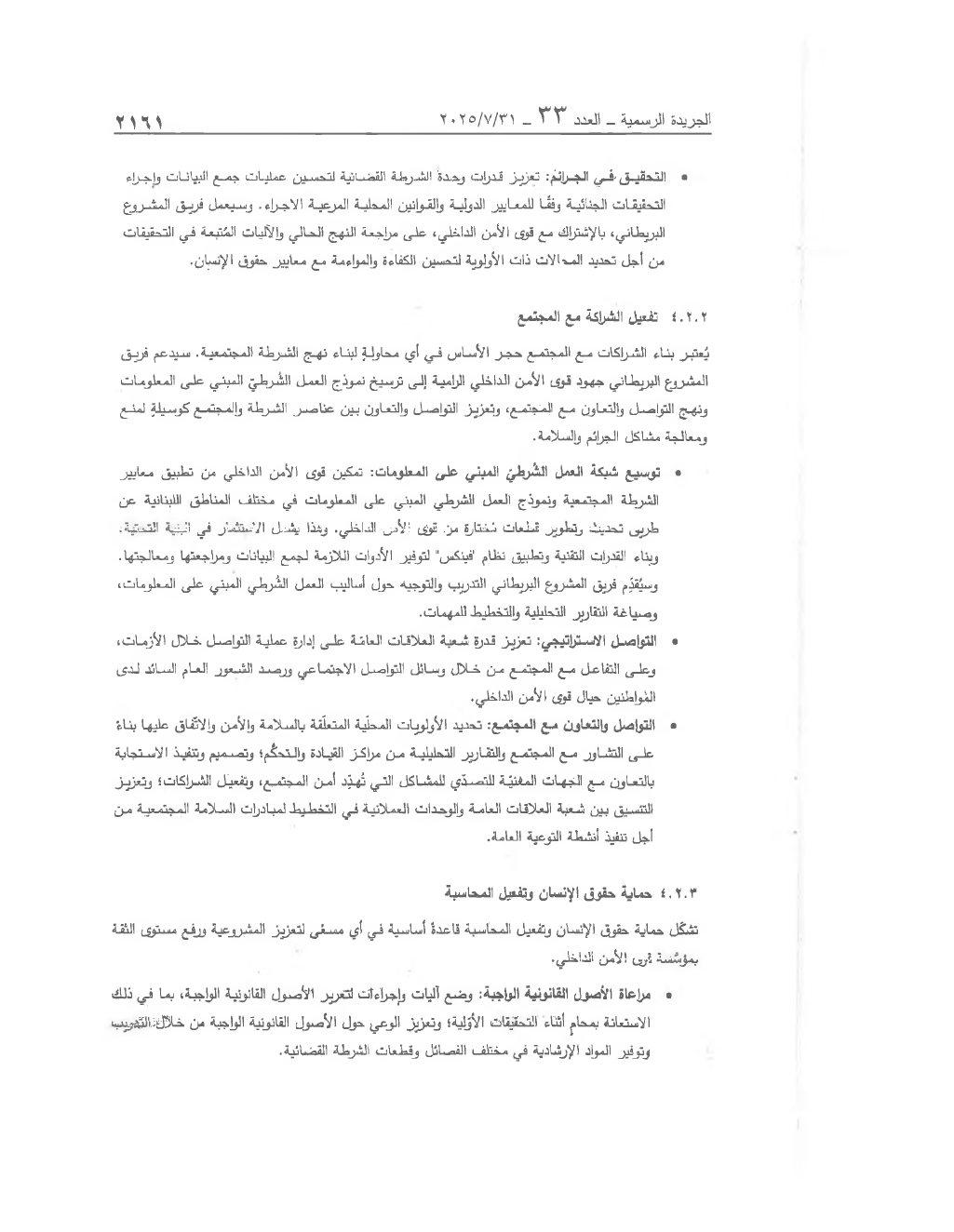
• التحقيق في الجرائم: تعزيز قدرات وحدة الشرطة القضائية لتحسين عمليات جمع البيانات وإجراء التحقيقات الجنائية وفقاً للمعايير الدولية والقوانين المحلية المرعية الاجراء. وسيعمل فريق المشروع البريطاني، بالإشتراك مع قوى الأمن الداخلي، على مراجعة النهج الحالي والآليات المتبعة في التحقيقات من أجل تحديد المجالات ذات الأولوية لتحسين الكفاءة والمواءمة مع معايير حقوق الإنسان.
٤.٢.٢ تفعيل الشراكة مع المجتمع
يُعتبر بناء الشراكات مع المجتمع حجر الأساس في أي محاولة لبناء نهج الشرطة المجتمعية. سيدعم فريق المشروع البريطاني جهود قوى الأمن الداخلي الرامية إلى ترسيخ نموذج العمل الشرطي المبني على المعلومات ونهج التواصل والتعاون مع المجتمع، وتعزيز التواصل والتعاون بين عناصر الشرطة والمجتمع كوسيلة لمنع ومعالجة مشاكل الجرائم والسلامة.
• توسيع شبكة العمل الشرطي المبني على المعلومات: تمكين قوى الأمن الداخلي من تطبيق معايير الشرطة المجتمعية ونموذج العمل الشرطي المبني على المعلومات في مختلف المناطق اللبنانية عن طريق تحديث وتطوير قطعات مختارة من قوى الأمن الداخلي. وهذا يشمل الاستثمار في البنية التحتية، وبناء القدرات التقنية وتطبيق نظام "فينكس" لتوفير الأدوات اللازمة لجمع البيانات ومراجعتها ومعالجتها. وسيقدم فريق المشروع البريطاني التدريب والتوجيه حول أساليب العمل الشرطي المبني على المعلومات، وصياغة التقارير التحليلية والتخطيط للمهمات.
• التواصل الاستراتيجي: تعزيز قدرة شعبة العلاقات العامة على إدارة عملية التواصل خلال الأزمات، وعلى التفاعل مع المجتمع من خلال وسائل التواصل الاجتماعي ورصد الشعور العام السائد لدى المواطنين حيال قوى الأمن الداخلي.
• التواصل والتعاون مع المجتمع: تحديد الأولويات المحلية المتعلقة بالسلامة والأمن والاتفاق عليها بناءً على التشاور مع المجتمع والتقارير التحليلية من مراكز القيادة والتحكّم؛ وتصميم وتنفيذ الاستجابة بالتعاون مع الجهات المعنيّة للتصدّي للمشاكل التي تُهدّد أمن المجتمع، وتفعيل الشراكات؛ وتعزيز التنسيق بين شعبة العلاقات العامة والوحدات العملانية في التخطيط لمبادرات السلامة المجتمعية من أجل تنفيذ أنشطة التوعية العامة.
٤.٢.٣ حماية حقوق الإنسان وتفعيل المحاسبة
تشكل حماية حقوق الإنسان وتفعيل المحاسبة قاعدة أساسية في أي مسعى لتعزيز المشروعية ورفع مستوى الثقة بمؤسسة قوى الأمن الداخلي.
• مراعاة الأصول القانونية الواجبة: وضع آليات وإجراءات لتعزيز الأصول القانونية الواجبة، بما في ذلك الاستعانة بمحامٍ أثناء التحقيقات الأولية؛ وتعزيز الوعي حول الأصول القانونية الواجبة من خلال التدريب وتوفير المواد الإرشادية في مختلف الفصائل وقطعات الشرطة القضائية.
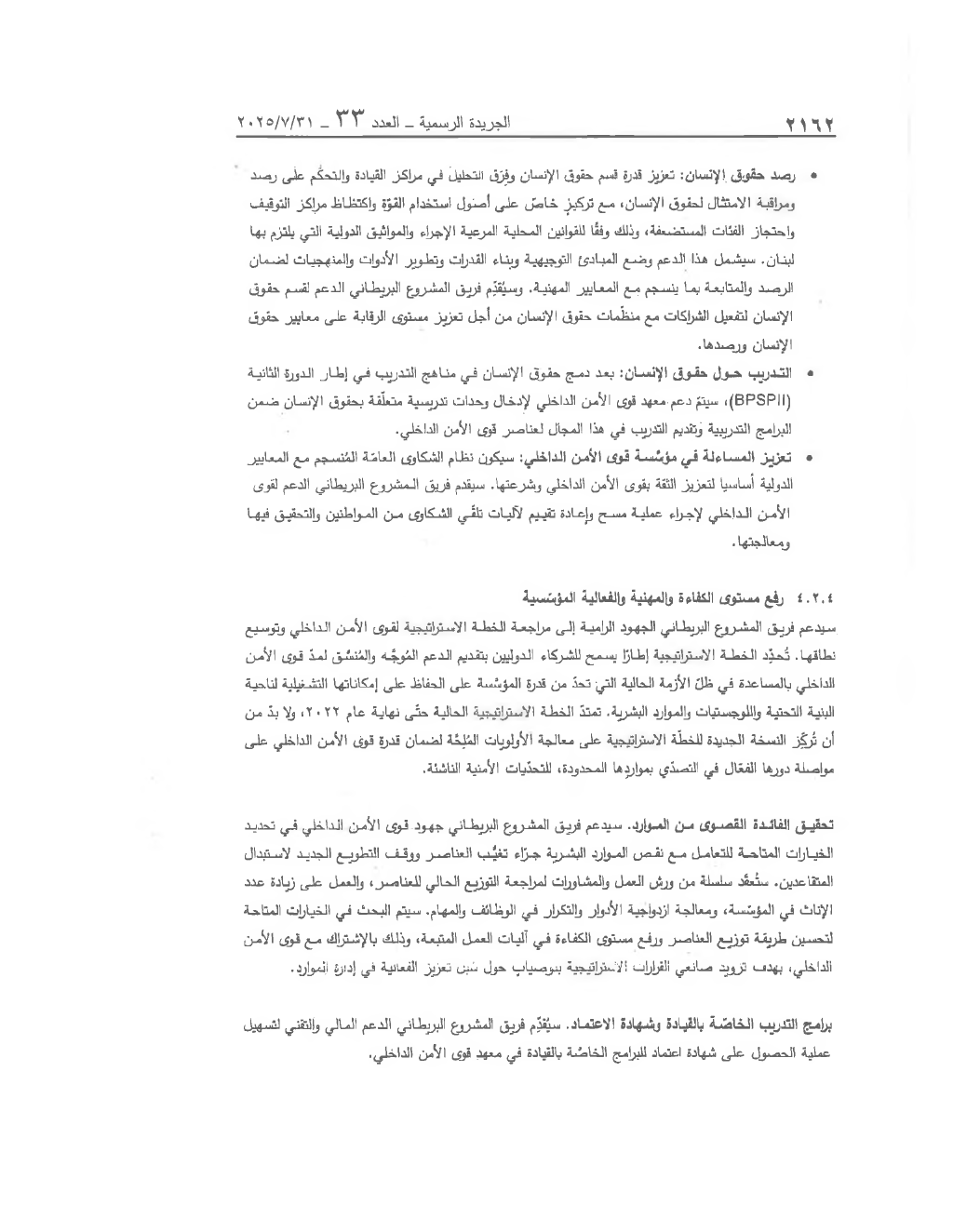
• رصد حقوق الإنسان: تعزيز قدرة قسم حقوق الإنسان وفرق التحليل في مراكز القيادة والتحكّم على رصد ومراقبة الامتثال لحقوق الإنسان، مع تركيز خاصّ على أصول استخدام القوة واكتظاظ مراكز التوقيف واحتجاز الفئات المستضعفة، وذلك وفقًا للقوانين المحلية المرعية الإجراء والمواثيق الدولية التي يلتزم بها لبنان. سيشمل هذا الدعم وضع المبادئ التوجيهية وبناء القدرات وتطوير الأدوات والمنهجيات لضمان الرصد والمتابعة بما ينسجم مع المعايير المهنية. وسيقدّم فريق المشروع البريطاني الدعم لقسم حقوق الإنسان لتفعيل الشراكات مع منظّمات حقوق الإنسان من أجل تعزيز مستوى الرقابة على معايير حقوق الإنسان ورصدها.
• التدريب حول حقوق الإنسان: بعد دمج حقوق الإنسان في مناهج التدريب في إطار الدورة الثانية (BPSPII)، سيتم دعم معهد قوى الأمن الداخلي لإدخال وحدات تدريسية متعلّقة بحقوق الإنسان ضمن البرامج التدريبية وتقديم التدريب في هذا المجال لعناصر قوى الأمن الداخلي.
• تعزيز المساءلة في مؤسسة قوى الأمن الداخلي: سيكون نظام الشكاوى العامة المنسجم مع المعايير الدولية أساسيا لتعزيز الثقة بقوى الأمن الداخلي وشرعتها. سيقدم فريق المشروع البريطاني الدعم لقوى الأمن الداخلي لإجراء عملية مسح وإعادة تقييم لآليات تلقّي الشكاوى من المواطنين والتحقيق فيها ومعالجتها.
٤.٢.٤ رفع مستوى الكفاءة والمهنية والفعالية المؤسسية
سيدعم فريق المشروع البريطاني الجهود الرامية إلى مراجعة الخطة الاستراتيجية لقوى الأمن الداخلي وتوسيع نطاقها. تُحدّد الخطة الاستراتيجية إطارًا يسمح للشركاء الدوليين بتقديم الدعم المُوجّه والمُنسّق لمدّ قوى الأمن الداخلي بالمساعدة في ظلّ الأزمة الحالية التي تحدّ من قدرة المؤسسة على الحفاظ على إمكاناتها التشغيلية لناحية البنية التحتية واللوجستيات والموارد البشرية. تمتدّ الخطة الاستراتيجية الحالية حتّى نهاية عام ٢٠٢٢، ولا بدّ من أن تُركّز النسخة الجديدة للخطّة الاستراتيجية على معالجة الأولويات المُلِحّة لضمان قدرة قوى الأمن الداخلي على مواصلة دورها الفعّال في التصدّي بمواردها المحدودة، للتحدّيات الأمنية الناشئة.
تحقيق الفائدة القصوى من الموارد. سيدعم فريق المشروع البريطاني جهود قوى الأمن الداخلي في تحديد الخيارات المتاحة للتعامل مع نقص الموارد البشرية جرّاء تغيّب العناصر ووقف التطويع الجديد لاستبدال المتقاعدين. ستُعقَد سلسلة من ورش العمل والمشاورات لمراجعة التوزيع الحالي للعناصر، والعمل على زيادة عدد الإناث في المؤسسة، ومعالجة ازدواجية الأدوار والتكرار في الوظائف والمهام. سيتم البحث في الخيارات المتاحة لتحسين طريقة توزيع العناصر ورفع مستوى الكفاءة في آليات العمل المتّبعة، وذلك بالإشتراك مع قوى الأمن الداخلي، بهدف تزويد صانعي القرارات الاستراتيجية بتوصيات حول سُبل تعزيز الفعالية في إدارة الموارد.
برامج التدريب الخاصة بالقيادة وشهادة الاعتماد. سيقدّم فريق المشروع البريطاني الدعم المالي والتقني لتسهيل عملية الحصول على شهادة اعتماد للبرامج الخاصّة بالقيادة في معهد قوى الأمن الداخلي.
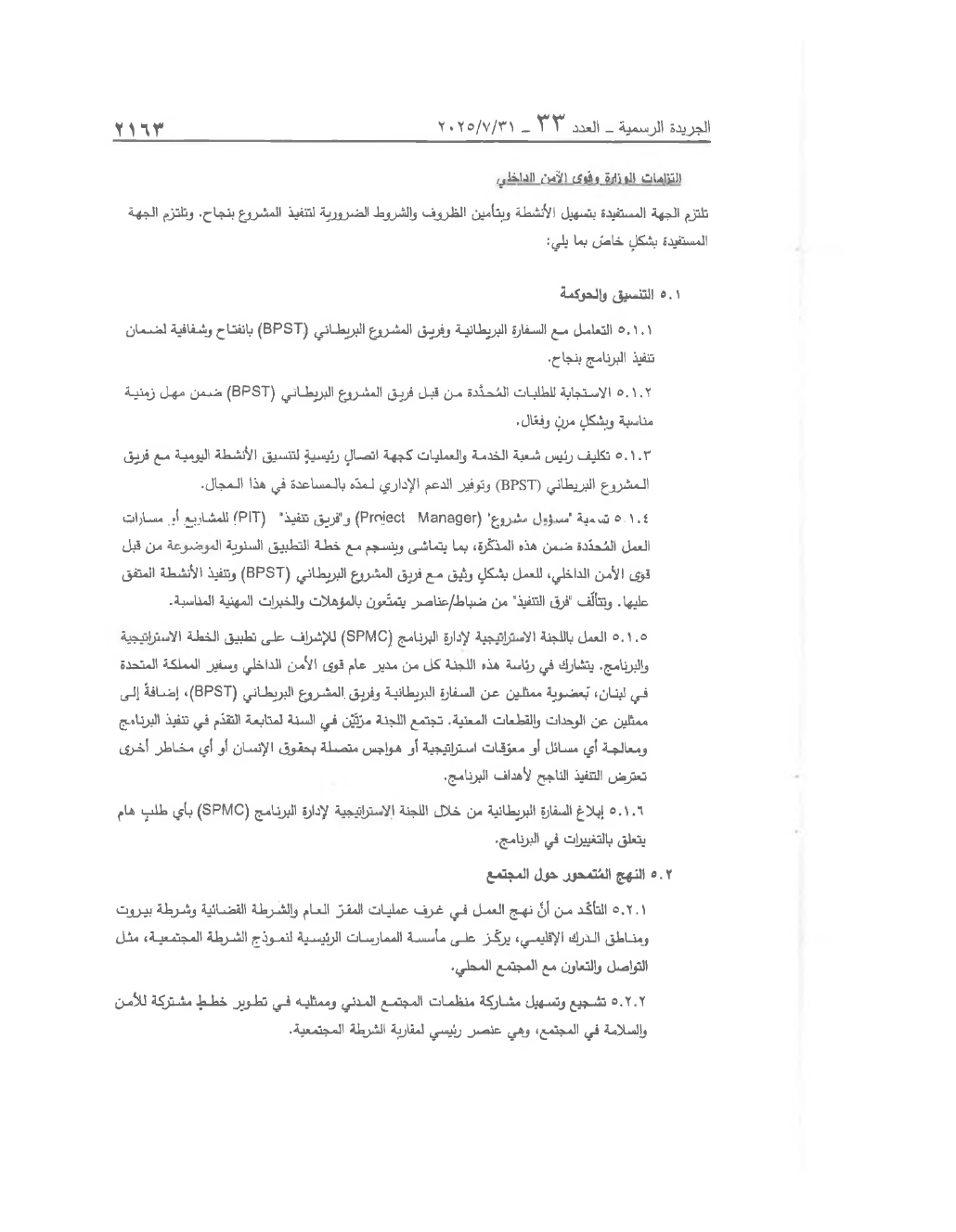
التزامات الوزارة وقوى الأمن الداخلي
تلتزم الجهة المستفيدة بتسهيل الأنشطة وبتأمين الظروف والشروط الضرورية لتنفيذ المشروع بنجاح. وتلتزم الجهة المستفيدة بشكلٍ خاصّ بما يلي:
٥.١ التنسيق والحوكمة
٥.١.١ التعامل مع السفارة البريطانية وفريق المشروع البريطاني (BPST) بانفتاح وشفافية لضمان تنفيذ البرنامج بنجاح.
٥.١.٢ الاستجابة للطلبات المُحدّدة من قبل فريق المشروع البريطاني (BPST) ضمن مهل زمنية مناسبة وبشكلٍ مرنٍ وفعّال.
٥.١.٣ تكليف رئيس شعبة الخدمة والعمليات كجهة اتصالٍ رئيسيةٍ لتنسيق الأنشطة اليومية مع فريق المشروع البريطاني (BPST) وتوفير الدعم الإداري لمدّه بالمساعدة في هذا المجال.
٥.١.٤ تسمية "مسؤول مشروع" (Project Manager) و"فريق تنفيذ" (PIT) للمشاريع أو مسارات العمل المُحدّدة ضمن هذه المذكّرة، بما يتماشى وينسجم مع خطة التطبيق السنوية الموضوعة من قبل قوى الأمن الداخلي، للعمل بشكلٍ وثيق مع فريق المشروع البريطاني (BPST) وتنفيذ الأنشطة المتفق عليها. وتتألف "فرق التنفيذ" من ضباط/عناصر يتمتّعون بالمؤهلات والخبرات المهنية المناسبة.
٥.١.٥ العمل باللجنة الاستراتيجية لإدارة البرنامج (SPMC) للإشراف على تطبيق الخطة الاستراتيجية والبرنامج. يتشارك في رئاسة هذه اللجنة كل من مدير عام قوى الأمن الداخلي وسفير المملكة المتحدة في لبنان، بعضوية ممثلين عن السفارة البريطانية وفريق المشروع البريطاني (BPST)، إضافةً إلى ممثلين عن الوحدات والقطعات المعنية. تجتمع اللجنة مرّتين في السنة لمتابعة التقدّم في تنفيذ البرنامج ومعالجة أي مسائل أو معوقات استراتيجية أو هواجس متصلة بحقوق الإنسان أو أي مخاطر أخرى تعترض التنفيذ الناجح لأهداف البرنامج.
٥.١.٦ إبلاغ السفارة البريطانية من خلال اللجنة الإستراتيجية لإدارة البرنامج (SPMC) بأي طلب هام يتعلق بالتغييرات في البرنامج.
٥.٢ النهج المُتمحور حول المجتمع
٥.٢.١ التأكد من أن نهج العمل في غرف عمليات المقرّ العام والشرطة القضائية وشرطة بيروت ومناطق الدرك الإقليمي، يركّز على مأسسة الممارسات الرئيسية لنموذج الشرطة المجتمعية، مثل التواصل والتعاون مع المجتمع المحلي.
٥.٢.٢ تشجيع وتسهيل مشاركة منظمات المجتمع المدني وممثليه في تطوير خططٍ مشتركةٍ للأمن والسلامة في المجتمع، وهي عنصر رئيسي لمقاربة الشرطة المجتمعية.
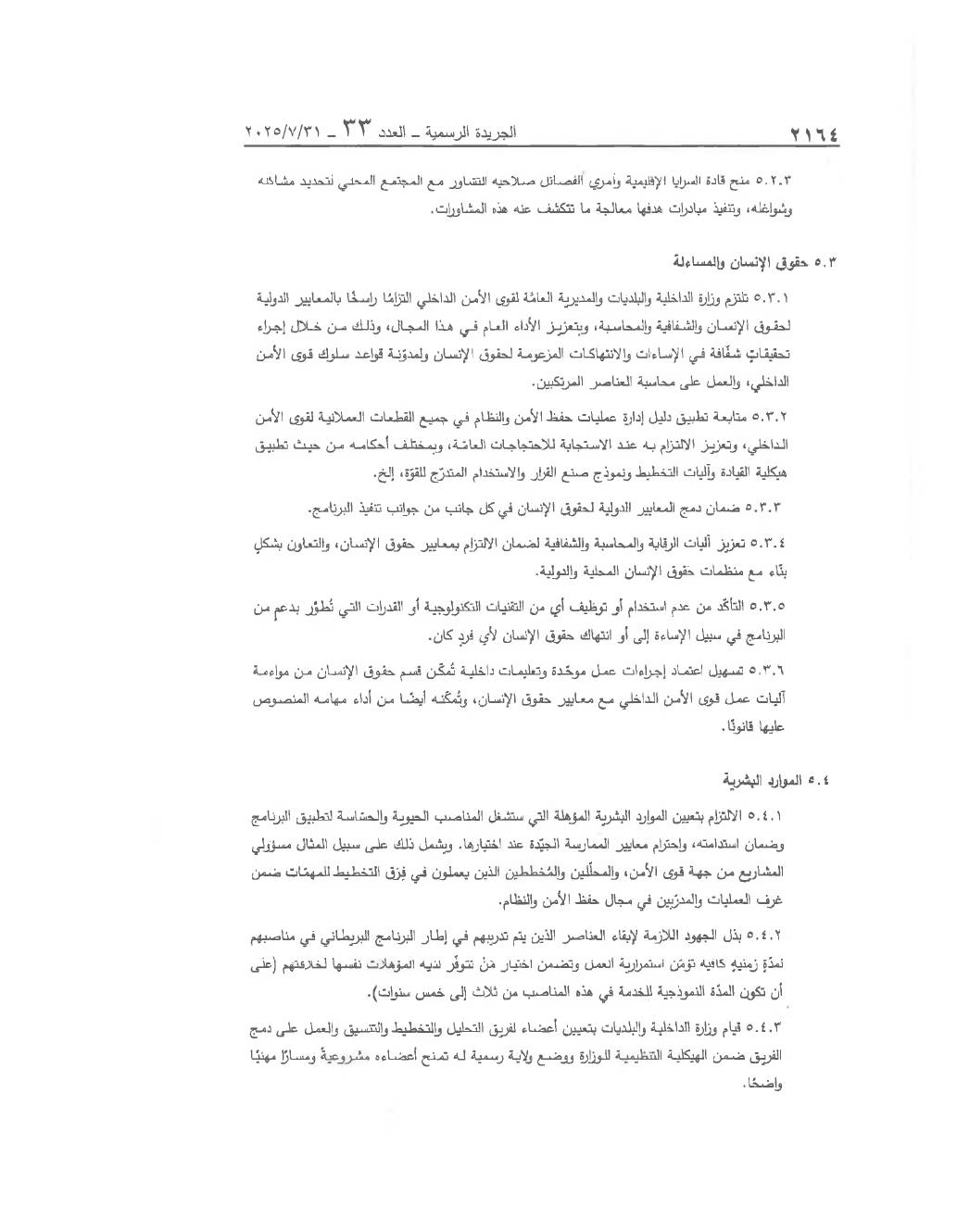
٥.٢.٣ منح قادة السرايا الإقليمية وأمري الفصائل صلاحيه / صلاحية التشاور مع المجتمع المحلي لتحديد مشاكله وشواغله، وتنفيذ مبادرات هدفها معالجة ما تتكشف عنه هذه المشاورات.
٥.٣ حقوق الإنسان والمساءلة
٥.٣.١ تلتزم وزارة الداخلية والبلديات والمديرية العامة لقوى الأمن الداخلي التزامًا راسخًا بالمعايير الدولية لحقوق الإنسان والشفافية والمحاسبة، وبتعزيز الأداء العام في هذا المجال، وذلك من خلال إجراء تحقيقاتٍ شفافة في الإساءات والانتهاكات المزعومة لحقوق الإنسان ولمدوّنة قواعد سلوك قوى الأمن الداخلي، والعمل على محاسبة العناصر المرتكبين.
٥.٣.٢ متابعة تطبيق دليل إدارة عمليات حفظ الأمن والنظام في جميع القطعات العملانية لقوى الأمن الداخلي، وتعزيز الالتزام به عند الاستجابة للاحتجاجات العامة، وبمختلف أحكامه من حيث تطبيق هيكلية القيادة وآليات التخطيط ونموذج صنع القرار والاستخدام المتدرج للقوة، إلخ.
٥.٣.٣ ضمان دمج المعايير الدولية لحقوق الإنسان في كل جانب من جوانب تنفيذ البرنامج.
٥.٣.٤ تعزيز آليات الرقابة والمحاسبة والشفافية لضمان الالتزام بمعايير حقوق الإنسان، والتعاون بشكل بنّاء مع منظمات حقوق الإنسان المحلية والدولية.
٥.٣.٥ التأكد من عدم استخدام أو توظيف أي من التقنيات التكنولوجية أو القدرات التي تُطوَّر بدعم من البرنامج في سبيل الإساءة إلى أو انتهاك حقوق الإنسان لأي فرد كان.
٥.٣.٦ تسهيل اعتماد إجراءات عمل موحّدة وتعليمات داخلية تُمكّن قسم حقوق الإنسان من مواءمة آليات عمل قوى الأمن الداخلي مع معايير حقوق الإنسان، وتُمكّنه أيضًا من أداء مهامه المنصوص عليها قانونًا.
٥.٤ الموارد البشرية
٥.٤.١ الالتزام بتعيين الموارد البشرية المؤهلة التي ستشغل المناصب الحيوية والحسّاسة لتطبيق البرنامج وضمان استدامته، واحترام معايير الممارسة الجيّدة عند اختيارها. ويشمل ذلك على سبيل المثال مسؤولي المشاريع من جهة قوى الأمن، والمحلّلين والمُخططين الذين يعملون في فِرق التّخطيط للمهمات ضمن غرف العمليات والمدرّبين في مجال حفظ الأمن والنظام.
٥.٤.٢ بذل الجهود اللازمة لإبقاء العناصر الذين يتم تدريبهم في إطار البرنامج البريطاني في مناصبهم لمدّةٍ زمنيه كافيه / زمنيةٍ كافية تؤمّن استمرارية العمل وتضمن اختيار مَنْ تتوفّر لديه المؤهلات نفسها لخلافتهم (على أن تكون المدّة النموذجية للخدمة في هذه المناصب من ثلاث إلى خمس سنوات).
٥.٤.٣ قيام وزارة الداخلية والبلديات بتعيين أعضاء لفريق التحليل والتخطيط والتنسيق والعمل على دمج الفريق ضمن الهيكلية التنظيمية للوزارة ووضع ولاية رسمية له تمنح أعضاءه مشروعية ومسارًا مهنيًا واضحًا.
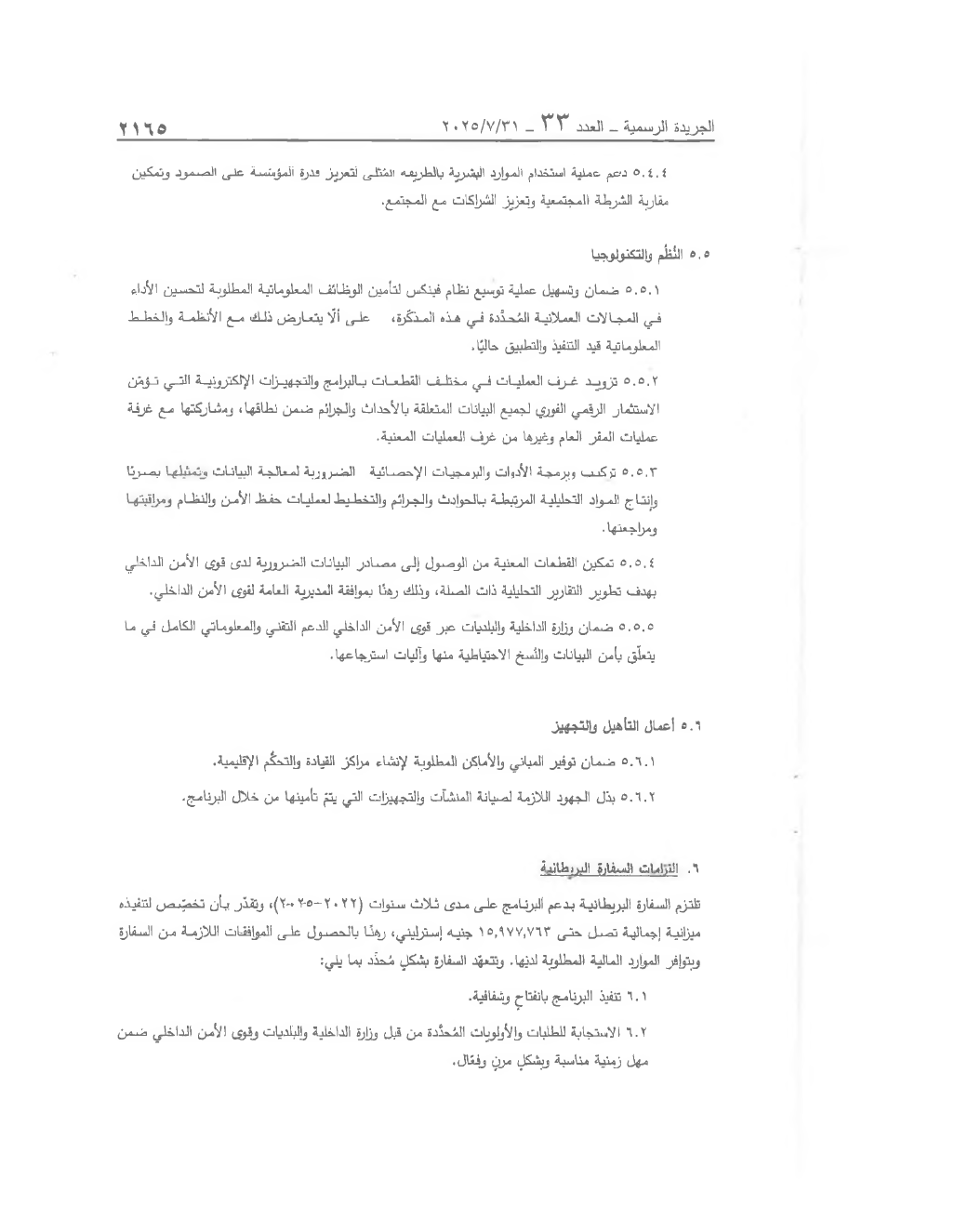
٥.٤.٤ دعم عملية استخدام الموارد البشرية بالطريقه / بالطريقة المُثلى لتعزيز قدرة المؤسسة على الصمود وتمكين مقاربة الشرطة المجتمعية وتعزيز الشراكات مع المجتمع.
٥.٥ النُظُم والتكنولوجيا
٥.٥.١ ضمان وتسهيل عملية توسيع نظام فينكس لتأمين الوظائف المعلوماتية المطلوبة لتحسين الأداء في المجالات العملانية المُحدّدة في هذه المذكرة، على ألّا يتعارض ذلك مع الأنظمة والخطط المعلوماتية قيد التنفيذ والتطبيق حاليًا.
٥.٥.٢ تزويد غرف العمليات في مختلف القطعات بالبرامج والتجهيزات الإلكترونية التي تؤمن الاستثمار الرقمي الفوري لجميع البيانات المتعلقة بالأحداث والجرائم ضمن نطاقها، ومشاركتها مع غرفة عمليات المقر العام وغيرها من غرف العمليات المعنية.
٥.٥.٣ تركيب وبرمجة الأدوات والبرمجيات الإحصائية الضرورية لمعالجة البيانات وتمثيلها بصريًا وإنتاج المواد التحليلية المرتبطة بالحوادث والجرائم والتخطيط لعمليات حفظ الأمن والنظام ومراقبتها ومراجعتها.
٥.٥.٤ تمكين القطعات المعنية من الوصول إلى مصادر البيانات الضرورية لدى قوى الأمن الداخلي بهدف تطوير التقارير التحليلية ذات الصلة، وذلك رهنًا بموافقة المديرية العامة لقوى الأمن الداخلي.
٥.٥.٥ ضمان وزارة الداخلية والبلديات عبر قوى الأمن الداخلي الدعم التقني والمعلوماتي الكامل في ما يتعلّق بأمن البيانات والنسخ الاحتياطية منها وآليات استرجاعها.
٥.٦ أعمال التأهيل والتجهيز
٥.٦.١ ضمان توفير المباني والأماكن المطلوبة لإنشاء مراكز القيادة والتحكّم الإقليمية.
٥.٦.٢ بذل الجهود اللازمة لصيانة المنشآت والتجهيزات التي يتمّ تأمينها من خلال البرنامج،
٦. التزامات السفارة البريطانية
تلتزم السفارة البريطانية بدعم البرنامج على مدى ثلاث سنوات (٢٠٢٢-٢٠٢٥)، وتقدّر بأن تخصّص لتنفيذه ميزانية إجمالية تصل حتى ١٥,٩٧٧,٧٦٣ جنيه إسترليني، رهنًا بالحصول على الموافقات اللازمة من السفارة وبتوافر الموارد المالية المطلوبة لديها. وتتعهّد السفارة بشكلٍ محدّد بما يلي:
٦.١ تنفيذ البرنامج بانفتاح وشفافية.
٦.٢ الاستجابة للطلبات والأولويات المُحدّدة من قبل وزارة الداخلية والبلديات وقوى الأمن الداخلي ضمن مهل زمنية مناسبة وبشكلٍ مرنٍ وفعّال.
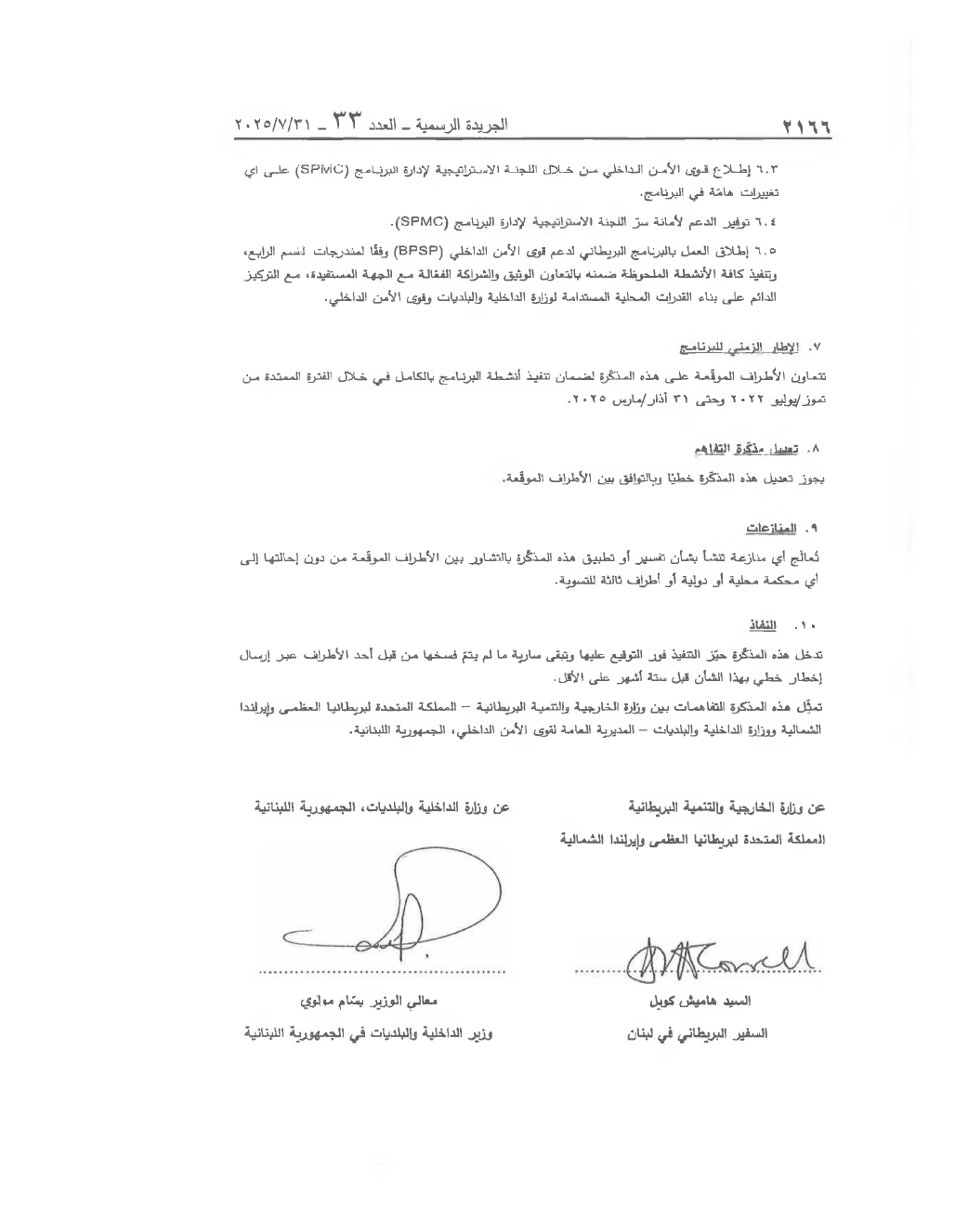
٦.٣ إطلاع قوى الأمن الداخلي من خلال اللجنة الاستراتيجية لإدارة البرنامج (SPMC) على اي تغييرات هامة في البرنامج.
٦.٤ توفير الدعم لأمانة سر اللجنة الاستراتيجية لإدارة البرنامج (SPMC).
٦.٥ إطلاق العمل بالبرنامج البريطاني لدعم قوى الأمن الداخلي (BPSP) وفقًا لمندرجات القسم الرابع، وتنفيذ كافة الأنشطة الملحوظة ضمنه بالتعاون الوثيق والشراكة الفعّالة مع الجهة المستفيدة، مع التركيز الدائم على بناء القدرات المحلية المستدامة لوزارة الداخلية والبلديات وقوى الأمن الداخلي.
٧. الإطار الزمني للبرنامج
تتعاون الأطراف الموقعة على هذه المذكرة لضمان تنفيذ أنشطة البرنامج بالكامل في خلال الفترة الممتدة من تموز/يوليو ٢٠٢٢ وحتى ٣١ آذار/مارس ٢٠٢٥.
٨. تعديل مذكرة التفاهم
يجوز تعديل هذه المذكرة خطيًا وبالتوافق بين الأطراف الموقعة.
٩. المنازعات
تعالج اي منازعة تنشأ بشأن تفسير أو تطبيق هذه المذكرة بالتشاور بين الأطراف الموقعة من دون إحالتها إلى أي محكمة محلية أو دولية أو أطراف ثالثة للتسوية.
١٠. النفاذ
تدخل هذه المذكرة حيز التنفيذ فور التوقيع عليها وتبقى سارية ما لم يتم فسخها من قبل أحد الأطراف عبر إرسال إخطار خطي بهذا الشأن قبل ستة أشهر على الأقل.
تمثل هذه المذكرة التفاهمات بين وزارة الخارجية والتنمية البريطانية - المملكة المتحدة لبريطانيا العظمى وإيرلندا الشمالية ووزارة الداخلية والبلديات - المديرية العامة لقوى الأمن الداخلي، الجمهورية اللبنانية.
عن وزارة الخارجية والتنمية البريطانية المملكة المتحدة لبريطانيا العظمى وإيرلندا الشمالية | عن وزارة الداخلية والبلديات، الجمهورية اللبنانية
المملكة المتحدة لبريطانيا العظمى وإيرلندا الشمالية | .......................................... | .......................................... السيد هاميش كويل | معالي الوزير بسّام مولوي
السفير البريطاني في لبنان | وزير الداخلية والبلديات في الجمهورية اللبنانية
British Embassy
Beirut
… / | British Policing Support Team
… / | | REPUBLIC OF LEBANON
MINISTRY OF
INTERIOR AND
MUNICIPALITIES
MEMORANDUM of UNDERSTANDING
Between
The Ministry of Interior and Municipalities
Republic of Lebanon
and
The Directorate General of the Internal Security Forces
of Lebanon
&
The Foreign, Commonwealth and Development Office
United Kingdom of Great Britain and Northern Ireland
Regarding
The British Policing Support Programme
(BPSP III)
1. Introduction
The United Kingdom (UK) has provided assistance to the Internal Security Forces of Lebanon (ISF) since 2008. Significant developments have been achieved in a number of areas resulting in increased ISF professionalism, improved responsiveness to communities, enhanced accountability and greater public trust in the ISF.
Since 2019 Lebanon and its institutions have undergone compounded national crises including hyperinflation, deteriorating living conditions and challenges to safety and security for communities. The ISF has been severely impacted by the local currency collapse, which has generated huge budget deficits for the institution, in turn affecting staff salaries, benefits, and the routine maintenance and upkeep of security facilities and essential equipment. Within this turbulent context, the ISF has continued to provide a policing service across Lebanon.
The UK remains committed to supporting the Ministry of Interior and Municipalities (MoIM) and the ISF.
2. Purpose
The purpose of the third iteration of the British Policing Support Programme (BPSP III) is to support the MoIM to build its capacities for effective strategic governance and donor coordination and to continue assisting the ISF with the aim of strengthening resilience and sustaining operational capability, further enhancing ISF legitimacy, human rights performance and accountability including gender-sensitive policing. The assistance will also extend to improved interagency cooperation with other security agencies enabling a more effective, efficient and human rights-compliant response to security threats.
3. Participants
This Memorandum of Understanding (MoU) sets the provisions for cooperation and understanding between the following participants:
• The Lebanese Ministry of Interior and Municipalities, hereinafter referred to as "The MoIM" / “The MoIM”
• The Directorate General of the Internal Security Forces hereafter referred to as "DG ISF" / “DG ISF”
• The Foreign, Commonwealth and Development Office of the United Kingdom of Great Britain and Northern Ireland. Represented by and hereafter referred to as "The / “The British Embassy" / Embassy” (each a 'Participant', / ‘Participant’, together the 'Participants'). / ‘Participants’).
The Participants have decided to cooperate, according to the provisions and modalities stipulated in the present Memorandum of Understanding, to implement the British Policing Support Programme 2022-2025, hereafter referred to as "the Programme", / “the Programme”, implemented on behalf of the British Embassy in Beirut by Siren Associates as the British Policing Support Team (BPST).
4. Support to be provided by the British Embassy
4.1 The British Embassy is committed to supporting the MoIM to strengthen governance and oversight of reforms and development assistance through continued support to the MoIM Analysis, Planning and Donor Coordination team (APC).
4.2 The ISF Strategic Plan 2018-2022 establishes a framework for ISF institutional development. The ISF maintains the mission to deliver a pioneering police service that promotes trust, respects human rights, safeguards freedoms, preserves order and security, and combats crime efficiently in partnership with the community. The strategic objectives spell out the commitment to promote safety, security and stability; reinforce partnerships with the community; protect human rights and enhance accountability; and improve professionalism, organisational efficiency and effectiveness. The British Embassy maintains its support for ISF pursuing its strategic objectives in alignment with the ISF Strategic Plan. The support will focus on the areas specified below.
4.2.1 Promoting Safety, Stability and Security
The BPST will build on previous achievements to support a more effective, coordinated, and human rights-compliant response to mounting public safety challenges informed by robust data analysis from Command and Control Centres.
• Human Rights Compliant Public Order Management: Progress the support to the institutional roll-out and implementation of the ISF Public Order Manual of Guidance (POMoG) with the aim of supporting the ISF alignment with international standards on the use of force, respect for human rights and the protection of public freedoms. Formed in BPSPII, the Public Order Unit for Management and Assessment (POUMA) will be supported to oversee, across all ISF Units, the application and operationalisation of the public order standards and processes outlined in the POMoG. The BPST will support the ISF Academy to deliver POMoG-informed, human rights mainstreamed public order training to all concerned ISF units aligned with ISF Training Plans. Commanders and Mission Planning Teams will be mentored on planning, managing and debriefing public order events to consolidate an intelligence-led and human rights-compliant approach to public order management across ISF.
• ISF/LAF Interoperability: Support the ISF to fulfil its internal security mandate as prescribed by law and improve cooperation, coordination and information sharing between the ISF and the Lebanese Armed Forces (LAF) in relation to planning and management of public order events and response to protests, building on the ISF-LAF jointly agreed recommendations to improve the infrastructure for information sharing and strengthening the processes for coordinated planning.
• Crime investigations: Enhance the capabilities of the Judicial Police to improve its data collection processes and to conduct criminal investigations in accordance with international professional standards and domestic applicable laws. BPST will in partnership with the ISF review the current approach and processes for investigations to identify prioritised areas to improve efficiency and alignment with human rights standards.
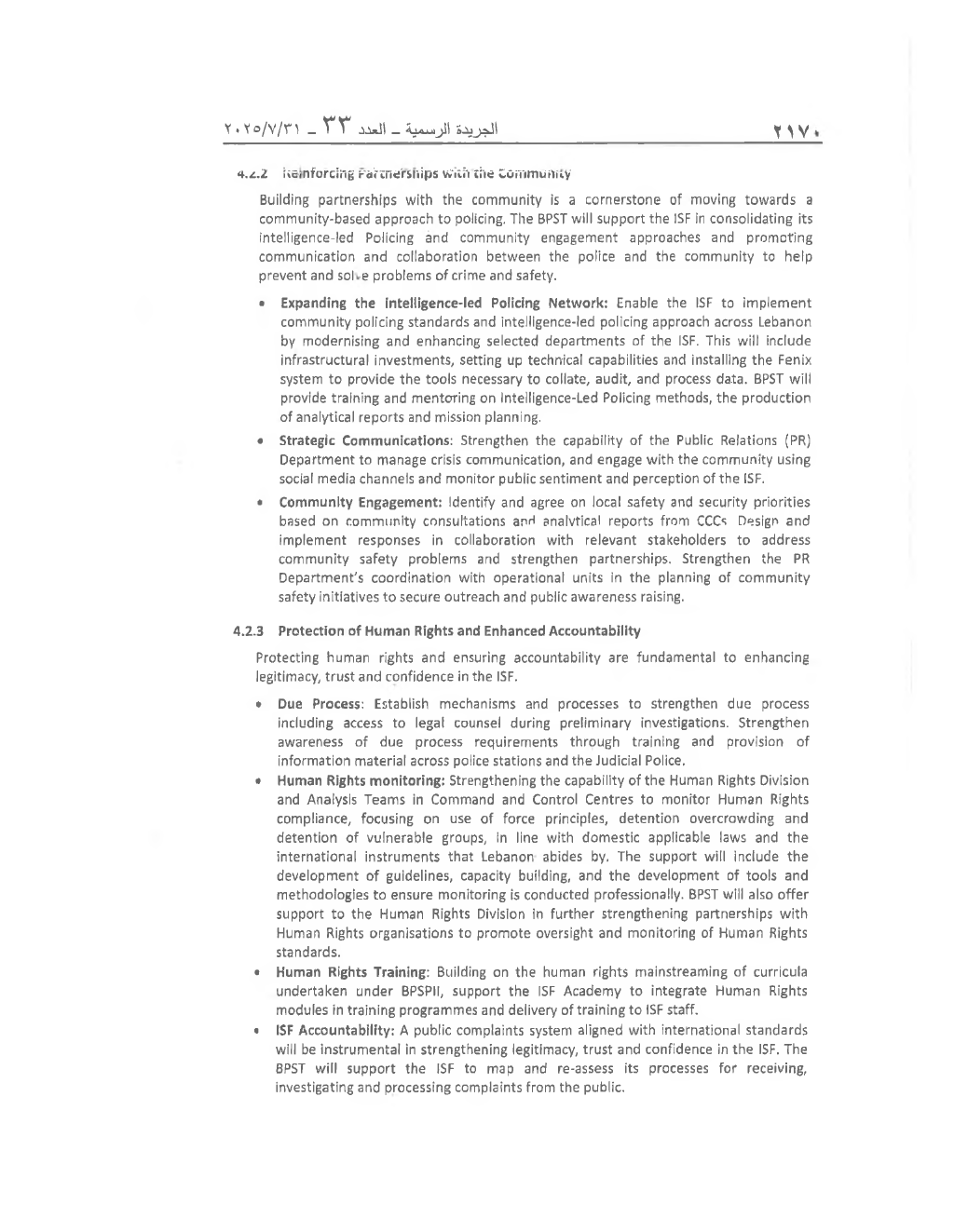
4.2.2 Reinforcing Partnerships with the Community
Building partnerships with the community is a cornerstone of moving towards a community-based approach to policing. The BPST will support the ISF in consolidating its intelligence-led Policing and community engagement approaches and promoting communication and collaboration between the police and the community to help prevent and solve problems of crime and safety.
• Expanding the intelligence-led Policing Network: Enable the ISF to implement community policing standards and intelligence-led policing approach across Lebanon by modernising and enhancing selected departments of the ISF. This will include infrastructural investments, setting up technical capabilities and installing the Fenix system to provide the tools necessary to collate, audit, and process data. BPST will provide training and mentoring on Intelligence-Led Policing methods, the production of analytical reports and mission planning.
• Strategic Communications: Strengthen the capability of the Public Relations (PR) Department to manage crisis communication, and engage with the community using social media channels and monitor public sentiment and perception of the ISF.
• Community Engagement: Identify and agree on local safety and security priorities based on community consultations and analytical reports from CCCs Design and implement responses in collaboration with relevant stakeholders to address community safety problems and strengthen partnerships. Strengthen the PR Department's coordination with operational units in the planning of community safety initiatives to secure outreach and public awareness raising.
4.2.3 Protection of Human Rights and Enhanced Accountability
Protecting human rights and ensuring accountability are fundamental to enhancing legitimacy, trust and confidence in the ISF.
• Due Process: Establish mechanisms and processes to strengthen due process including access to legal counsel during preliminary investigations. Strengthen awareness of due process requirements through training and provision of information material across police stations and the Judicial Police.
• Human Rights monitoring: Strengthening the capability of the Human Rights Division and Analysis Teams in Command and Control Centres to monitor Human Rights compliance, focusing on use of force principles, detention overcrowding and detention of vulnerable groups, in line with domestic applicable laws and the international instruments that Lebanon abides by. The support will include the development of guidelines, capacity building, and the development of tools and methodologies to ensure monitoring is conducted professionally. BPST will also offer support to the Human Rights Division in further strengthening partnerships with Human Rights organisations to promote oversight and monitoring of Human Rights standards.
• Human Rights Training: Building on the human rights mainstreaming of curricula undertaken under BPSPII, support the ISF Academy to integrate Human Rights modules in training programmes and delivery of training to ISF staff.
• ISF Accountability: A public complaints system aligned with international standards will be instrumental in strengthening legitimacy, trust and confidence in the ISF. The BPST will support the ISF to map and re-assess its processes for receiving, investigating and processing complaints from the public.
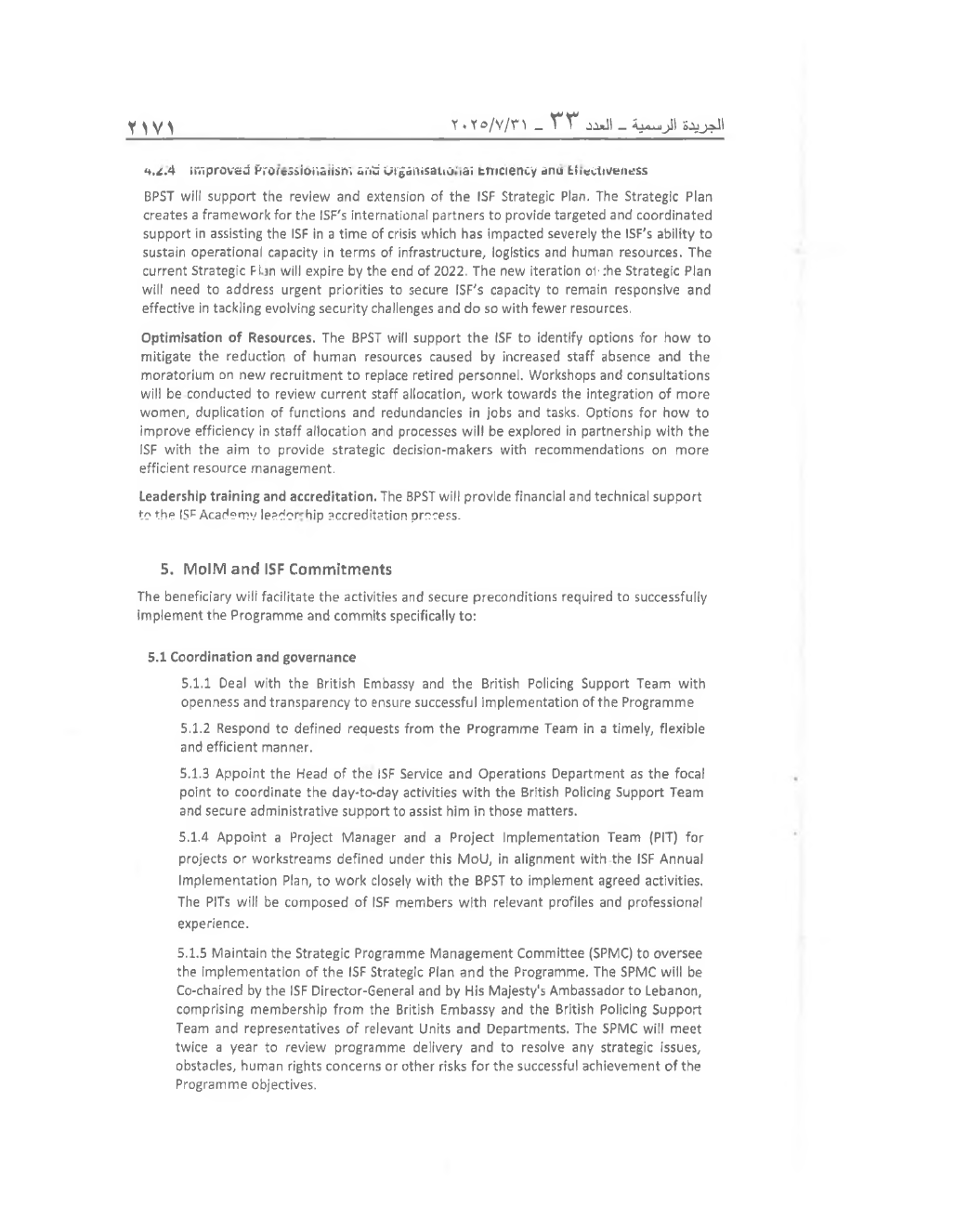
4.2.4 improved / Improved Professionalism and Organisational Efficiency and Effectiveness
BPST will support the review and extension of the ISF Strategic Plan. The Strategic Plan creates a framework for the ISF’s international partners to provide targeted and coordinated support in assisting the ISF in a time of crisis which has impacted severely the ISF’s ability to sustain operational capacity in terms of infrastructure, logistics and human resources. The current Strategic Plan will expire by the end of 2022. The new iteration of the Strategic Plan will need to address urgent priorities to secure ISF’s capacity to remain responsive and effective in tackling evolving security challenges and do so with fewer resources.
Optimisation of Resources. The BPST will support the ISF to identify options for how to mitigate the reduction of human resources caused by increased staff absence and the moratorium on new recruitment to replace retired personnel. Workshops and consultations will be conducted to review current staff allocation, work towards the integration of more women, duplication of functions and redundancies in jobs and tasks. Options for how to improve efficiency in staff allocation and processes will be explored in partnership with the ISF with the aim to provide strategic decision-makers with recommendations on more efficient resource management.
Leadership training and accreditation. The BPST will provide financial and technical support to the ISF Academy leadership accreditation process.
5. MoIM and ISF Commitments
The beneficiary will facilitate the activities and secure preconditions required to successfully implement the Programme and commits specifically to:
5.1 Coordination and governance
5.1.1 Deal with the British Embassy and the British Policing Support Team with openness and transparency to ensure successful implementation of the Programme
5.1.2 Respond to defined requests from the Programme Team in a timely, flexible and efficient manner.
5.1.3 Appoint the Head of the ISF Service and Operations Department as the focal point to coordinate the day-to-day activities with the British Policing Support Team and secure administrative support to assist him in those matters.
5.1.4 Appoint a Project Manager and a Project Implementation Team (PIT) for projects or workstreams defined under this MoU, in alignment with the ISF Annual Implementation Plan, to work closely with the BPST to implement agreed activities. The PITs will be composed of ISF members with relevant profiles and professional experience.
5.1.5 Maintain the Strategic Programme Management Committee (SPMC) to oversee the implementation of the ISF Strategic Plan and the Programme. The SPMC will be Co-chaired by the ISF Director-General and by His Majesty's Ambassador to Lebanon, comprising membership from the British Embassy and the British Policing Support Team and representatives of relevant Units and Departments. The SPMC will meet twice a year to review programme delivery and to resolve any strategic issues, obstacles, human rights concerns or other risks for the successful achievement of the Programme objectives.
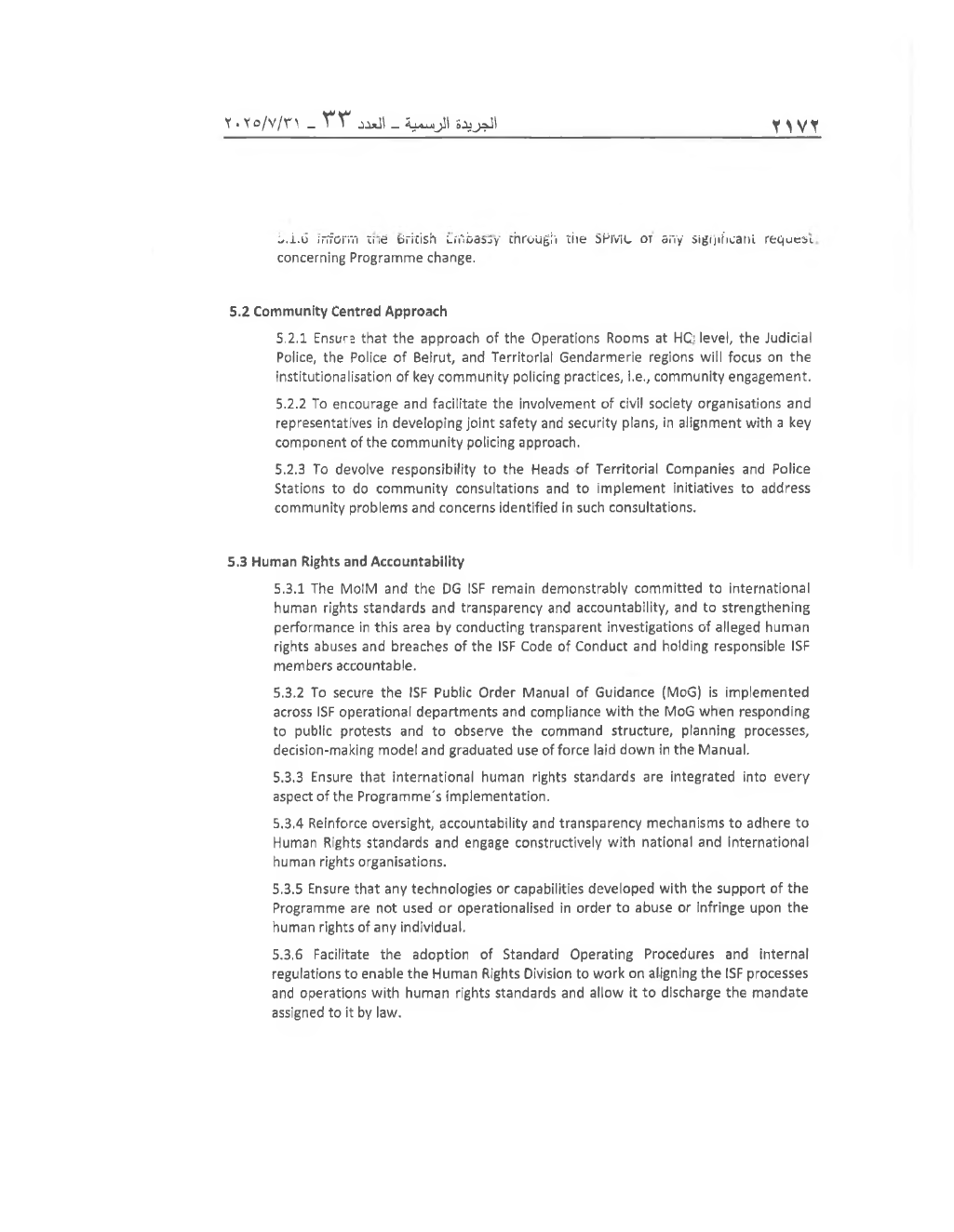
5.1.6 inform / Inform the British Embassy through the SPMC of any significant request concerning Programme change.
5.2 Community Centred Approach
5.2.1 Ensure that the approach of the Operations Rooms at HQ level, the Judicial Police, the Police of Beirut, and Territorial Gendarmerie regions will focus on the institutionalisation of key community policing practices, i.e., community engagement.
5.2.2 To encourage and facilitate the involvement of civil society organisations and representatives in developing joint safety and security plans, in alignment with a key component of the community policing approach.
5.2.3 To devolve responsibility to the Heads of Territorial Companies and Police Stations to do community consultations and to implement initiatives to address community problems and concerns identified in such consultations.
5.3 Human Rights and Accountability
5.3.1 The MoIM and the DG ISF remain demonstrably committed to international human rights standards and transparency and accountability, and to strengthening performance in this area by conducting transparent investigations of alleged human rights abuses and breaches of the ISF Code of Conduct and holding responsible ISF members accountable.
5.3.2 To secure the ISF Public Order Manual of Guidance (MoG) is implemented across ISF operational departments and compliance with the MoG when responding to public protests and to observe the command structure, planning processes, decision-making model and graduated use of force laid down in the Manual.
5.3.3 Ensure that international human rights standards are integrated into every aspect of the Programme's / Programme’s implementation.
5.3.4 Reinforce oversight, accountability and transparency mechanisms to adhere to Human Rights standards and engage constructively with national and international human rights organisations.
5.3.5 Ensure that any technologies or capabilities developed with the support of the Programme are not used or operationalised in order to abuse or infringe upon the human rights of any individual.
5.3.6 Facilitate the adoption of Standard Operating Procedures and internal regulations to enable the Human Rights Division to work on aligning the ISF processes and operations with human rights standards and allow it to discharge the mandate assigned to it by law.
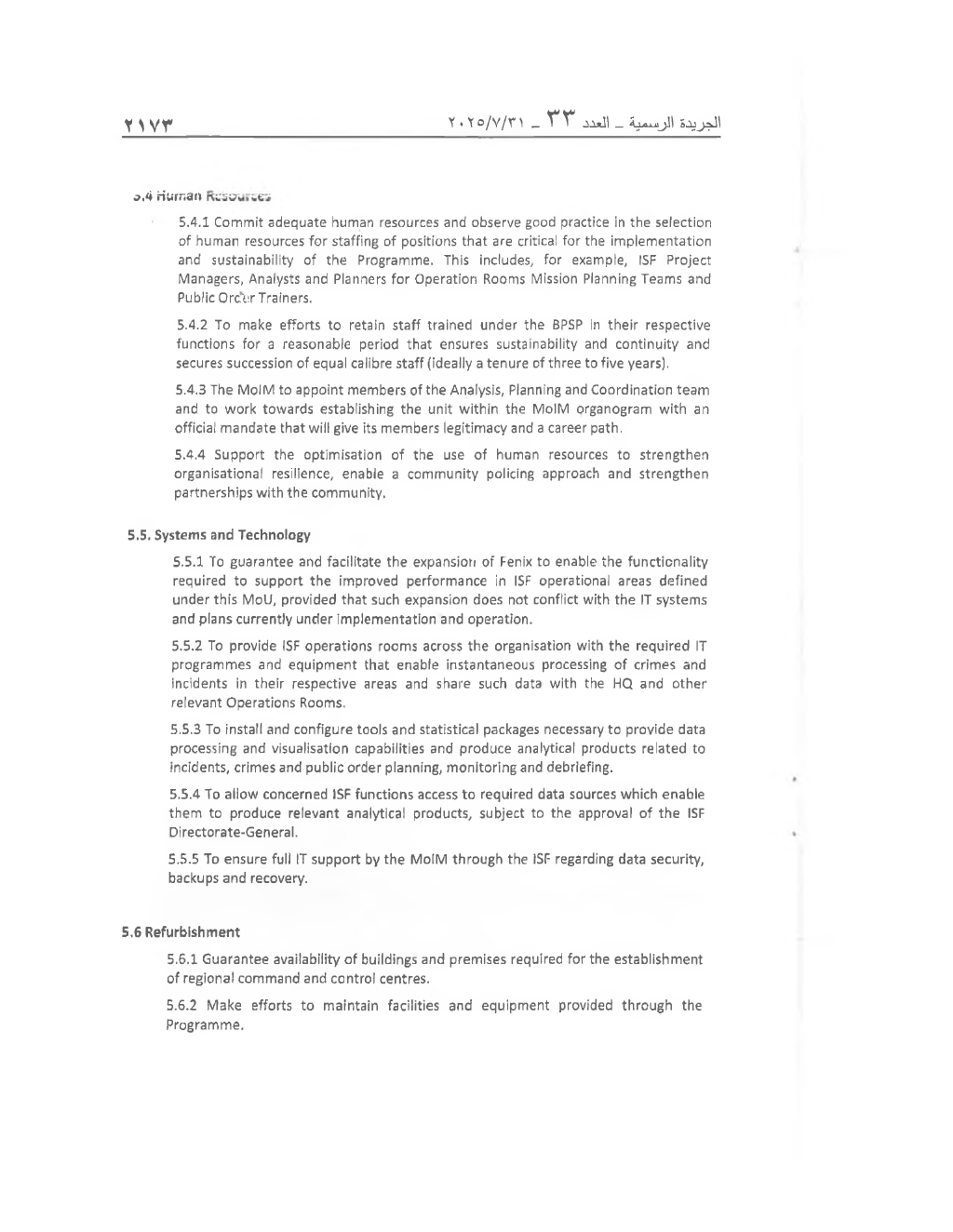
5.4 Human Resources
5.4.1 Commit adequate human resources and observe good practice in the selection of human resources for staffing of positions that are critical for the implementation and sustainability of the Programme. This includes, for example, ISF Project Managers, Analysts and Planners for Operation Rooms Mission Planning Teams and Public Order Trainers.
5.4.2 To make efforts to retain staff trained under the BPSP in their respective functions for a reasonable period that ensures sustainability and continuity and secures succession of equal calibre staff (ideally a tenure of three to five years).
5.4.3 The MoIM to appoint members of the Analysis, Planning and Coordination team and to work towards establishing the unit within the MoIM organogram with an official mandate that will give its members legitimacy and a career path.
5.4.4 Support the optimisation of the use of human resources to strengthen organisational resilience, enable a community policing approach and strengthen partnerships with the community.
5.5. Systems and Technology
5.5.1 To guarantee and facilitate the expansion of Fenix to enable the functionality required to support the improved performance in ISF operational areas defined under this MoU, provided that such expansion does not conflict with the IT systems and plans currently under implementation and operation.
5.5.2 To provide ISF operations rooms across the organisation with the required IT programmes and equipment that enable instantaneous processing of crimes and incidents in their respective areas and share such data with the HQ and other relevant Operations Rooms.
5.5.3 To install and configure tools and statistical packages necessary to provide data processing and visualisation capabilities and produce analytical products related to incidents, crimes and public order planning, monitoring and debriefing.
5.5.4 To allow concerned ISF functions access to required data sources which enable them to produce relevant analytical products, subject to the approval of the ISF Directorate-General.
5.5.5 To ensure full IT support by the MoIM through the ISF regarding data security, backups and recovery.
5.6 Refurbishment
5.6.1 Guarantee availability of buildings and premises required for the establishment of regional command and control centres.
5.6.2 Make efforts to maintain facilities and equipment provided through the Programme.
6. The British Embassy’s commitments
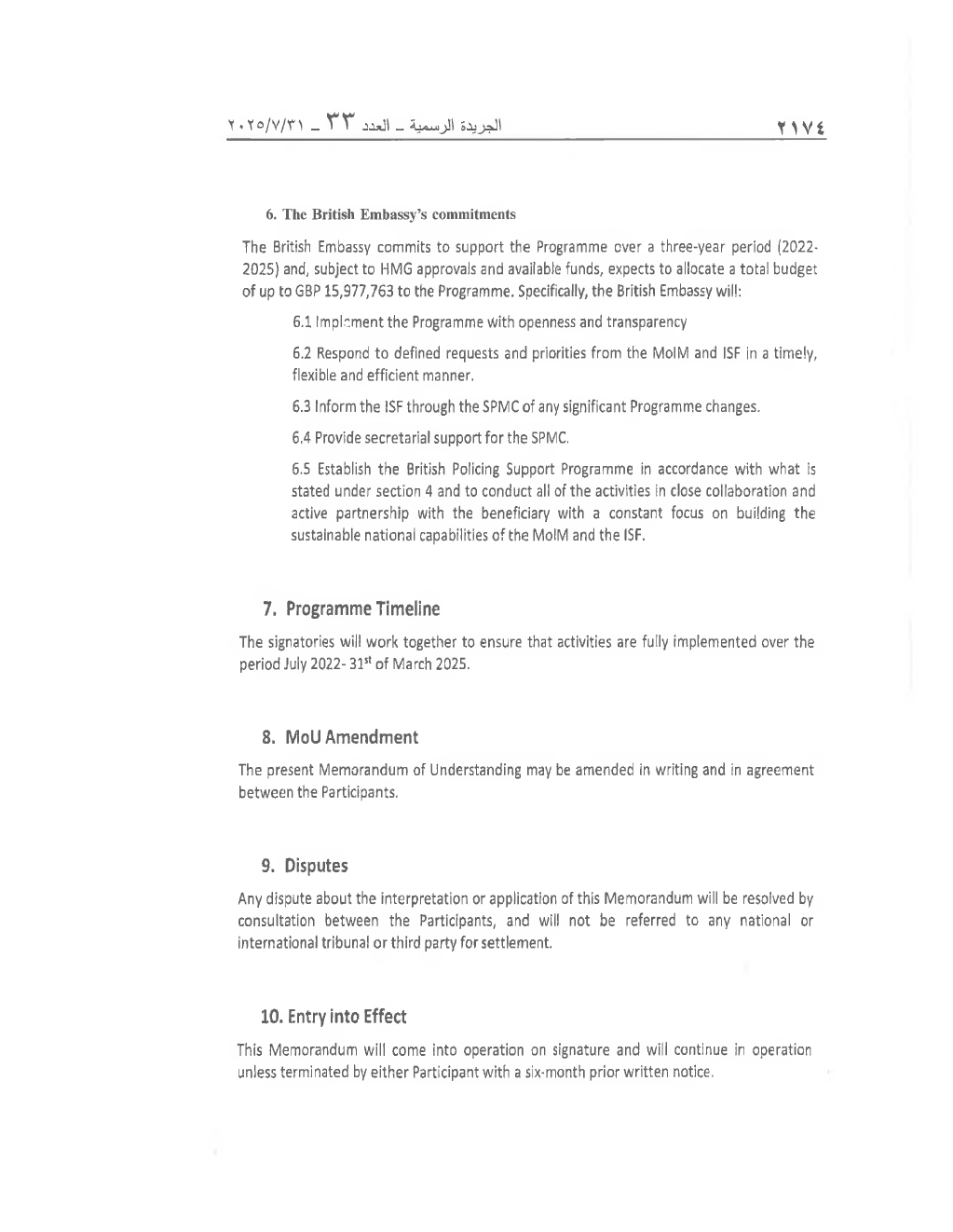
The British Embassy commits to support the Programme over a three-year period (2022-2025) and, subject to HMG approvals and available funds, expects to allocate a total budget of up to GBP 15,977,763 to the Programme. Specifically, the British Embassy will:
6.1 Implement the Programme with openness and transparency
6.2 Respond to defined requests and priorities from the MoIM and ISF in a timely, flexible and efficient manner.
6.3 Inform the ISF through the SPMC of any significant Programme changes.
6.4 Provide secretarial support for the SPMC.
6.5 Establish the British Policing Support Programme in accordance with what is stated under section 4 and to conduct all of the activities in close collaboration and active partnership with the beneficiary with a constant focus on building the sustainable national capabilities of the MoIM and the ISF.
7. Programme Timeline
The signatories will work together to ensure that activities are fully implemented over the period July 2022- 31st of March 2025.
8. MoU Amendment
The present Memorandum of Understanding may be amended in writing and in agreement between the Participants.
9. Disputes
Any dispute about the interpretation or application of this Memorandum will be resolved by consultation between the Participants, and will not be referred to any national or international tribunal or third party for settlement.
10. Entry into Effect
This Memorandum will come into operation on signature and will continue in operation unless terminated by either Participant with a six-month prior written notice.
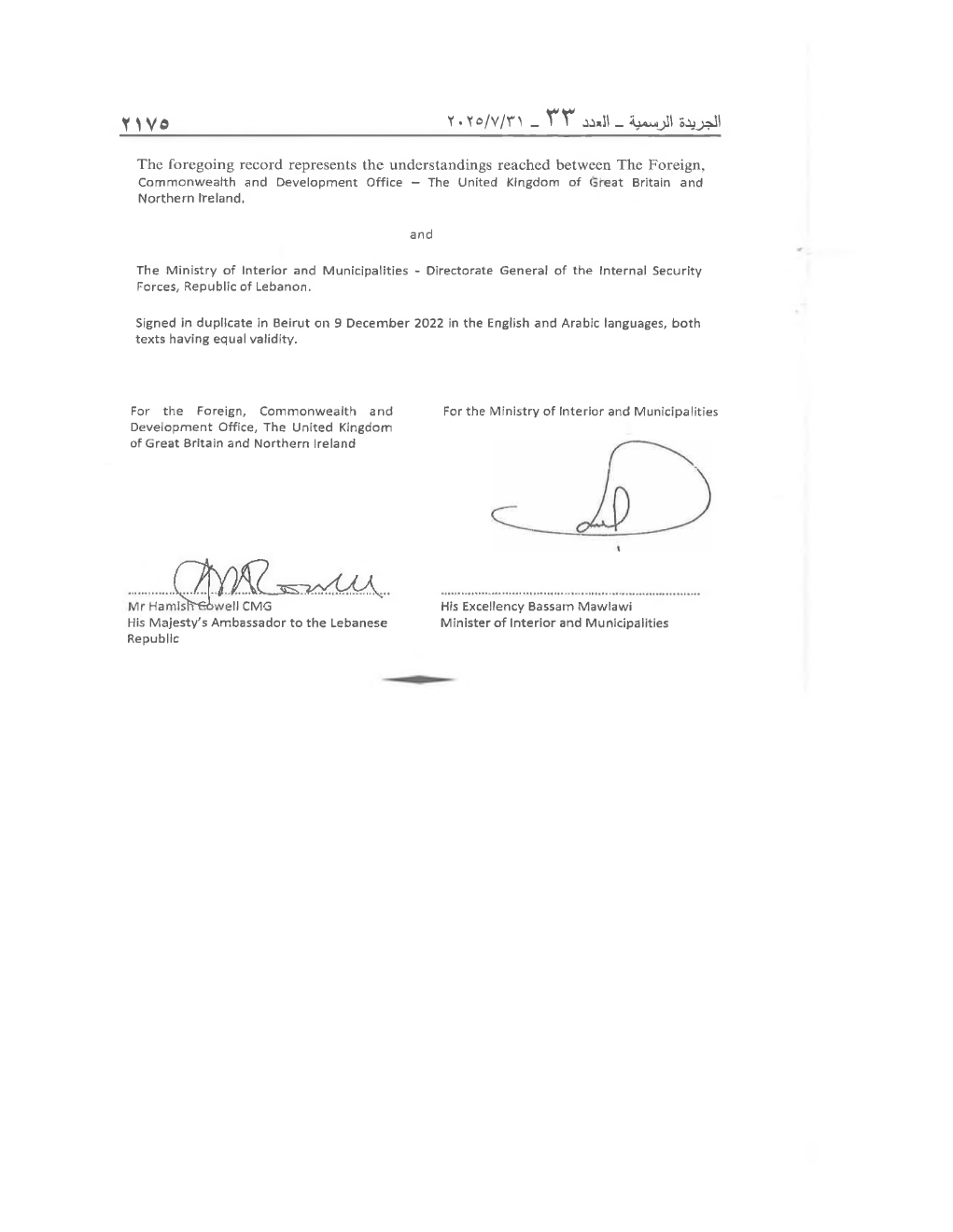
The foregoing record represents the understandings reached between The Foreign, Commonwealth and Development Office - The United Kingdom of Great Britain and Northern Ireland,
and
The Ministry of Interior and Municipalities - Directorate General of the Internal Security Forces, Republic of Lebanon.
Signed in duplicate in Beirut on 9 December 2022 in the English and Arabic languages, both texts having equal validity.
For the Foreign, Commonwealth and Development Office, The United Kingdom of Great Britain and Northern Ireland | For the Ministry of Interior and Municipalities
Mr Hamish Cowell CMG | / … His Excellency Bassam Mawlawi His / … Majesty's Ambassador to the Lebanese Republic | … / His Excellency Bassam Mawlawi Minister of Interior and Municipalities
المصدر
صور الصفحات من أرشيف SaderLex. اتفقت القراءتان على 99.3% من الكلمات.
نصوص ذات صلة